
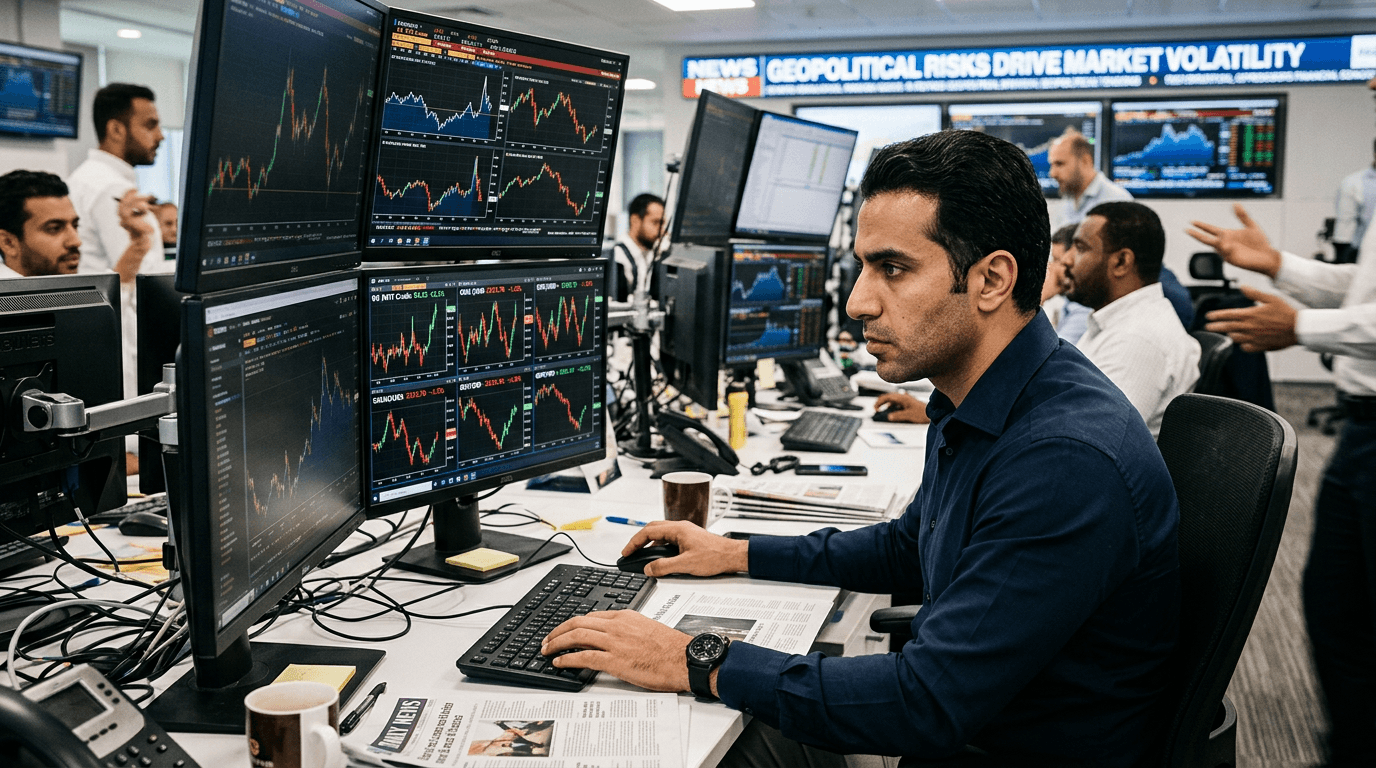
Oil, precious metals, and major currencies are all feeling the strain as the Middle East crisis and the Iran conflict keep volatility elevated across global markets.[1][2][9] Energy benchmarks like WTI and Brent are swinging on each new headline, while gold, silver and safe‑haven FX pairs oscillate as investors constantly reassess risk.[1][8][9] For traders, this is a textbook environment where geopolitics, macroeconomics, and market microstructure collide—creating both opportunity and danger.
Geopolitical Risk And Market Volatility
The latest phase of the Iran conflict was triggered by US–Israel airstrikes on Iranian targets, turning geopolitical risk into a primary driver of market pricing rather than a background factor.[3][11] Concerns focus heavily on the Strait of Hormuz, one of the world’s most critical energy chokepoints, where the near‑halt of shipping activity has amplified fears of sustained supply disruptions.[1][12] As a result, volatility has surged not only in crude futures but across related assets, from energy equities to freight rates and inflation‑sensitive instruments.[11]
Markets are reacting in typical “headline‑driven” fashion: sharp intraday moves, rapid reversals, and clusters of price gaps around news events.[9][10] Traders are liquidating positions across bonds, equities, and even some commodities as they reprice the risk of deeper economic damage and a potential return of 2022‑style inflation shocks.[4][11] This is a prime example of how non‑economic events—military actions, ceasefire talks, diplomatic statements—can temporarily overwhelm traditional data releases as the main catalysts for market moves.
Oil Markets: Pricing In Supply Shocks
Oil is at the center of this crisis. At the height of the conflict, Brent surged toward $120 per barrel, reflecting a substantial war premium on top of normal supply‑demand fundamentals.[1] Even after a fragile ceasefire, daily closes have retraced to below $100 but remain roughly 35% above pre‑conflict levels, showing how risk is still baked into prices.[1] Earlier phases of escalation saw single‑day moves of 25% in Brent, taking prices to their highest levels since mid‑2022 as traders rushed to re‑hedge exposure.[5]
The reason is straightforward: the Middle East, and Iran in particular, sit at the core of global oil flows. Any credible threat to shipping through the Strait of Hormuz forces the market to price in potential shortages, higher transport costs, and knock‑on effects for gas and refined products.[11][12] That feeds into inflation expectations, central bank policy paths, and ultimately growth forecasts—so crude is not just an energy story, but a macro story.
For traders, these conditions highlight several key lessons:
- Volatility is path‑dependent. The same headline can trigger different reactions depending on positioning and sentiment at the time.
- Risk premiums can linger. Even when prices pull back from extremes, they rarely snap straight back to pre‑crisis levels while uncertainty persists.[1][14]
- Correlations can shift. Energy stocks, airlines, and industrials may respond very differently to the same oil move, depending on hedging, costs, and demand outlooks.[7][11]
In a simulated environment, this makes oil an ideal asset class to practice trading around event risk: managing gap risk over weekends, using smaller position sizes when implied volatility is high, and testing how trend strategies behave when fundamentals change rapidly.
Precious Metals: Safe Haven, But Not One-way
Gold and silver have traditionally been safe‑haven assets during geopolitical turmoil, and recent moves have reinforced that narrative—but with important nuances.[7][9] As the Iran conflict escalated, gold prices climbed, briefly touching multi‑month highs as investors sought protection from both war risk and potential inflation.[9][10] Silver also saw increased interest, benefiting from its dual role as a precious and industrial metal.[8]
However, the behavior of precious metals has been far from linear. On some days, gold has declined even as conflict headlines worsened, particularly when a stronger US dollar or rising real yields offset safe‑haven demand.[2][5] Analysts examining gold and silver futures now highlight elevated intraday swings and “indecisive” price structures, with frequent tests of key levels and rapid reversals.[1][8]
Educationally, this underscores that:
- “Safe haven” does not mean guaranteed upside. Currency moves, rate expectations, and profit‑taking can all counteract geopolitical demand.[5][9]
- Time horizon matters. Gold may spike on a headline, then mean‑revert once the initial shock fades.
- Positioning is crucial. If speculative longs are crowded, even a risk‑off event can trigger a sharp flush lower.
Simulated trading in metals during such periods can help traders learn to combine macro drivers (inflation, rates, FX) with technical signals, rather than relying on a single narrative like “war equals higher gold.”
Fx Markets: Defensive Positioning And Safe-haven Flows
The FX market has responded with a familiar mix of dollar strength, pressure on vulnerable currencies, and selective safe‑haven demand.[9][10][13] The US dollar index has rallied as investors seek liquidity and safety, reversing earlier year‑to‑date losses and reaching multi‑week highs.[9][13] At the same time, analysts point to increased demand for currencies such as the Swiss franc and Japanese yen, which historically perform well in risk‑off regimes.[7][13]
Regional and emerging‑market currencies have felt the stress more acutely. MENA currencies have faced carry‑trade unwinds and net selling as investors reassess risk in the region, while some Gulf and neighboring currencies struggled to attract safe‑haven flows despite energy exposure.[2] In Asia, policymakers in countries like India and the Philippines have intervened or signaled readiness to support their currencies as the oil shock widened current account concerns and raised the risk of disorderly moves.[6]
Key FX takeaways
- Risk‑off environments typically favor high‑liquidity, low‑risk currencies (USD, CHF, JPY) over high‑yield or frontier markets.[7][9]
- Carry trades become vulnerable. Strategies that rely on borrowing in low‑yield currencies and investing in higher‑yield ones can unwind rapidly when volatility spikes.[2][6]
- Policy expectations shift. Rising oil and inflation risk have nudged markets toward the possibility of tighter monetary policy in some regions, influencing interest‑rate differentials and FX pricing.[4][11][13]
For traders, FX during crises is a powerful playground to test concepts like safe‑haven flows, carry sensitivity, and how central bank expectations feed into currency trends.
Practical Lessons For Traders In A High-volatility Regime
With oil, metals, and FX all buffeted by the Iran conflict and broader Middle East tensions, the central challenge is not predicting each headline, but building robust trading processes that can withstand regime shifts.[1][9][14] In simulated finance environments, traders can safely experiment with:
- Scenario planning: Map out “short conflict,” “prolonged conflict,” and “ceasefire and normalization” scenarios, and test how portfolios behave under each.[11][14]
- Volatility‑aware sizing: Adjust trade size and leverage based on realized and implied volatility levels, rather than using static risk assumptions.
- Cross‑asset thinking: Explore how an oil shock affects currencies, metals, equities, and rates simultaneously, and look for relative value rather than single‑asset bets.[7][11]
- News discipline: Practice reacting to news systematically—waiting for confirmation, using predefined levels, and avoiding emotional over‑trading.
The Middle East crisis is a stark reminder that markets remain vulnerable to geopolitical shocks even in a data‑driven world. For traders, the goal is not to forecast every twist in the Iran conflict, but to understand how such events transmit through oil, precious metals, and FX—and to build strategies and risk frameworks that can adapt quickly when volatility spikes.