
Middle East Tensions Ignite Financial Market Turmoil
In the wake of escalating military actions by the US and Israel against Iran, global financial markets are experiencing substantial upheaval. The initiation of Operation Epic Fury on February 28, 2026, culminating in the death of Supreme Leader Ali Khamenei and other key Iranian figures, has intensified the conflict, sending shockwaves through forex, commodities, and equity markets. The subsequent Iranian retaliation, notably the March 27 missile attack on Saudi Arabia's Prince Sultan Air Base injuring over 300 US service members, has fundamentally shifted risk perceptions among global traders and investors. These events starkly illustrate how regional conflicts can swiftly impact currency values, energy prices, and market volatility.
US Dollar: The Safe-Haven Beacon
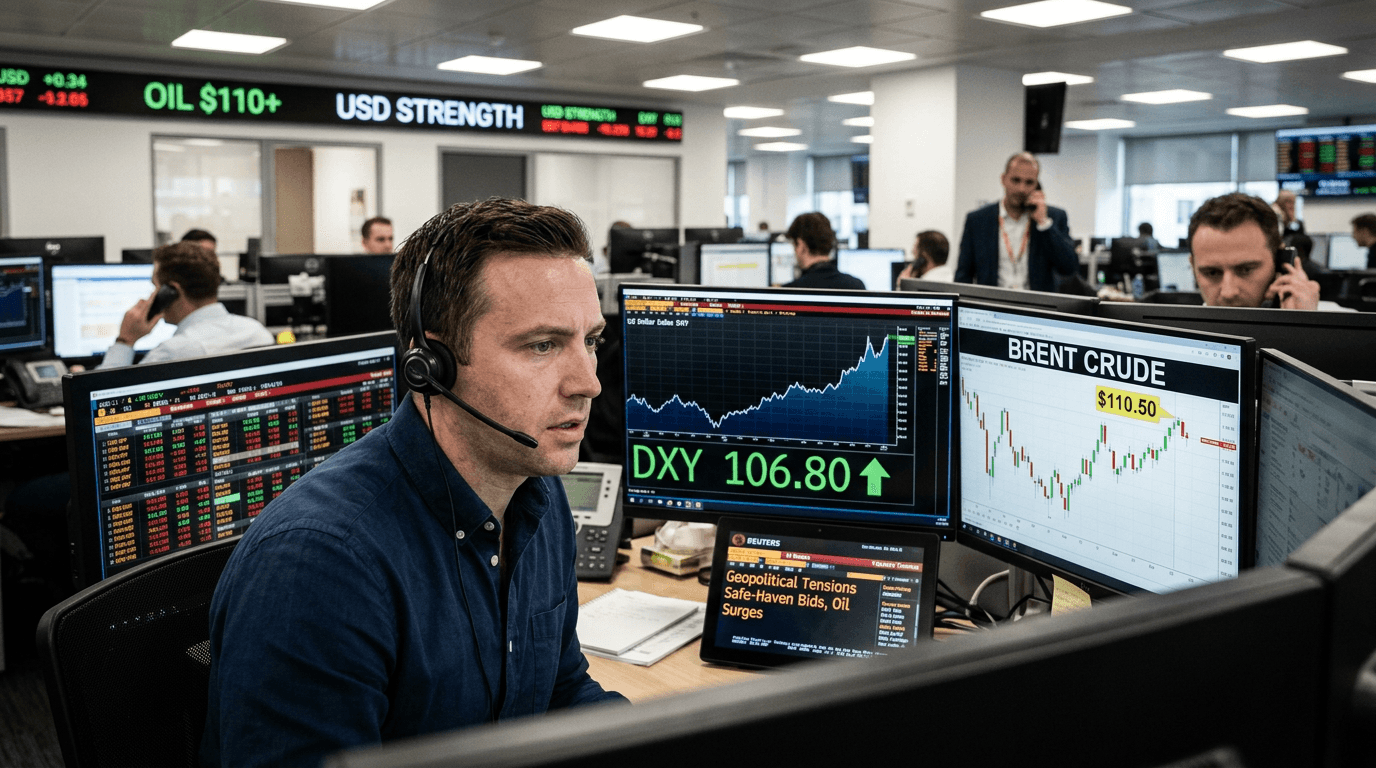
The US dollar has emerged as a primary refuge amid the escalating tensions, attracting significant investments from both institutional and retail sectors. As geopolitical uncertainties mount, market participants instinctively pivot towards assets perceived to have minimal political or military risk. The dollar’s dominance in global trade, backed by US Treasuries and military might, reinforces its status as a crisis haven. This latest escalation has underscored this trend, with the USD gaining strength against major currencies, particularly those from emerging markets exposed to Middle East instability. Investors have rapidly converted regional currencies like the Turkish lira and Israeli shekel into dollars, creating a decisive directional flow. For forex traders, this has been especially evident in USD/JPY and USD/CHF movements, where safe-haven demand overrides technical and fundamental analyses.
Crude Oil Spikes and the $110 Threshold
Energy markets have responded predictably, with crude oil prices surging to around $110 per barrel as traders anticipate supply disruptions and uncertainties surrounding the Strait of Hormuz. This pivotal waterway, handling about 21% of global petroleum trade, is crucial to energy pricing stability. The closure threat by the Islamic Revolutionary Guard Corps has raised the stakes, creating a genuine supply shock scenario. The resulting higher energy prices ripple through various asset classes, affecting stock market indices with significant energy sector exposure, shipping costs, and inflation expectations in currency forwards. For forex traders, oil price fluctuations directly impact the currencies of oil-producing nations like Canada, Norway, and Russia, offering secondary trading opportunities as energy prices adjust to geopolitical shifts. The current $110 price level marks a significant leap from pre-crisis norms, highlighting market concerns over actual supply disruptions rather than temporary anxieties.
Forex Volatility: Challenges and Opportunities
The geopolitical upheaval has sparked measurable growth in forex volatility, characterized by wider bid-ask spreads, larger daily ranges, and more pronounced intraday currency swings. This volatility presents both challenges and opportunities for traders. While heightened uncertainty increases execution risk and adverse price slippage, it also creates directional trading opportunities for those positioned correctly. The USD has shown notable strength against currencies linked to the Middle East or vulnerable emerging market fundamentals, while the Japanese yen and Swiss franc have benefited from traditional safe-haven roles. With event risk remaining high and potential for further Iranian or Israeli actions, traders should expect continued elevated volatility until de-escalation signals or a definitive military resolution emerges.
Strait of Hormuz: Closure Risks and Long-Term Effects
The potential closure of the Strait of Hormuz poses perhaps the most significant market risk from this conflict. Unlike typical geopolitical tensions that often resolve diplomatically, an actual closure would disrupt global energy markets, triggering widespread financial system effects. US officials remain confident in maintaining navigation freedom, with Secretary of State Rubio expressing concerns over potential Iranian toll systems if control persists. The deployment of additional US military assets, including up to 10,000 troops, underscores American resolve to keep the strait open and highlights the situation's severity. Energy traders are adjusting for contingency premiums reflecting the non-zero probability of extended disruptions. Any closure would likely provoke dramatic oil price increases, forced currency realignments, and equity market corrections as investors reassess macroeconomic scenarios.
Key Takeaways for Traders
Current conditions demand close monitoring of geopolitical developments and news. Safe-haven positions in USD, Japanese yen, and Swiss franc remain prudent until clear de-escalation signals appear. Oil-linked currencies offer potential trading interest as energy markets stabilize. Effective risk management is crucial, with wider stop-losses and smaller position sizes advisable in this uncertain environment. The coming weeks will likely determine whether this conflict reaches a resolution or evolves into prolonged regional warfare with lasting market implications.
News Impact Score: 9