
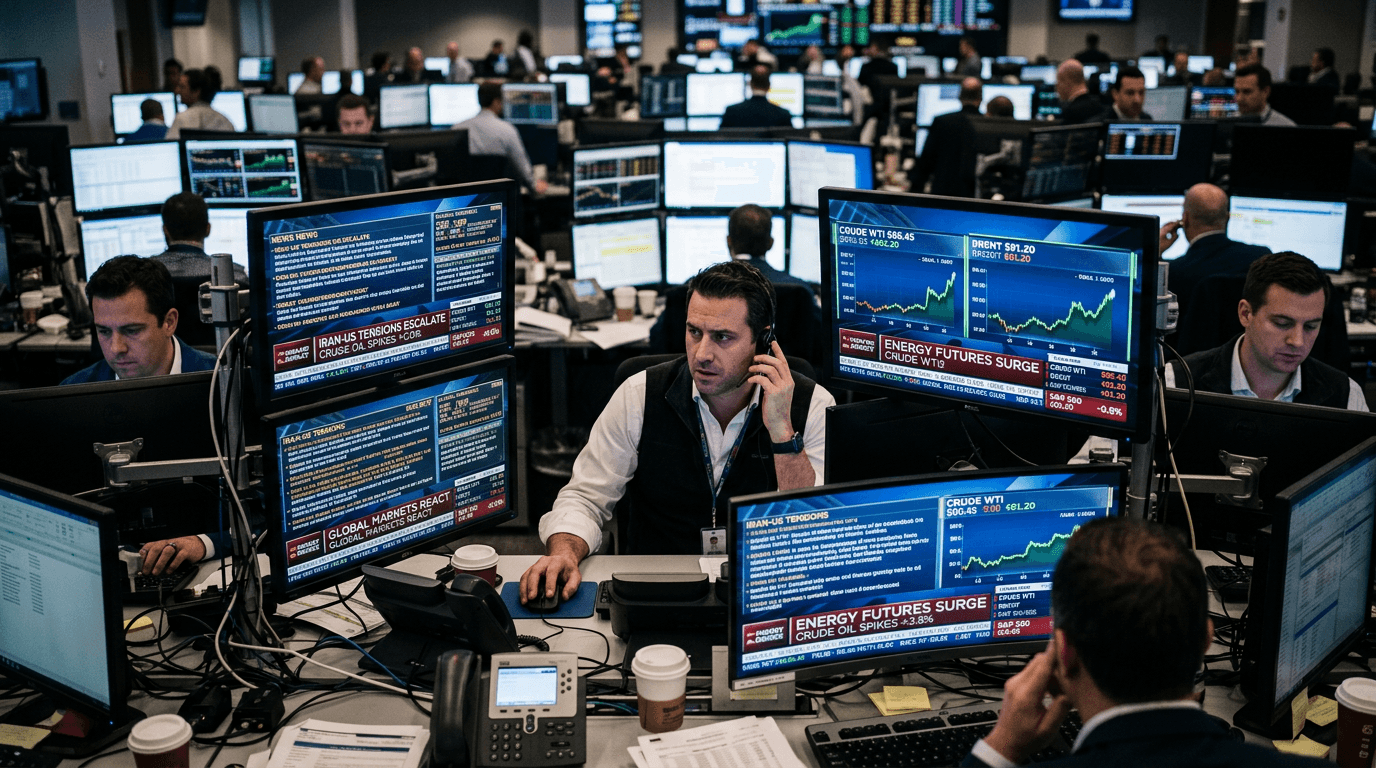
A new round of military escalations involving Iran and U.S. forces has injected fresh volatility into global markets, pushing crude oil and energy futures higher while souring broader risk sentiment.[1][2] With U.S. crude trading in the low $80s and Brent in the mid-$80s, markets are once again pricing a geopolitical premium into oil—reviving inflation worries and prompting investors to seek shelter in safe-haven currencies and gold.[2][5][6]
Geopolitical Shock: Why Oil Is Moving
Oil tends to react quickly to Middle East headlines because the region still sits at the heart of global supply and transit routes.[3][4] When tensions rise—especially if they involve Iran, key shipping lanes, or U.S. military assets—traders immediately reassess the probability of supply disruption, even before any barrels are actually taken off the market.[3][6]
Recent war-related headlines involving Iran have pushed U.S. crude toward $81–82 and Brent toward the mid-$80s, a range analysts have long flagged as the first “risk band” in a serious regional flare-up.[2][3] In past episodes, such as earlier spikes toward the mid-$70s and beyond, the market often rallied aggressively on headlines and then cooled once it became clear that actual flows were still moving.[1][3]
This dynamic is exactly what we are seeing: traders are paying for insurance against future disruption in the form of higher prices today, even though core Gulf production and exports have not yet been significantly impaired.[3][4] The result is a visible geopolitical premium embedded in oil and across the energy complex.
From Oil Price Spike To Inflation Fears
Higher oil prices do not stay confined to energy markets; they ripple through the entire macro picture.[2][5] Every sustained move higher in crude eventually shows up in:
1) Fuel and transportation costs 2) Production and logistics expenses for companies 3) Headline inflation data watched by central banks
When crude jumped sharply on the latest Middle East headlines, investors quickly revived the question many hoped was fading: is the inflation battle really over?[2][5] Elevated energy prices can slow the pace of disinflation, forcing central banks to keep policy tighter for longer or at least delay rate cuts.
Bond markets reflect this tension. Historically, geopolitical oil shocks that raise inflation expectations tend to push nominal yields higher, even if growth worries are simmering in the background.[2][3] That mix—higher yields plus higher energy costs—is typically negative for risk assets such as equities and high-yield credit.
Risk Sentiment, Equities, Fx, And Gold
The latest oil spike has once again put risk assets on the defensive.[2][3] Equity indices and futures have come under pressure as investors reassess margins, earnings, and the path of central bank policy in a potentially stickier inflation environment.[2]
At the same time, traditional safe havens have found support. Episodes of Middle East conflict risk often see:
- Stronger demand for the U.S. dollar, Japanese yen, and Swiss franc as defensive FX plays[5][6]
- Higher gold prices as traders look for a hedge against both geopolitical uncertainty and inflation risk[5]
- Increased volatility across FX and rates as markets scramble to reprice macro scenarios[5][6]
In other words, oil is not just another commodity here; it is a sentiment barometer. Rising crude on geopolitical headlines often coincides with a broader “risk-off” tilt, where capital flows out of equities and into safe havens and cash-like assets.
HOW TODAY’S OIL MARKET DIFFERS FROM THE PAST
It is important to understand that the oil-geopolitics relationship is not as mechanical as it once was.[4] Research and recent experience suggest that the long-held assumption—“any Middle East escalation = sustained, large oil spike”—has weakened.[4]
Several structural factors help explain this
- Non-OPEC supply growth and robust North American production have boosted redundancy in global supply.[4]
- Demand growth has moderated, especially in parts of Asia, reducing the urgency of each additional barrel.[4]
- Markets now discriminate between broad political tension and specific threats to key infrastructure—production sites, pipelines, refineries, and critical chokepoints like the Strait of Hormuz.[3][4][6]
Since late 2023, conflict intensity in the region has often escalated without triggering a runaway oil rally, as long as exports kept flowing and key facilities were not directly targeted.[4] Today’s move into the low $80s for U.S. crude and mid-$80s for Brent fits this “targeted risk premium” narrative: meaningful, but not yet a full-blown supply shock.[2][4]
For traders, that means the focus should be less on headlines in isolation and more on whether there is credible evidence of damage or disruption to specific pieces of the energy infrastructure.
What Traders Should Watch In Oil And Energy Futures
Professional and retail traders alike can structure their analysis around a few key signposts when geopolitical tensions lift oil and energy futures:
1) Futures curve shape Is the curve moving into steeper backwardation (near-term prices above longer-dated contracts)? That typically signals tight near-term supply and a strong risk premium.[2][3] A more muted curve response suggests markets see a short-lived shock rather than a lasting squeeze.
2) Physical flows and shipping Data and news around tanker traffic, port operations, and key routes like the Strait of Hormuz matter more than headline volume alone.[3][6] A rise in war-related rhetoric without confirmed shipping disruption is very different from an actual closure or attack on export facilities.
3) Cross-asset confirmation Moves in bond yields, inflation expectations, volatility indices, and safe-haven assets help confirm whether the oil spike is changing the broader macro narrative or is being treated as a contained event.[2][5] If yields, volatility, and gold all jump alongside oil, markets are signaling a more consequential shift in risk perceptions.
Practical Takeaways For Simulated And Live Traders
For traders operating both in SimFi environments and live markets, this kind of episode offers valuable lessons in risk management and strategy design:
- Separate noise from signal Not every headline is a trade. Focus on developments that affect supply, transit routes, or policy responses. Use news feeds, shipping data, and futures curve analysis to build a structured view instead of reacting emotionally.
- Build scenarios, not predictions Develop “if-then” scenarios: If crude holds above a key resistance level, how might equity indices, energy stocks, and FX safe havens respond? If tensions ease and oil retraces, what reversals are likely? Scenario planning is more robust than trying to call the exact outcome of a conflict.[2][3]
- Respect volatility and position sizing Energy markets can move quickly on geopolitical shocks, with intraday swings that easily exceed recent averages.[1][7] In both simulated and real trading, adjusting position size, leverage, and stop placement to this higher volatility is crucial to avoiding outsized drawdowns.
- Think across assets Even if you do not trade oil directly, its impact on indices, sector futures, FX, and gold means you are still exposed.[2][5][6] Equity traders should watch energy, airlines, industrials, and consumer sectors; FX traders should monitor petro-currencies versus safe havens; macro traders should track the interplay between yields, inflation expectations, and risk assets.
Ultimately, the latest Middle East tensions are a reminder that geopolitical risk remains a powerful catalyst for markets—especially when it intersects with critical energy flows. Oil and energy futures are pricing in a meaningful risk premium, risk sentiment has turned more cautious, and cross-asset correlations are back in focus. Traders who understand these transmission channels, manage risk proactively, and use simulated environments to stress-test their strategies will be better positioned for whatever the next headline brings.