
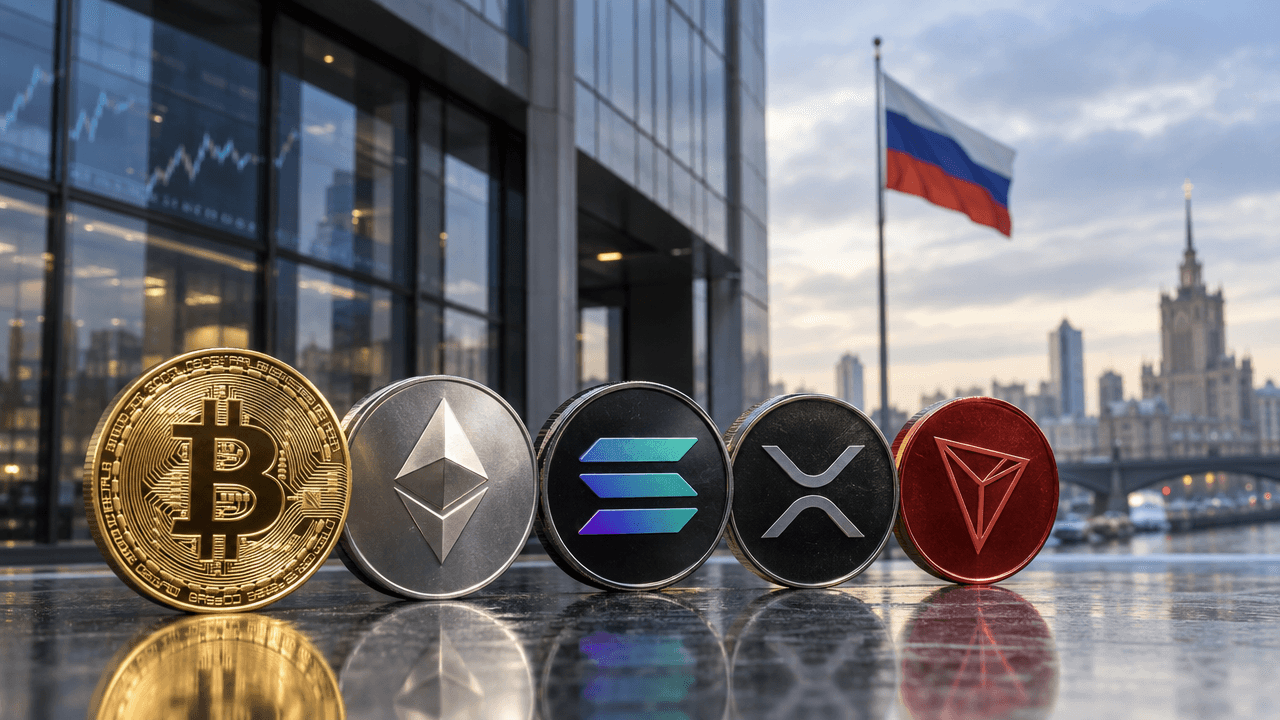
Russia’s Moscow Exchange (MOEX) is pushing deeper into regulated crypto derivatives with new perpetual futures linked to indexes for Bitcoin, Ether, Solana, XRP and Tron.[1][13][15] The move brings five of the largest crypto assets into a familiar exchange-traded format, while keeping trading within Russia’s traditional securities infrastructure and regulatory perimeter.[4][11] For traders, it signals a maturing market where crypto exposure increasingly resembles conventional futures and index products.[8][9]
MARKET OVERVIEW: WHY MOEX’S MOVE MATTERS
MOEX is Russia’s primary venue for equities, bonds and derivatives, so any expansion into crypto-linked products has outsized signaling power for the local market.[2][4] By listing perpetual futures tied to crypto indexes rather than spot tokens, the exchange gives investors a way to participate in price moves without touching on-chain infrastructure or unregulated offshore venues.[7][11] That approach aligns with policy trends in multiple jurisdictions, where regulators prefer cash-settled instruments over physically delivered crypto.[8][14]
The new lineup includes contracts linked to MOEX indices for Bitcoin, Ether, Solana, XRP and Tron, under tickers such as BTCUSDF, ETHUSDF, SOLUSDF, XRPUSDF and TRXUSDF.[10][12][15] Each contract references an exchange-calculated index rather than a single venue’s price, which can help reduce the impact of isolated volatility or liquidity issues on any one exchange.[1][9] For traders familiar with equity or commodity index futures, this structure makes the products more intuitive: you are trading a benchmark, not a wallet balance.
Access to the contracts is restricted to qualified investors under Russian regulation, reflecting a cautious stance toward leveraged crypto exposure.[2][4][11] This concentrates activity among institutions and experienced traders, but it also sets a template that could be broadened if regulators grow more comfortable with the risk profile and market behavior of these instruments.[8][14]
How The New Perpetual Futures Work
Technically, these instruments are described as one-day futures with automatic rollover, which means they behave like perpetual contracts without a fixed expiry.[2][10][15] Positions are effectively renewed each trading day, with funding mechanics ensuring that contract prices stay anchored to the underlying index value.[10][15] This structure allows traders to hold directional exposure over long horizons while avoiding the calendar rolls required by conventional dated futures.
Quotes for the contracts are denominated in U.S. dollars, but settlements occur in Russian rubles on a cash basis rather than through delivery of the underlying coins.[2][7][11] That design keeps currency risk and payment flows inside the domestic financial system, while still allowing traders to target dollar-linked benchmarks like BTC or ETH indices.[10][15] It also removes custody and transfer of digital assets from the workflow, which simplifies operations and reduces operational risk for brokers and clearing members.[4][7]
Funding calculations use parameters where K1 is set at 0% and K2 at 0.35%, defining how the cost of maintaining positions is shared between longs and shorts.[2][15] In practice, this means traders must factor an ongoing funding rate into their strategy, similar to perpetual swaps on major global crypto exchanges.[8][10] Active management of funding costs becomes essential for arbitrage, hedging and carry trades, especially for large or leveraged positions.
Implications For Russian Crypto And Derivatives Markets
MOEX had previously offered a more limited crypto derivatives lineup, and the addition of five major assets marks a clear expansion in breadth and sophistication.[15] By moving from a single Bitcoin contract to a diversified basket including Ether, Solana, XRP and Tron, the exchange acknowledges the multi-asset reality of today’s crypto market.[8][9] Traders now have more tools to express views on ecosystem rotation, altcoin cycles and relative value across chains.
Because the contracts are cash-settled and index-based, they can serve as building blocks for structured products, hedging overlays and portfolio risk management strategies for Russian institutions.[4][12] Asset managers could, for example, use crypto index futures to hedge exposure in publicly listed companies with significant crypto holdings or mining operations.[8][9] Similarly, proprietary desks may deploy these instruments to run market-neutral or basis trades between spot and futures once local liquidity develops.
On the regulatory side, keeping crypto derivatives on MOEX rather than offshore platforms supports transparency, centralized clearing and standardized risk controls.[4][11] Daily settlement in rubles and oversight by domestic authorities can make it easier to monitor leverage, margin practices and systemic risk.[7][14] Over time, consistent market behavior in these products may encourage policymakers to further develop guidelines for digital asset markets, including possible expansion to options or volatility-linked instruments.
Global Context: Perpetual Futures In The Crypto Ecosystem
Perpetual futures and swaps have become core infrastructure on global crypto exchanges, often generating the majority of derivatives volume for assets like BTC and ETH.[8][14] MOEX’s adoption of a similar structure within a regulated, state-connected exchange highlights how crypto-native designs are migrating into traditional finance.[4][8] This blurs the line between “CeFi” and “TradFi,” especially when index-based contracts mirror the behavior of perpetuals on offshore venues but run under securities law.
Unlike many offshore platforms that settle and margin in stablecoins or crypto, MOEX’s ruble-settled model creates a different funding and collateral dynamic.[7][11] Domestic traders must consider not just crypto price risk, but also FX and interest rate conditions in Russia when managing margin and carry.[2][10] For global market observers, this offers a case study in how local currency frameworks shape the behavior of crypto derivatives markets in different jurisdictions.
For international investors, the direct trading impact may be limited by access restrictions and the need for qualified investor status.[2][11][13] However, the symbolic importance is higher: a major national exchange is normalizing crypto-linked derivatives as part of its mainstream product suite, which can influence perceptions of legitimacy and regulatory direction.[4][8] If similar models spread to other exchanges, the result could be a deeper, more geographically diversified network of regulated crypto derivatives venues.
Practical Takeaways For Simulated And Real-world Traders
For traders using simulated finance platforms, MOEX’s launch is an opportunity to study how perpetual futures behave when transplanted into a traditional exchange environment.[8][10] Simulated portfolios can model strategies such as delta hedging BTC spot with BTCUSDF, running spread trades between ETH and SOL futures, or exploring funding-rate arbitrage across domestic and offshore venues.[2][15] This allows traders to build playbooks that may become relevant if similar products emerge in their own jurisdictions.
Risk management should remain central. These contracts are leveraged derivatives tied to volatile underlying assets, so margin calls and funding costs can erode returns if positions are not closely monitored.[8][14] In a simulation context, traders can stress-test scenarios including sharp crypto sell-offs, FX swings in ruble-dollar rates and sudden shifts in funding parameters like K2.[2][15] The goal is to understand how multi-risk exposures compound under real market conditions.
Finally, the index-based nature of the products invites more systematic approaches. Backtesting strategies against MOEX crypto indices and their futures equivalents can help traders refine entry and exit rules, position sizing and hedging overlays.[1][10][12] Whether trading live markets or practicing in a SimFi environment, the key is to treat these instruments as part of a broader derivatives ecosystem in which liquidity, regulation and cross-market dynamics all matter.