
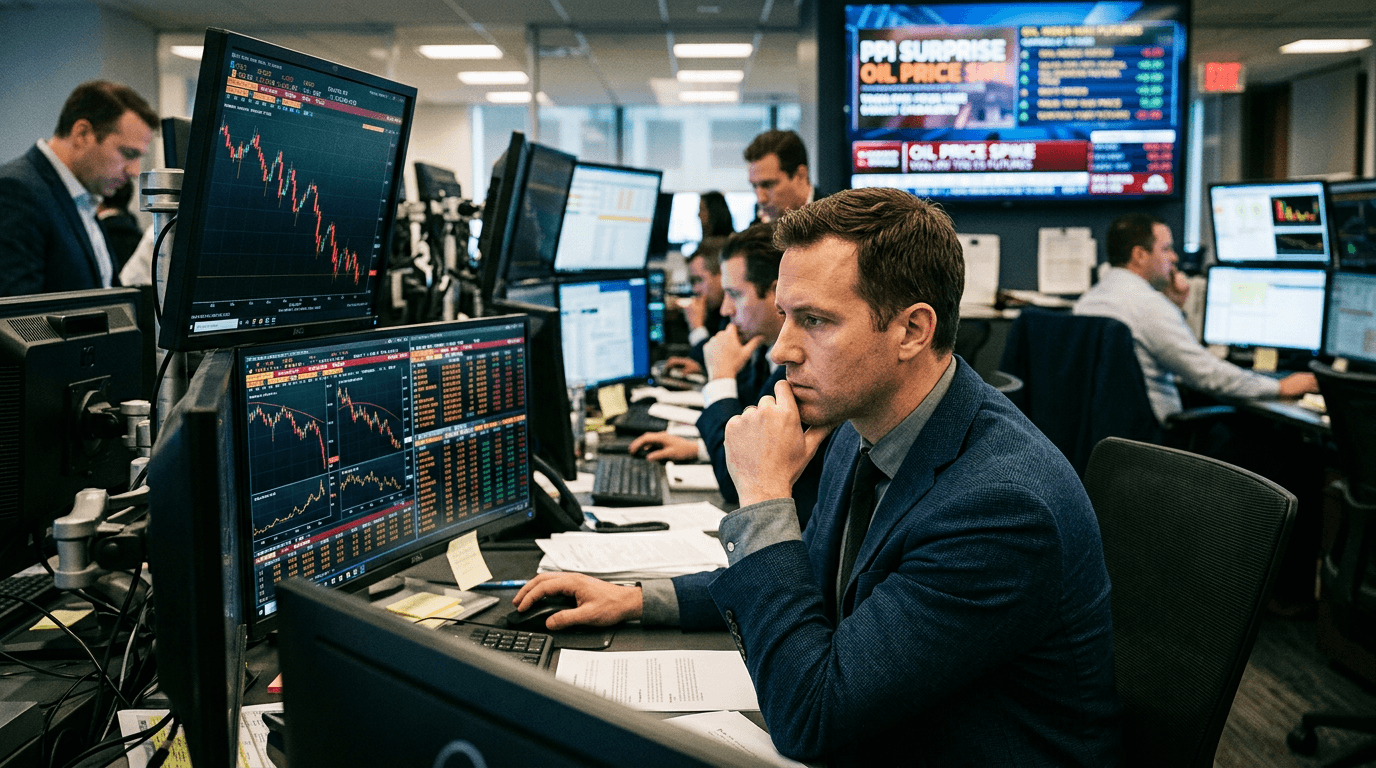
US equity index futures are back on shaky ground as traders digest a potent mix of softer US data and a sharp jump in oil prices. The Nasdaq 100 and S&P 500 have both tried to stabilize off session lows, but futures remain jumpy, with sentiment fragile and quick to react to any new macro or geopolitical headline. For traders, including those in simulated environments, this is a live case study in how macro shocks ripple through equity indices, volatility, FX, and commodities all at once.
Markets Rocked By Twin Shocks
The latest wobble in Nasdaq 100 and S&P 500 futures is being driven by a “twin shock” dynamic: a surprise in US producer price inflation (PPI) and a spike in crude oil. Together, they complicate the outlook for both growth and inflation.
A hotter or more volatile PPI print challenges the market’s expectations for the path of interest rates, forcing traders to reassess how quickly central banks might cut—or whether they could even be forced to tighten again. When that happens, equity index futures often become the primary venue for repricing risk in real time, given their deep liquidity and near 24-hour trading[7][10].
At the same time, sharply higher oil prices feed directly into inflation expectations and corporate cost structures, pressuring margins for energy-intensive sectors and raising questions about consumer demand. That helps explain why index futures saw renewed selling, then choppy attempts to stabilize, rather than a clean V-shaped rebound.
In this environment, small data surprises or headlines that might normally be ignored can drive outsized moves, because traders are already on edge and positioned for a particular macro narrative.
Why Index Futures React So Violently
To understand the wobble, it helps to revisit what equity index futures actually are. These are standardized contracts that allow traders to buy or sell an equity index—such as the S&P 500 or Nasdaq 100—at a predetermined price on a set date in the future[1][3]. They are cash-settled, so no one is delivering the underlying stocks; instead, gains and losses are marked to market daily[3].
Because index futures trade nearly around the clock and are highly leveraged, they are often the first place large institutions express directional views on macro news. A single data point can quickly change the perceived fair value of the entire index, and futures reflect that instantly.
Several factors amplify the reaction
Leverage and margin. Futures require only a fraction of the notional exposure as margin, which magnifies gains and losses. When volatility spikes, margin calls and risk limits can trigger forced selling or rapid position adjustments.
Portfolio hedging. Asset managers and dealers frequently use index futures to hedge equity exposure. When macro risk rises, demand for downside protection via futures can jump, contributing to sharp moves.
Volatility feedback loop. As prices swing, implied volatility (as reflected in the options market) tends to rise. The Cboe Volatility Index (VIX), which measures the market’s 30‑day implied volatility for the S&P 500[2], often moves inversely to equity prices. Elevated VIX levels can push systematic strategies to de-risk, adding further pressure.
The end result is that index futures become the “shock absorber” for the entire equity market, transmitting changing expectations about rates, growth, and inflation into prices in real time.
Nasdaq 100 Vs S&p 500: Why The Difference Matters
During the recent moves, the Nasdaq 100 has tried to stabilize off intraday lows, while S&P 500 futures have been hovering just above key technical support. That divergence is meaningful.
The Nasdaq 100 is heavily tilted toward large-cap technology and growth stocks. These names are especially sensitive to interest rate expectations, because a larger portion of their value comes from cash flows far into the future. When rate expectations rise, those future cash flows are discounted more heavily, putting pressure on valuations.
The S&P 500, by contrast, is broader and includes more exposure to financials, industrials, energy, and defensives. This can sometimes buffer the index when specific sectors are under pressure, but it also means that shocks to oil and global growth can hit the S&P 500 more directly.
In a twin shock scenario
Rate-sensitive growth stocks may suffer from hawkish rate repricing.
Energy and commodity-linked names may benefit from higher oil, but broader cyclicals can be hurt by growth concerns.
Defensive sectors can attract flows as investors seek stability.
For traders, this creates opportunity in spreads and relative value. For example, simulated traders might explore Nasdaq 100 vs S&P 500 spreads to test how growth vs value dynamics play out under shifting rate and commodity regimes, without putting real capital at risk.
Volatility, Fx, And Commodities: Why Everything Moves Together
The market’s fragile tone is not limited to equities. Volatility has spilled into FX and commodities as well, underscoring how tightly interconnected macro assets have become.
When equity index futures reprice sharply, several channels can spread that stress:
Risk sentiment. Rising equity volatility, captured by measures like VIX[2][6], often coincides with risk-off moves in FX, such as flows into safe-haven currencies.
Rates and dollar dynamics. Changing interest rate expectations affect yield differentials, which can drive currency trends. A hawkish repricing may strengthen the dollar, putting pressure on commodities priced in USD.
Commodity feedback loop. Higher oil prices not only fuel inflation expectations but also alter growth outlooks for energy importers vs exporters. This can influence both equity sector performance and FX, as well as the volatility regime in broader commodity markets.
For traders in both live and simulated environments, understanding these cross-asset linkages is critical. Index futures do not move in isolation; they are part of a complex macro ecosystem.
How Traders Can Navigate This Environment
Periods when Nasdaq 100 and S&P 500 futures struggle to stabilize are challenging but also rich in learning opportunities. A structured approach can help:
Clarify your macro map. Before trading, define the key drivers you think matter most: rate expectations, inflation data, energy prices, central bank communication. Build simple scenarios—hawkish vs dovish, higher vs lower oil—and think through how they might affect indices, sectors, and volatility.
Use futures for scenario testing. Equity index futures are a clean way to express a view on broad market direction or relative performance between indices[1][7][10]. In a SimFi environment, you can test how your strategy behaves when volatility suddenly jumps or when gaps occur around data releases.
Respect volatility. When implied volatility is elevated, price moves can be larger and faster than typical. Reduce position sizes, widen expected ranges, and consider both directional and hedging strategies. Remember that a high VIX implies a wider expected band of future S&P 500 moves[2].
Watch technical levels but don’t rely on them alone. Key support and resistance levels in futures matter because they anchor many traders’ decision points. However, in macro-driven markets, a single data point can blow through technical levels. Combine charts with a clear view of the macro catalysts.
Keep a trading journal. Document how the market reacted to the PPI surprise and oil spike, what you expected to happen, and where your view differed. Over time, this archive of real-world stress episodes becomes a powerful training tool.
Looking Ahead
The current wobble in Nasdaq 100 and S&P 500 futures is a reminder that equity markets are ultimately macro instruments, constantly repricing the outlook for growth, inflation, and policy. When rate shocks collide with commodity shocks, the resulting volatility tests both risk management and conviction.
For traders using simulated finance platforms, this environment is an invaluable live laboratory. It allows you to practice framing macro narratives, translating them into index futures strategies, and managing risk across changing volatility regimes—skills that remain essential long after the current bout of turbulence fades.