
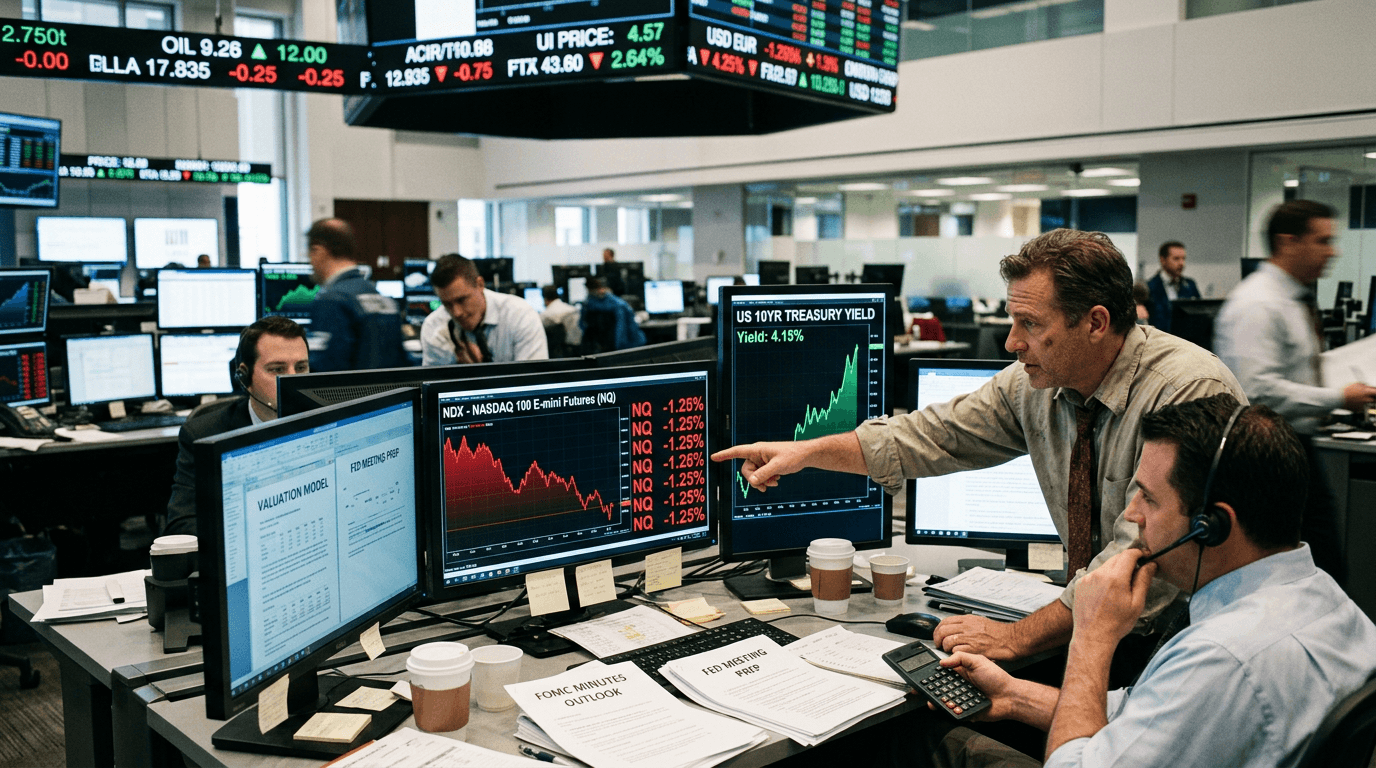
Nasdaq 100 futures easing ahead of key macro policy minutes is a familiar but important warning sign for risk assets. Higher Treasury yields, firmer expectations for the Federal Reserve’s path of interest rates, and a stronger dollar often combine to put pressure on growth-heavy indices and FX carry trades at the same time[1][4][8][15]. For traders on both live and simulated platforms, this backdrop is an opportunity to reassess positioning, volatility scenarios, and how macro narratives translate into price action.
Macro Backdrop: Yields And Policy Expectations
When Treasury yields rise into a major Fed communication, the market is effectively repricing the expected path of policy rates. The 2‑year yield is especially sensitive, because it tracks near‑term Fed expectations and tends to move when investors scale back hopes for rate cuts or price in a longer period of restrictive policy[1][4][8][7]. Moves of just a few basis points can ripple across valuations, discount rates, and FX, even if headline levels do not look dramatic[1][4][15]. Into Fed minutes and meetings, this repricing often happens in stages as traders front‑run potential shifts in tone.
The 10‑year yield, by contrast, anchors long‑term borrowing costs and market views on growth and inflation. A rise in the 10‑year ahead of policy minutes usually signals concern that inflation may prove stickier than hoped, or that the Fed will emphasize its willingness to keep rates higher for longer[1][4][8]. That combination tends to tighten financial conditions: credit is marginally more expensive, equity risk premia widen, and the hurdle rate for new investment projects goes up[5][15]. For equity and futures traders, these marginal changes matter because they feed directly into valuation models and relative attractiveness versus bonds.
Nasdaq 100 Futures: Why Minutes Matter
The Nasdaq 100 is heavily weighted toward technology, communication services, and other growth sectors whose cash flows are expected further out in the future. Those long‑duration earnings streams are more sensitive to changes in discount rates, so when yields rise, Nasdaq 100 futures often underperform more value‑tilted indices[3][9][12]. If minutes hint that policymakers remain uneasy about inflation or that they see risks tilted toward keeping rates restrictive, the market can quickly reassess rich tech valuations and crowded AI‑related trades[3][9][11].
Previous Fed minutes releases have produced choppy but meaningful responses in index futures. Episodes where the minutes sounded more hawkish than expected saw Nasdaq futures give back recent gains, with technical setups pointing to short‑term reversal patterns and 2–3 day pullbacks[3][9][12]. More neutral or dovish minutes, on the other hand, have allowed futures to stabilize or extend rallies, especially when earnings momentum and thematic drivers like AI remain strong[9][11][14]. The key for traders is understanding that minutes do not change policy directly, but they refine the narrative about how the Fed is thinking, and that narrative drives positioning.
Dollar, Fx, And Global Risk Sentiment
Higher U.S. yields and more hawkish policy expectations tend to support the dollar, particularly against lower‑yielding currencies and those reliant on external funding. Empirical work on FOMC communications shows that while minutes surprises have mixed effects on equities, the dollar index often reacts significantly, strengthening when the tone is interpreted as more restrictive[5]. That stronger dollar tightens global financial conditions by raising the cost of dollar funding and lowering the local‑currency value of dollar‑denominated assets and liabilities[5][15]. For EM FX, carry trades, and commodity‑linked currencies, this can translate into underperformance even if local fundamentals look solid.
Risk assets as a whole—equities, credit spreads, and high‑beta sectors—have a history of softening when yields climb and the dollar firms. Around hawkish minutes or policy statements, stock indices have posted broad declines while measures of volatility and risk premia increased, reflecting a pullback in risk appetite[5][9][15]. Cross‑asset traders watch these correlations closely: a simultaneous move up in yields and the dollar often coincides with weaker equity futures, wider credit spreads, and pressure on cyclical FX. This correlation pattern is why the combination of soft Nasdaq futures and rising yields ahead of minutes is such a focal point for macro desks.
Practical Takeaways For Index Futures Traders
For traders using Nasdaq 100 futures, several practical lessons emerge from this environment:
1. Treat policy minutes as a volatility catalyst, not a guaranteed trend changer. The information content is about tone and risk balance rather than new decisions, so be prepared for whipsaws and false breakouts around the release[3][5][10].
2. Watch the 2‑year and 10‑year yields as real‑time indicators of how the market is interpreting the minutes. Sudden moves of 5–10 basis points can precede or coincide with abrupt shifts in futures pricing and intraday momentum[1][4][8][15].
3. Align technical levels with macro triggers. Key support, resistance, and prior highs in Nasdaq futures can become inflection points when macro news hits; breakouts or failures at these levels often decide whether a move is a brief shakeout or the start of a larger rotation[3][9][12].
4. Size positions with scenario analysis. Consider how portfolios would behave if minutes are more hawkish, more dovish, or largely neutral, and adjust leverage so that adverse scenarios remain survivable in terms of drawdown and margin impact[5][9][15].
What Simulated Finance Traders Can Learn
On a SimFi platform, traders can turn this type of macro event into a structured learning exercise. By replaying past Fed minutes days with historical Nasdaq futures and yield data, it becomes easier to see how narrative shifts propagate through prices over hours and days[3][9][12]. Traders can experiment with different strategies—range‑trading around support and resistance, event‑driven breakout systems, or options‑based hedging—without real capital at risk, then measure which approaches handled volatility best[3][9][10].
Simulated environments also lend themselves to stress testing. Users can model scenarios where yields overshoot, the dollar rallies sharply, and Nasdaq futures break key levels, then track the knock‑on effects across correlated assets like high‑beta stocks, FX pairs, and crypto proxies[5][9][15]. This cross‑asset lens helps build the macro intuition that live traders rely on: understanding that a move in the front end of the curve, for example, may have implications for growth stocks, EM FX, and volatility surfaces simultaneously.
Looking Ahead
As Nasdaq 100 futures soften and Treasury yields edge higher into macro policy minutes, the market is signaling caution rather than panic. The Fed’s words can recalibrate expectations even without a rate change, and that recalibration matters for high‑valuation sectors and leveraged strategies[3][5][9]. For traders, both live and simulated, the opportunity lies in preparation: mapping key levels, understanding the yield curve, and planning how to respond if the narrative shifts toward “higher for longer” or, alternatively, a more balanced stance. In a landscape where macro signals and market microstructure intersect, turning events like Fed minutes into repeatable learning and trading frameworks is one of the most durable edges a modern futures trader can build.