
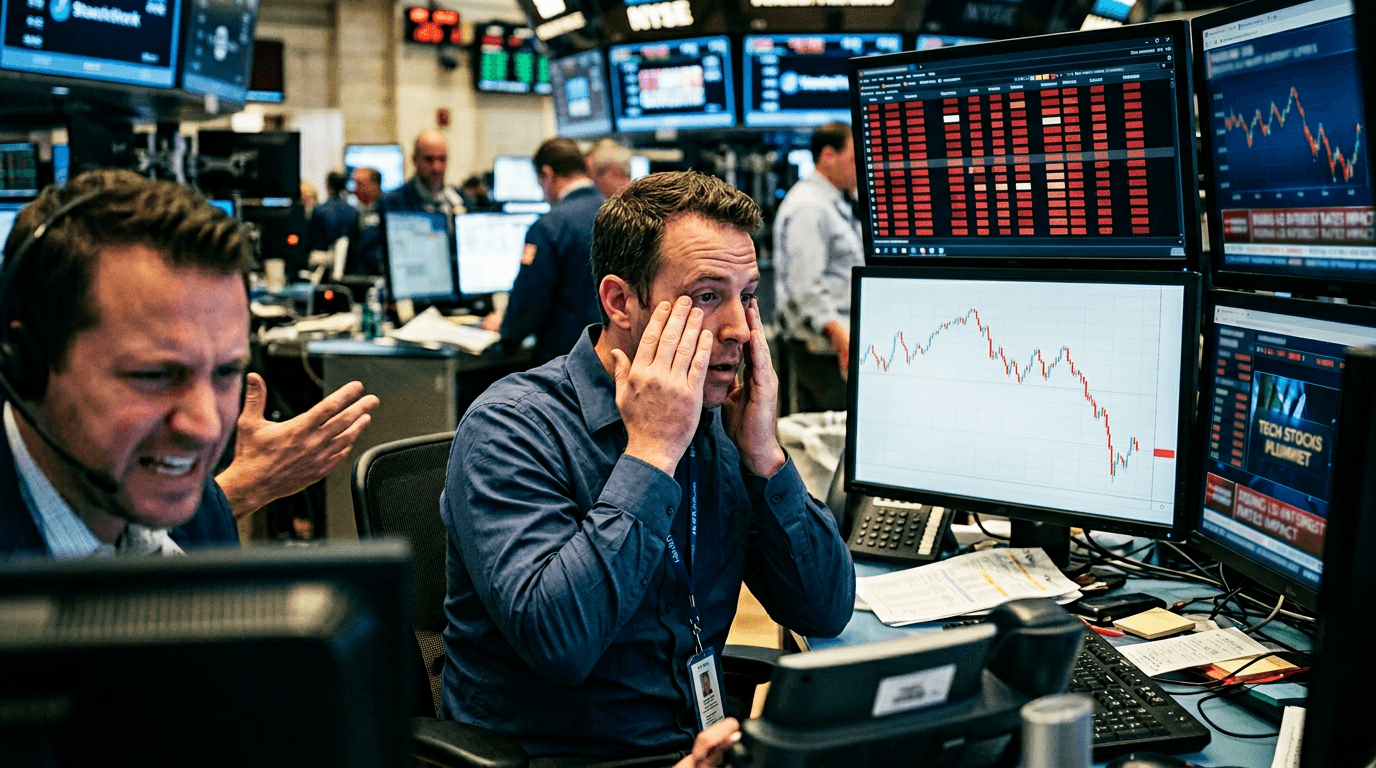
Nasdaq 100 Plummets Below 23,800: Unveiling the Impact of Rising Interest Rates on Tech Stocks
The Nasdaq 100 has hit a pivotal moment, with its recent plunge through crucial technical levels as rising US interest rates exert significant pressure on technology stocks and futures markets. By late March 2026, this index has slipped beneath the psychologically critical 23,800 mark and has breached its 50-week exponential moving average, indicating a shift in market sentiment that extends beyond the tech sector alone. This downturn coincides with a broader market weakness, increasingly hard to ignore, as the S&P 500 faces five consecutive weeks of declines—a pattern reminiscent of 2022.
Deciphering The Nasdaq 100 Downfall
The recent decline of the Nasdaq 100 is more than mere market turbulence. As a benchmark heavily weighted toward technology and growth stocks, it serves as an indicator of investor sentiment towards sectors that have fueled market gains in recent years. The drop below 23,800 carries weighty technical repercussions for traders and portfolio managers who consider these price levels as foundational support zones. A breach of this magnitude often triggers automated selling and compels institutional investors to reassess their positions.
The decline is starkest in the tech sector, where companies are highly sensitive to interest rate fluctuations. Higher borrowing costs disproportionately affect growth companies compared to value-oriented firms, rendering the Nasdaq 100's composition particularly susceptible during rate-hiking cycles. The emotional reaction from market participants has intensified this technical downturn, creating a feedback loop where fear begets selling, further validating that fear and encouraging more sell-offs.
The Impact Of Interest Rate Increases
The primary driver behind the current market pressure on tech stocks is the rise in US interest rates. When the Federal Reserve or market expectations signal higher rates, investors reevaluate the future value of company earnings. Growth companies, which derive much of their worth from anticipated future profits, become less attractive when these profits are discounted at elevated rates. This mathematical reality establishes a structural headwind for the Nasdaq 100 that cannot be easily countered by positive news or market sentiment alone.
The relationship between interest rates and tech stock valuations is both inverse and potent. A mere 1% rise in interest rates can significantly compress valuation multiples across the sector. As rate expectations have shifted in 2026, portfolio managers have been compelled to reposition, shifting capital away from high-growth, unprofitable tech companies towards more traditional, cash-generative businesses. This transition has been swift and decisive, offering little respite for those heavily weighted in growth stocks.
The Bigger Market Picture
The fragility of the Nasdaq 100 cannot be viewed in isolation. The S&P 500's five-week decline signifies a substantial erosion in overall market breadth and momentum. This pattern suggests that market weakness has transcended technology stocks to encompass a broader array of equities. When major indices endure such sustained declines, it often signals a fundamental shift in how investors perceive risk.
The S&P 500's five-week losing streak marks a stark departure from the relatively calm conditions that have dominated much of the recent market cycle. The last occurrence of this pattern was in 2022, a year characterized by considerable market upheaval and investor repositioning. Historical precedence indicates that when such patterns arise, they demand serious attention from both active traders and long-term investors.
Technical Levels And The Psychology Of Investors
The 23,800 level in the Nasdaq 100 is more than just a number on a chart—it served as a support zone for technical traders, and its breach confirms bearish momentum, encouraging further selling. The violation of the 50-week exponential moving average exacerbates this technical damage, signaling a shift from a positive to a negative intermediate-term trend. Traders using moving averages as directional indicators are now receiving an unequivocal sell signal.
These technical disruptions are significant because they affect trading algorithms and rule-based investment strategies. Once a level is convincingly breached, it frequently becomes a resistance level if the market attempts a recovery, creating additional hurdles for any bounce attempts.
Strategic Insights For Investors
First, acknowledge that rising interest rates fundamentally alter the calculus for technology stocks. Valuations will compress until they reach levels perceived as fair value in the new higher rate environment. Second, recognize the importance of technical levels, as the breach of 23,800 in the Nasdaq 100 holds real implications for market momentum. Third, the broader five-week decline in the S&P 500 suggests this is not merely a tech issue but a genuine market rotation. Lastly, investors should adhere to a disciplined approach during volatile periods, avoiding emotional decisions based on short-term price fluctuations.
The current market environment presents both risks and opportunities. For those overexposed to high-flying growth stocks, the correction provides a chance to rebalance portfolios. For those with available capital, the increased volatility may offer attractive entry points for long-term investors with suitable time horizons.
NEWSIMPACTSCORE: 7