
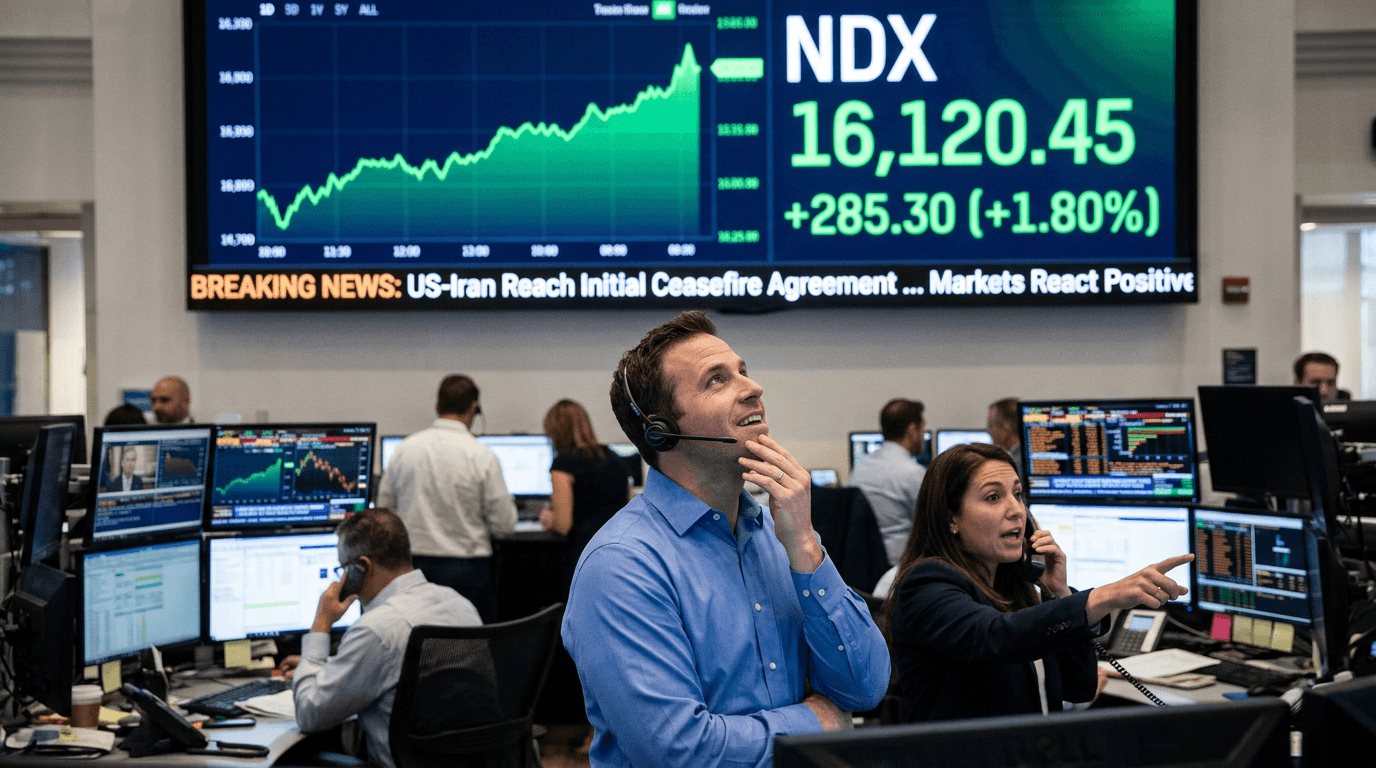
Nasdaq 100 Soars as US-Iran Ceasefire Fuels Risk Asset Surge
Global Markets React to Ceasefire News
In an unexpected turn of events, global equity markets experienced a significant upswing on Wednesday following the announcement of a ceasefire agreement between the United States and Iran. This development prompted investors to pivot from defensive stances, reallocating capital into riskier assets such as stocks. The easing of geopolitical tensions, which had clouded the market for weeks, triggered a robust rally across various asset classes, underscoring the tight linkage between financial markets and geopolitical events. For those closely observing the tech-heavy Nasdaq 100, this marked a pivotal moment, as the index capitalized on converging market tailwinds.
The Catalyst: US-Iran Ceasefire
The ceasefire agreement between the US and Iran, contingent upon Tehran reopening the crucial Strait of Hormuz, addressed a major concern for global markets. For weeks, tensions in West Asia had fueled uncertainty, with investors wary of disruptions to a vital oil chokepoint. This temporary two-week agreement provided immediate relief, diminishing the threat of an escalation that could have severely impacted global energy supplies. Consequently, investors shifted their focus from geopolitical risks to fundamental economic conditions, a transition that particularly favored growth-oriented stocks in the Nasdaq 100.
Oil Prices Tumble, Reshaping Market Dynamics
A key driver of the equity rally was the dramatic decline in oil prices. Brent crude futures plummeted by over 15%, nearing $90 per barrel, while WTI futures also fell by more than 15%, dropping below $95 per barrel. This marked a stark departure from the previously high energy costs that had strained consumer purchasing power and corporate profit margins. Lower oil prices alleviate inflationary pressures, reduce business input costs, and enhance real investor returns. The technology sector, sensitive to rising interest rates and inflation, stands to gain significantly from this energy price relief, bolstering the Nasdaq 100.
Shift from Safe Havens to Equities
A crucial mechanism fueling the market rally was the shift in investor sentiment from defensive assets to equities. Geopolitical uncertainty typically drives investors toward the safety of the US dollar and government bonds, diverting capital from riskier assets like stocks. However, the ceasefire news alleviated immediate geopolitical concerns, reversing this trend sharply. The US dollar weakened as investors moved away from safe havens, while the euro strengthened, and capital flowed back into global equities. This reallocation was particularly beneficial for growth stocks and technology companies, which had faced heightened uncertainty. The Nasdaq 100, concentrated in high-growth tech names, was well-positioned to capture gains from this renewed risk appetite.
Global Equity Markets Rally
The ceasefire's positive effect was felt worldwide, with equity markets rallying across the globe. Asian markets showed notable strength, with the Nikkei up 5.4%, the Shanghai Composite rising 2.7%, and the Hang Seng gaining 2.8%. European indices followed suit, with the DAX 40 increasing by 5.0% and the CAC 40 climbing 2.6%. This widespread global rally provided a supportive backdrop for US tech stocks, as international investors reassessed their exposure to growth equities. The synchronized nature of the global market strength indicated a powerful and coordinated relief trade, benefiting major indices like the Nasdaq 100.
Caveats and Future Considerations
Despite the dramatic market reaction, analysts caution that significant risks remain. The ceasefire is a temporary two-week pause rather than a resolution of underlying conflicts. The root causes of the conflict remain unresolved, maintaining the risk of reescalation. This suggests that the current rally, while genuine, may be vulnerable to renewed geopolitical tensions. Investors should view this development as immediate relief rather than long-term confidence in geopolitical stability. The sustainability of gains in the Nasdaq 100 and broader equity markets will depend on whether the ceasefire leads to lasting diplomatic progress or if underlying tensions resurface.
The Nasdaq 100's surge in response to the US-Iran ceasefire highlights the intricate interplay between geopolitical developments, commodity prices, and equity market performance. By reducing inflation pressures through lower oil prices, shifting investor sentiment away from defensive assets, and removing a significant tail risk, the ceasefire created an environment conducive to growth stock rallies. However, investors should remain cognizant of the temporary nature of this relief while closely monitoring developments in West Asia for signs of stability or potential escalation.
Global equity markets surged following the US-Iran ceasefire agreement, as oil prices plummeted and investors moved from safe havens to growth stocks, notably those in the Nasdaq 100.