
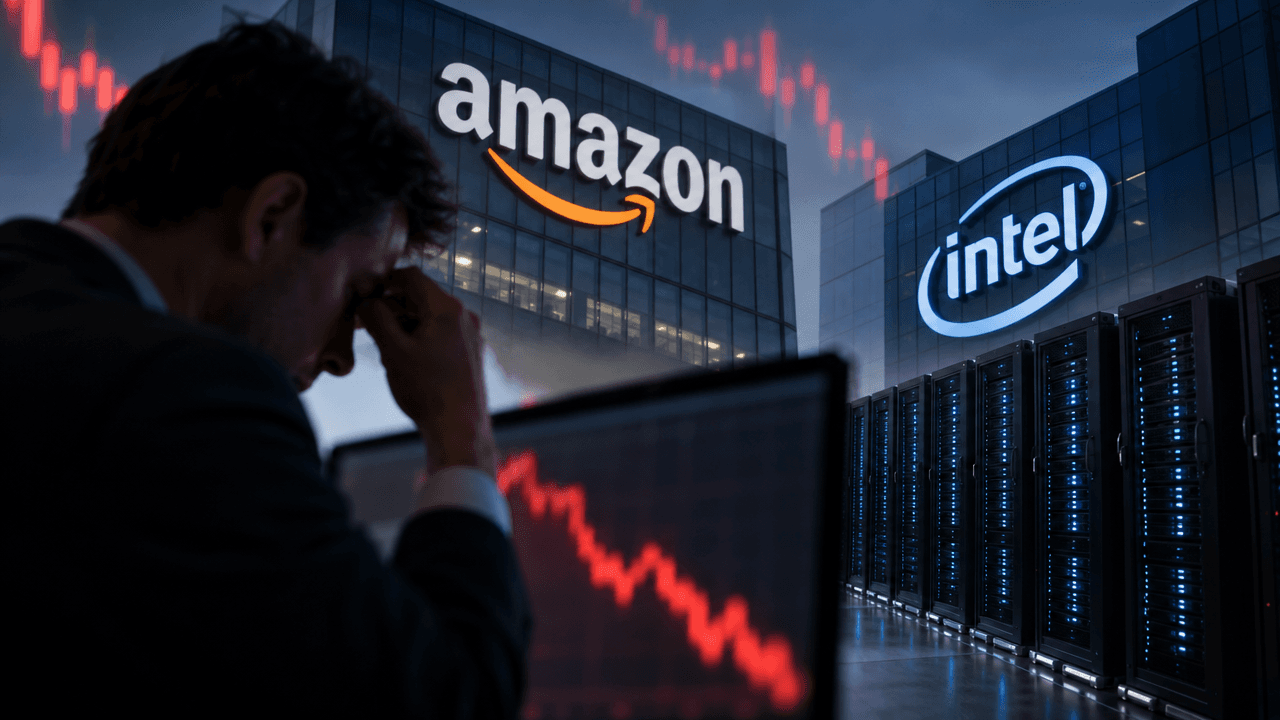
Nasdaq futures slid sharply on Friday as Amazon and Intel earnings reignited concerns that the artificial-intelligence boom may require more spending, time and risk than investors previously expected. Nasdaq 100 futures fell about 2.2%, while Amazon dropped roughly 7% and Intel plunged about 23% in after-hours trading. The reaction spread beyond those companies, pressuring technology shares, semiconductor stocks and broader risk assets. [5]
THE MARKET’S INITIAL REACTION
The selloff was not caused by a single disappointing number. Instead, investors focused on the relationship between aggressive AI investment and the returns those investments are expected to produce.
Amazon reported third-quarter earnings per share of $1.89 on revenue of $201.94 billion, below analyst expectations of $1.96 per share and $202.31 billion in revenue. The company also reported negative free cash flow of $42.4 billion and reaffirmed a 2026 capital-expenditure forecast of $220 billion. [3]
That spending is largely connected to data centers, cloud infrastructure and the computing capacity required to support AI services. Amazon Web Services remains a major growth engine, but investors are increasingly asking whether cloud growth can expand quickly enough to justify the enormous capital commitment.
Intel’s problem was different but equally important. The chipmaker delivered a strong third-quarter profit, yet its outlook for the current quarter disappointed investors. Intel projected adjusted earnings of 25 cents per share and revenue between $15 billion and $16 billion. Its third-quarter revenue also missed estimates, while weakness in personal computers added to concerns about the company’s recovery. [3]
Why Ai Spending Has Become A Market Risk
For much of the recent AI rally, spending was interpreted as evidence of opportunity. Companies investing in processors, networking equipment, data centers and cloud capacity were viewed as beneficiaries of a structural technology transformation.
That interpretation is now being tested.
AI infrastructure is expensive to build and operate. Companies must purchase advanced chips, expand electricity capacity, construct data centers and hire specialized workers. The investment may eventually create powerful new revenue streams, but the timing of those returns remains uncertain.
This creates a difficult balance for investors. If companies spend too little, they risk falling behind competitors. If they spend too much, they may weaken free cash flow, increase borrowing needs and reduce shareholder returns.
Amazon’s results made that tension visible. Strong long-term AI ambitions did not prevent investors from reacting negatively to near-term pressure on cash flow and earnings. The broader concern is that major technology companies could continue spending at record levels while monetization develops more slowly than expected.
Intel added a second warning sign. Its weak forecast suggested that not every part of the semiconductor industry is benefiting equally from AI demand. Companies supplying AI data centers may be experiencing strong demand, while traditional PC-related businesses remain vulnerable to sluggish consumer and corporate spending.
From Ai Enthusiasm To Selective Investing
The market reaction does not necessarily mean that the AI investment cycle is over. It does suggest that investors are becoming more selective.
Earlier in the cycle, companies could receive favorable treatment simply for announcing AI plans. Now, investors are looking for measurable evidence: rising revenue, improving margins, strong customer demand and a credible path to recovering capital expenditures.
This shift can create greater volatility across the technology sector. High-growth companies with elevated valuations are particularly sensitive to changes in expectations. When traders begin questioning future cash flows, share prices can decline even if a company continues to expand its sales.
The selloff also demonstrates how closely linked the technology ecosystem has become. A spending decision by a cloud provider can affect chip designers, equipment manufacturers, data-center operators, utilities and software companies. When confidence weakens at the top of that chain, the pressure can quickly spread across the sector.
What Traders Should Watch Next
Traders should focus on guidance and cash flow, not just headline earnings. A company can exceed quarterly profit estimates and still fall if its outlook is weak or its investment needs are rising too quickly.
Key indicators include capital-expenditure forecasts, free-cash-flow trends, cloud growth, data-center utilization and management commentary about customer demand. It is also important to distinguish between productive investment and spending that is difficult to monetize. Not all AI expenditure carries the same financial risk.
Market participants should also monitor interest rates and credit conditions. Higher funding costs make large infrastructure projects more expensive and can reduce the present value of future earnings. Reuters reported that investors were also moving toward safer assets, with bonds strengthening as concerns over AI spending intensified. [4]
For SimFi traders, this environment offers a useful lesson in scenario planning. Rather than assuming that technology stocks will move together, consider separate outcomes: continued AI spending, a slower investment cycle, stronger-than-expected monetization or a broader risk-off move. Track correlated markets such as semiconductor shares, Treasury yields and the dollar, then define risk before entering a position.
Practical Takeaways
The Nasdaq futures decline shows that earnings reports can change the market narrative within minutes. Amazon’s results raised questions about the cost and timing of AI investment, while Intel’s outlook highlighted weakness in traditional semiconductor demand.
The main lesson is not to treat AI exposure as a guarantee of market gains. Investors are increasingly demanding proof that spending will lead to durable revenue and profitable growth. Companies that demonstrate strong execution may continue to attract capital, but businesses relying mainly on ambitious projections could face greater scrutiny.
For traders, disciplined position sizing and clear exit levels matter more when uncertainty is concentrated in a highly valued sector. Earnings volatility can create opportunity, but only when risk is measured rather than assumed.
The AI economy remains one of the most important long-term themes in financial markets. However, Friday’s selloff shows that enthusiasm alone is no longer enough. The next phase of the trade will be determined by cash flow, returns on investment and whether real demand can keep pace with the extraordinary cost of building the future.