
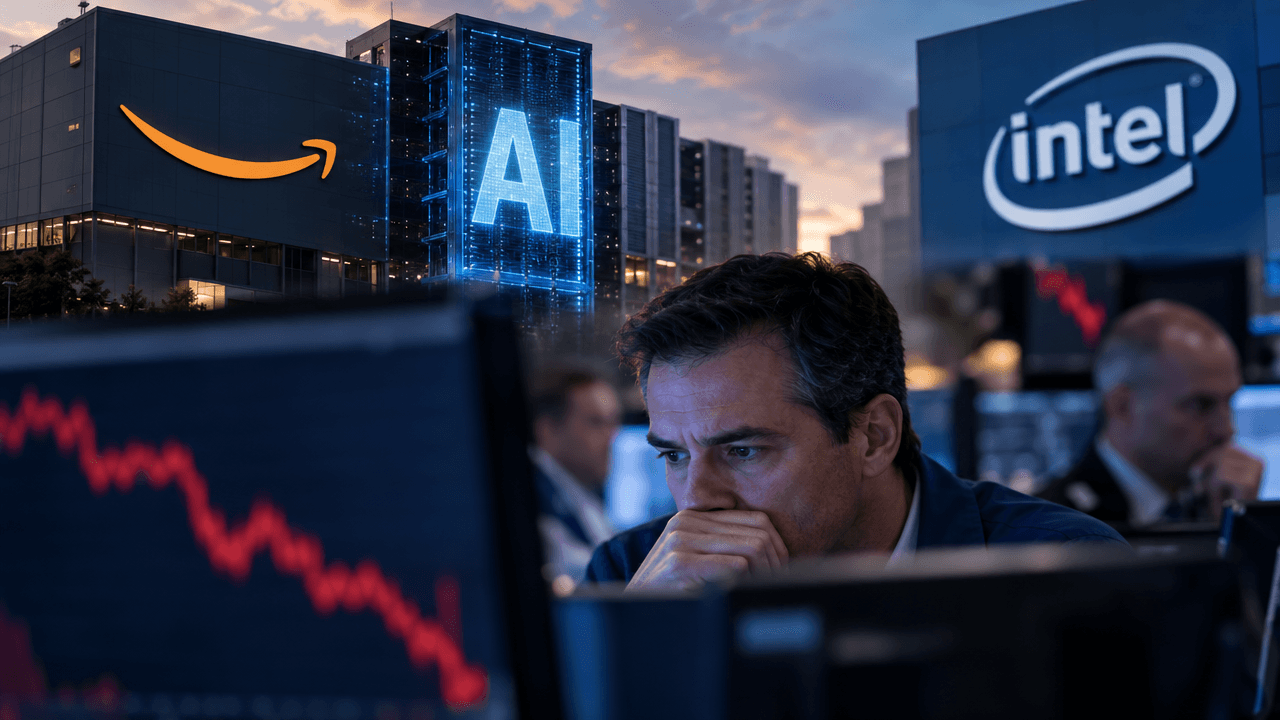
Nasdaq futures slid sharply on Friday after Amazon and Intel earnings revived a difficult question for technology investors: how much can companies spend on artificial intelligence before the financial returns begin to justify the investment?
Nasdaq 100 futures fell about 2.2% in premarket trading, extending a technology-led sell-off and signaling renewed pressure on major AI-linked stocks. The reaction was not simply about one disappointing quarter. Instead, investors focused on the growing cost of building AI infrastructure and the increasingly uncertain timeline for turning that spending into sustainable profits. [2]
The Earnings That Triggered The Selloff
Amazon was at the center of the debate after reporting weaker-than-expected third-quarter revenue and earnings. The company also posted negative free cash flow of $42.4 billion and maintained a 2026 capital expenditure forecast of approximately $220 billion. Those figures highlighted the financial burden created by data centers, chips, networking equipment, and other infrastructure required to expand its cloud and AI operations. [1]
Amazon shares fell roughly 6% to 7% in premarket or extended trading, depending on the trading session and source. The market reaction showed that investors were no longer willing to evaluate AI investment solely through the lens of future growth. They were also examining how quickly those investments consume cash today. [3]
Intel’s results created a separate but related concern. The chipmaker warned that it expected to burn cash during the year, citing weakness in the personal-computer market, manufacturing bottlenecks, and heavy spending to expand production. Intel shares plunged more than 20% in premarket trading, with some reports placing the decline near 25% to 29%. [3]
Together, the reports presented investors with two different risks: Amazon demonstrated the scale of ongoing AI spending, while Intel underscored the operational and cash-flow challenges that can accompany an ambitious semiconductor expansion.
Why Ai Spending Is Under Scrutiny
The AI investment cycle has supported enormous gains across technology and semiconductor markets. Companies supplying processors, cloud capacity, data-center equipment, and software have benefited from a powerful demand narrative. However, the latest earnings reports have shifted attention from the size of that opportunity to its economics.
Building AI capacity requires substantial upfront investment. A company may spend billions on specialized chips and data centers well before customer revenue fully reflects those costs. Investors must therefore estimate future demand, pricing power, utilization rates, depreciation, energy expenses, and the competitive response from other technology companies.
The concern is not necessarily that AI demand is disappearing. Rather, markets are questioning whether the revenue and productivity gains will arrive quickly enough to support current valuations and spending plans. If customers are reluctant to pay higher prices for AI services, or if competing providers drive prices lower, the return on invested capital could disappoint.
Amazon’s negative free cash flow made that issue particularly visible. A profitable company can still experience significant cash pressure when capital expenditures rise faster than operating cash generation. That does not automatically indicate financial weakness, but it does reduce flexibility and increases the importance of future execution.
The Broader Market Rotation
The futures decline contributed to a wider rotation away from technology and AI-linked assets. Investors moved toward more defensive areas and safer assets, including government bonds, as the earnings news increased uncertainty around high-growth stocks. The technology-heavy Nasdaq 100 was hit harder than the broader market because its valuation and earnings expectations are more closely tied to continued innovation and investment. [13]
This distinction matters for traders. A decline in Nasdaq futures does not necessarily mean that the entire economy is entering a downturn. It may instead represent a repricing of a concentrated group of companies whose share prices had benefited from exceptional expectations.
The selloff can also spread through supply chains. Weakness in chipmakers may pressure equipment manufacturers, data-center suppliers, and companies whose revenue depends on cloud infrastructure spending. At the same time, lower technology valuations can affect investor sentiment across growth stocks, even when the underlying businesses have limited direct exposure to AI.
What Traders Should Watch Next
The next market reaction will depend on whether investors receive evidence that heavy spending is producing measurable results. Important indicators include cloud revenue growth, AI-related bookings, data-center utilization, operating margins, free cash flow, and management guidance for future capital expenditures.
Traders should also distinguish between a temporary earnings disappointment and a change in the long-term business outlook. One weak quarter may reflect timing, supply constraints, or unusually high investment. Several quarters of rising costs, slowing demand, and declining cash generation would represent a more serious shift.
Risk management is especially important during earnings-driven volatility. Futures can move quickly outside regular trading hours, and premarket declines may widen or reverse once the full market opens. Position sizing, defined stop levels, and awareness of overnight gaps can help traders avoid allowing a single announcement to dominate portfolio risk.
For SimFi traders, this environment offers a useful scenario-building exercise. Consider how a stock might respond to three outcomes: capital spending rises while revenue accelerates, spending rises while revenue remains moderate, or management cuts investment because demand weakens. Comparing these scenarios encourages disciplined analysis instead of reacting only to the headline move.
The Key Takeaway
The Nasdaq futures decline after Amazon and Intel earnings reflects a market demanding proof that the AI boom can generate durable financial returns. Amazon’s enormous capital spending and negative free cash flow raised questions about the cost of growth, while Intel’s cash-burn warning exposed the execution risks facing semiconductor manufacturers.
AI remains a significant technological and commercial trend, but investors are becoming less willing to reward spending without evidence of profitable returns. For traders, the central lesson is clear: track cash flow, margins, guidance, and valuation—not just revenue growth or optimistic AI narratives. In the next phase of the market, companies may be judged less by how much they spend on artificial intelligence and more by how efficiently that spending creates value.