
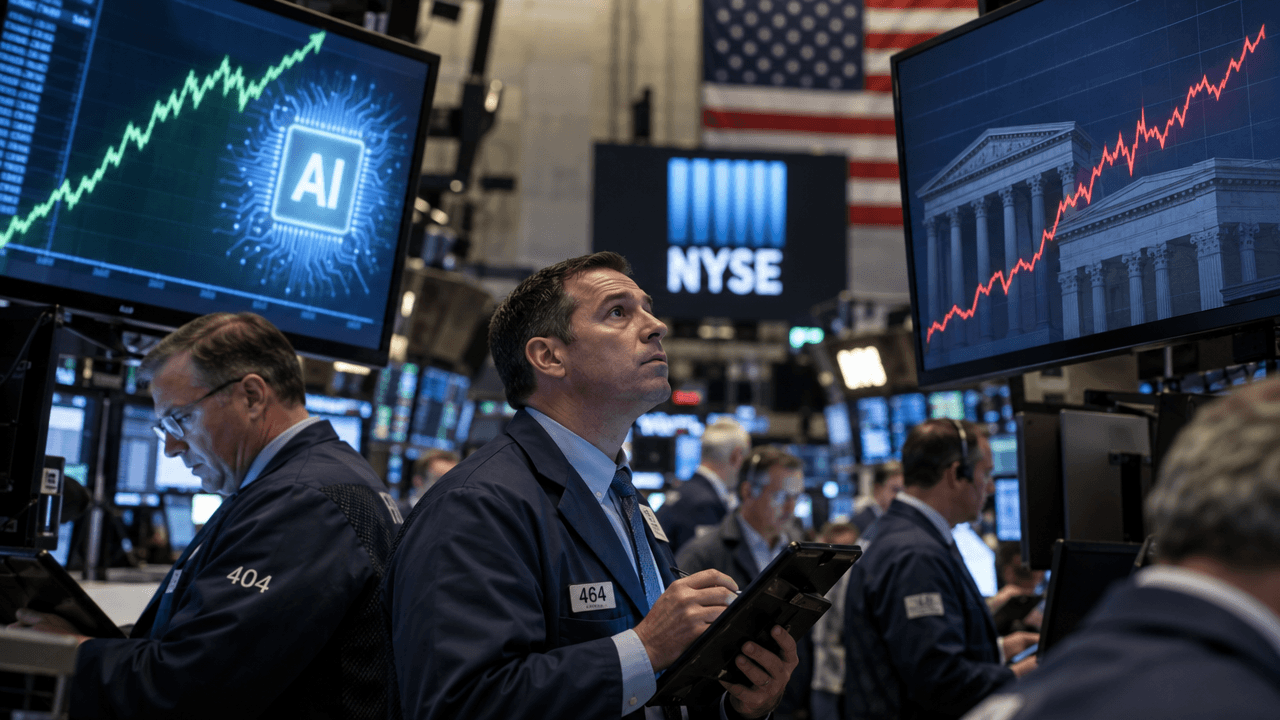
Wall Street delivered a powerful rebound on Friday, but the rally carried an unusual message: investors bought stocks even as Treasury yields moved higher. The Nasdaq Composite led the advance, gaining 2.31% to close at 24,129.50. The S&P 500 rose 1.60% to 7,297.49, while the Dow Jones Industrial Average added 1.18%, or nearly 600 points. [3][5]
The move was driven largely by renewed demand for beaten-down artificial-intelligence and technology shares. After weeks of selling pressure, investors appeared willing to re-enter the market, betting that the recent decline had gone too far. Yet the combination of rising yields, falling volatility and concentrated buying in growth stocks also suggests that Friday’s advance may represent a sharp tactical rebound rather than the beginning of a fully established new trend.
What Drove The Rally
AI-linked shares were at the center of the recovery. Semiconductor companies and major technology platforms attracted buyers after suffering substantial losses during the previous several sessions. AI hyperscalers, including Alphabet, Amazon, Microsoft, Meta Platforms and Oracle, all moved higher during the session, with gains ranging from roughly 1% to 2.7%. [10]
The buying came after a difficult period for the technology trade. Investors had become increasingly concerned about elevated valuations, the enormous capital spending required to build AI infrastructure and the time needed for those investments to generate reliable profits. Those concerns caused sharp declines across parts of the sector, leaving many traders looking for opportunities among stocks that had recently been heavily sold.
This is a familiar market pattern. When a popular sector falls quickly, short-term traders often return once selling momentum weakens. Investors who believe the long-term growth story remains intact may also use the decline to build positions at lower prices. Friday’s rally suggests both forces were active.
Why Higher Yields Matter
Ordinarily, rising Treasury yields can create headwinds for high-growth equities. The yield on government bonds represents the return investors can receive from a relatively low-risk asset. When that return increases, the future profits of growth companies become less attractive in comparison.
Higher yields also raise the discount rate used to value future earnings. Technology companies often receive high valuations because investors expect significant profits years into the future. As interest rates rise, those future profits are worth less in today’s dollars. This is one reason technology stocks can react sharply to changes in bond markets.
Friday’s rally therefore deserves careful interpretation. Stocks did not rise because interest-rate pressure disappeared. They advanced because enthusiasm for beaten-down AI and technology shares temporarily overwhelmed that pressure. The move may indicate strong underlying demand, but it could also reflect short covering, position adjustments and investors taking advantage of lower prices.
A Risk-on Move With A Warning
The decline in the Cboe Volatility Index added to the day’s risk-on tone. The VIX, often called Wall Street’s fear gauge, fell by more than 10% and closed near 23.87, according to market reports. [1] A lower VIX generally indicates that options traders expect less short-term turbulence.
However, a VIX above the low-to-mid teens still reflects a market that is far from calm. The decline in volatility is encouraging, but it does not erase the instability seen earlier in the week. Recent trading included abrupt reversals, large moves in AI shares and significant changes in investor preferences.
For traders, this distinction matters. A falling VIX can support a continuation of the rally, but it should not be treated as proof that risk has disappeared. Volatility can remain elevated even while stocks recover, particularly when the market is dominated by a small group of highly influential companies.
What Traders Should Watch Next
The next test is whether the rally broadens beyond AI and mega-cap technology shares. A healthier advance would typically include participation from financials, industrials, consumer companies and other economically sensitive sectors. If only a narrow group of technology stocks continues to lead, the market may remain vulnerable to another rotation.
Treasury yields will also be important. If yields continue rising while equities hold their gains, investors may be signaling confidence in economic growth and corporate earnings. If yields rise because of renewed inflation or expectations of tighter monetary policy, however, the pressure on equity valuations could return quickly.
Traders should also monitor trading volume, market breadth and follow-through. A single strong session is less convincing than several consecutive sessions in which more stocks participate and pullbacks are met with sustained buying. The Nasdaq’s 2.31% gain is significant, but confirmation will require evidence that buyers remain active after the initial rebound.
For SimFi traders, the practical lesson is to avoid chasing a large move simply because an index has surged. Instead, identify the catalyst, define the invalidation level and consider how the position would behave if yields move against it. Position sizing is especially important when volatility remains above normal.
The Bigger Market Lesson
Friday’s rally demonstrates how quickly sentiment can change in an AI-driven market. Investors shifted from aggressively selling technology shares to buying them again, helping the Nasdaq outperform the broader market. That reaction reflects continued belief in the long-term importance of artificial intelligence, but it also highlights how crowded and sensitive the trade has become.
The strongest rallies often begin when pessimism is elevated, but they do not all develop into lasting recoveries. The market now faces a critical test: can technology stocks maintain their momentum while yields remain elevated, and can gains spread to a wider range of companies?
For now, the answer is uncertain. The session was clearly bullish, with strong index gains and a retreat in volatility. But the unusual relationship between rising yields and a technology-led rally suggests that investors should remain selective rather than assume that market risk has been fully resolved. In the days ahead, disciplined analysis will matter more than the headline percentage gain.