
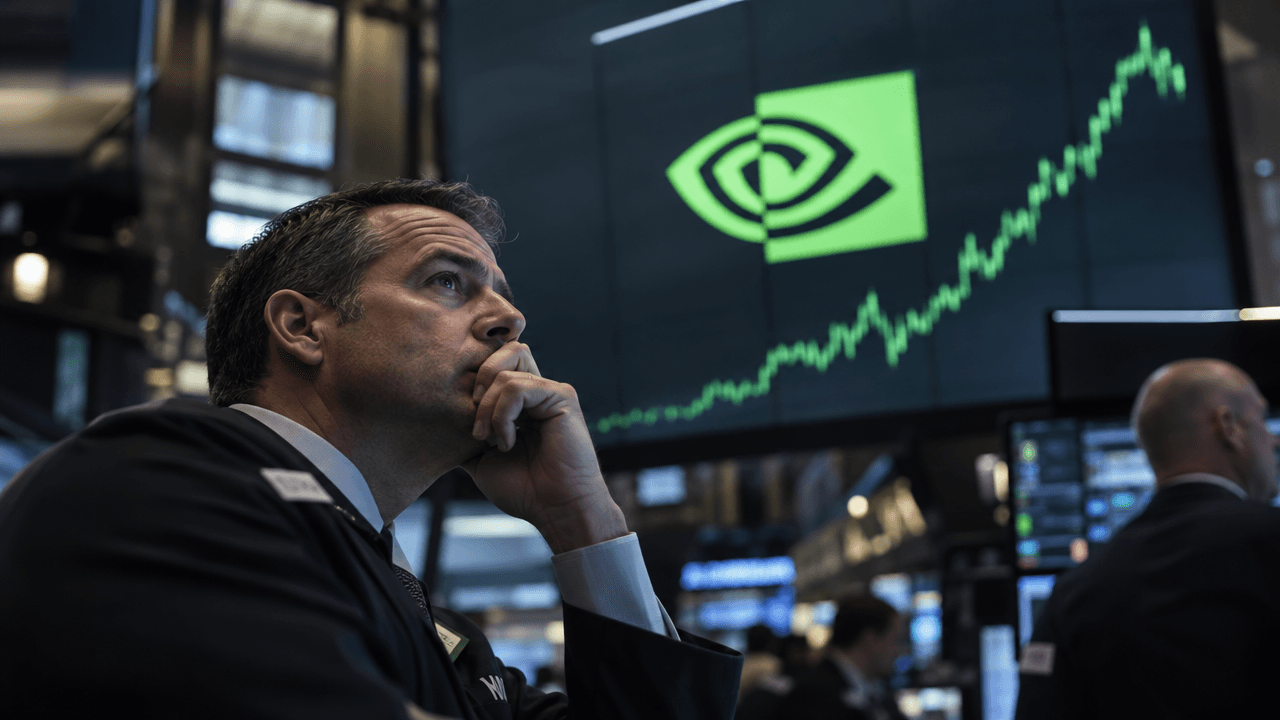
Nvidia-related weakness has become a reminder that even the strongest companies can face a difficult market reaction when leadership uncertainty and elevated expectations collide. Nvidia futures reportedly fell about 3.7% after the company’s board confirmed that former chief executive Jensen Huang would not return, adding pressure to technology shares, high-growth assets, and cryptocurrencies.
The reaction was notable because Nvidia had just delivered exceptionally strong financial results. The company reported fiscal third-quarter revenue of approximately $115.8 billion, up 103% from a year earlier, while adjusted earnings per share reached $2.68 compared with expectations of $2.48. Nvidia also guided toward roughly $130 billion in fourth-quarter revenue, above the consensus estimate near $125 billion. [2][6]
The contrast between powerful operating results and weaker market sentiment highlights an important lesson for traders: price is influenced not only by what a company earns, but also by expectations, leadership confidence, positioning, and the broader risk environment.
Leadership Uncertainty Changes The Market Narrative
Jensen Huang has been closely associated with Nvidia’s transformation from a graphics processor manufacturer into the dominant supplier of artificial intelligence infrastructure. His public presence, strategic vision, and communication with customers and investors have become part of the company’s identity.
That makes leadership uncertainty especially important. Nvidia’s board reportedly confirmed that it accepted Huang’s resignation and did not intend to reinstate him, despite calls for his return. The board is instead supporting the company’s current direction while an independent search and investigation process continues. [3][12]
For investors, the issue is not simply whether Nvidia can continue producing strong chips. It is whether the company can maintain execution, customer relationships, product development, and strategic momentum without the executive who helped build its AI business.
This does not automatically change Nvidia’s long-term financial outlook. However, it can change the valuation investors are willing to assign to future growth. When a stock has already priced in extraordinary performance, even a small increase in uncertainty can trigger profit-taking.
Strong Earnings Do Not Guarantee A Rally
Nvidia’s results demonstrate how markets can separate business performance from short-term price behavior. Revenue growth above 100%, record data-center demand, and an optimistic forecast would normally support a bullish reaction. Yet those positives were competing with leadership concerns, a recent decline in the share price, interest-rate expectations, and broader caution toward expensive technology stocks.
Nvidia shares had already fallen significantly before the earnings announcement, increasing the sensitivity of the market to both good and bad news. One market report noted that the stock had declined more than 27% over the previous month before the results. [2]
This is sometimes called an expectations problem. If investors expect near-perfect results, a strong earnings report may already be reflected in the price. The next question becomes whether the results are strong enough to exceed increasingly demanding expectations.
For traders, the practical takeaway is to compare reported figures with estimates rather than viewing them in isolation. Revenue growth can be impressive, but the market may focus more closely on guidance, margins, customer concentration, supply constraints, or management credibility.
Why Technology And Crypto Respond To Nvidia
Nvidia is more than a single company in market psychology. It is widely treated as a proxy for artificial intelligence investment, semiconductor demand, cloud infrastructure, and the growth-stock trade.
When Nvidia weakens, traders may reassess the broader AI ecosystem. That can affect chipmakers, software companies, data-center operators, cloud providers, and other businesses valued on expectations of rapid future growth. High-growth technology shares are particularly sensitive because their valuations depend heavily on profits expected years in the future.
Cryptocurrency can also respond to the same shifts in risk appetite. Bitcoin is not directly tied to Nvidia’s earnings, but both markets often attract capital when investors are comfortable with volatility and future-oriented growth themes. Conversely, when traders reduce exposure to technology and other risk-sensitive assets, crypto can experience additional selling pressure.
Following Nvidia’s earnings, Bitcoin recovered toward the $64,000–$66,000 area as technology sentiment briefly improved. However, market observers continued to point to contracting liquidity, cautious institutional participation, and interest-rate concerns as limits on any recovery. [4][9]
This relationship should not be interpreted as a guaranteed trading signal. Nvidia’s price and Bitcoin’s price can diverge sharply. Instead, Nvidia is best viewed as one indicator of broader risk tolerance.
What Traders Should Watch Next
The first priority is follow-through. A temporary futures decline does not necessarily establish a lasting trend. Traders should monitor whether Nvidia stabilizes after the initial leadership news, whether technology indexes confirm the move, and whether volume increases during advances or declines.
The second priority is the company’s execution under its current leadership structure. Upcoming product launches, data-center demand, gross margins, supply conditions, and customer spending will provide more useful evidence than speculation alone.
The third is the macroeconomic backdrop. Interest rates, bond yields, the U.S. dollar, and liquidity conditions can influence technology valuations even when company-specific results remain strong. A positive Nvidia report may support prices in a favorable macro environment, but it may have a weaker effect when investors are reducing risk across markets.
Finally, traders should manage concentration risk. Building a portfolio around one company, one sector, or one narrative can create substantial exposure to unexpected news. Position sizing, defined risk levels, and a willingness to wait for confirmation are more reliable than reacting to every headline.
The Bigger Lesson For Simfi Traders
Nvidia-related weakness illustrates why market impact is rarely determined by a single statistic. The company’s earnings were strong, but leadership uncertainty and broader risk aversion changed how investors interpreted those results.
For SimFi traders, the event provides a valuable exercise in separating facts from assumptions. The facts include Nvidia’s exceptional revenue growth, its above-consensus outlook, and the board’s reported decision not to pursue Huang’s return. The assumptions concern whether the new leadership can preserve the company’s competitive advantage and whether the AI trade has further room to run.
The most disciplined approach is to build scenarios rather than predictions. A bullish scenario could involve continued demand, successful leadership transition, and renewed confidence in technology stocks. A bearish scenario could involve weaker execution, multiple compression, or contagion across high-growth assets. A neutral scenario could see Nvidia’s business remain strong while its share price consolidates as investors wait for more evidence.
Nvidia remains a central company in the AI investment story, but its latest market reaction shows that extraordinary growth does not eliminate uncertainty. Traders who combine earnings analysis with leadership assessment, macro awareness, and careful risk management will be better prepared for the next move in technology and crypto markets.