
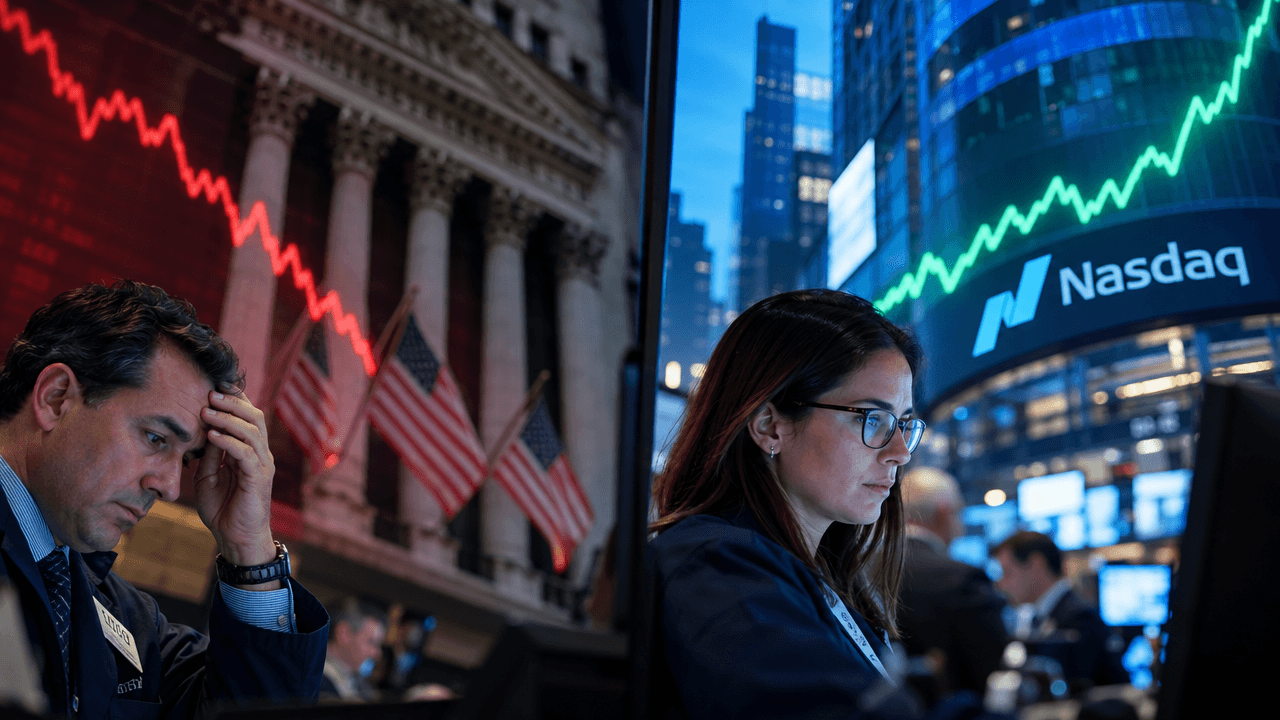
U.S. index futures are sending a conflicted message to traders. Dow futures fell roughly 550 points, while Nasdaq 100 futures gained about 100 points and S&P 500 futures edged lower near 7,300. The divergence reflects a market pulled between technology optimism, earnings-related uncertainty and renewed concern that the Federal Reserve may keep raising interest rates. [6]
For traders, the important signal is not simply whether futures are higher or lower. It is the gap between sectors. A sharp decline in Dow futures suggests pressure on economically sensitive companies, while gains in Nasdaq 100 futures indicate that investors may still be willing to buy selected growth and technology names. That contrast points to rotation rather than a uniform shift toward either risk-taking or risk aversion.
Rate Expectations Are Driving The Market
Interest-rate expectations have become the central force behind the latest volatility. Recent Federal Reserve communications and meeting minutes have kept additional tightening on the table, while stronger inflation data has reinforced the argument for higher rates. Markets have been pricing in a high probability of a quarter-point increase at the next policy meeting, with a smaller possibility of a larger move. [8]
Higher interest rates affect stocks through several channels. First, they increase borrowing costs for companies and consumers. Businesses may delay expansion, reduce capital spending or face higher interest expenses. Households may also become more cautious as credit cards, mortgages and other loans become more expensive.
Second, higher rates reduce the present value of future corporate profits. This matters most for growth companies whose valuations depend heavily on earnings expected years from now. When bond yields rise, investors often demand a lower price for those distant cash flows. That is why technology and software shares can experience sharp moves even when their underlying businesses remain profitable.
However, the impact is not identical across the market. Financial companies may benefit from higher rates in some circumstances, while energy, industrial and consumer companies can react more directly to expectations for economic growth. The mixed futures performance shows that traders are assessing each sector through a different lens.
Technology Stocks Remain A Key Swing Factor
Technology shares continue to dominate market sentiment because of their large weight in major indexes and their connection to the artificial intelligence investment cycle. Recent trading has been influenced by concerns about AI valuations, data-center spending, chip demand and corporate leadership developments. Nvidia earnings and the anticipated market debut of Anthropic have also increased attention on the sustainability of AI-related investment. [1]
A rise in Nasdaq 100 futures despite weakness in Dow futures may indicate that investors are selectively defending technology exposure. Traders could be responding to attractive prices after recent declines, positive earnings expectations or confidence that demand for AI infrastructure remains strong.
That optimism is not risk-free. Technology companies often carry elevated valuations, meaning even a modest change in interest-rate expectations can produce an outsized price reaction. A disappointing earnings forecast, weaker margin guidance or evidence that customers are slowing AI spending could quickly reverse gains.
This is why headline index direction can be misleading. A rising Nasdaq does not necessarily mean the entire market is healthy. A small group of heavily weighted technology companies can lift the index while smaller companies and economically sensitive shares remain under pressure.
How Traders Should Read The Futures Signal
Index futures are an important planning tool, but they are not a guarantee of where the cash market will open. Futures prices can change as new economic data is released, Federal Reserve officials speak or company earnings alter expectations. The reported 550-point Dow decline should therefore be viewed as a measure of overnight risk perception, not a prediction that the index will open exactly 550 points lower. [4]
Traders should watch three relationships. The first is the performance gap between the Nasdaq 100 and the Dow. A widening gap may signal continued rotation into growth stocks and away from economically sensitive companies. The second is the relationship between Treasury yields and technology shares. Rising yields combined with falling growth stocks would confirm that discount-rate concerns are dominating. The third is market breadth: whether gains or losses are concentrated in a few large companies or spread across most stocks.
Volatility also changes the importance of position sizing. Traders who normally risk a fixed dollar amount should consider reducing trade size when index swings become unusually large. Stop-loss levels should reflect current market conditions rather than being placed so tightly that ordinary volatility triggers an unnecessary exit.
Practical Takeaways For Simfi Traders
SimFi traders can use this environment to practice separating market direction from market structure. Instead of asking only whether the S&P 500 will rise or fall, examine which sectors are leading, which are lagging and what catalyst is driving the move.
Before entering a position, identify the event that could invalidate the trade thesis. For a long technology trade, that might be a renewed rise in Treasury yields or weak AI guidance. For a Dow-related short, it could be stronger economic data or a shift toward lower rate expectations.
It is also useful to create multiple scenarios. In a bullish case, easing rate concerns and strong technology earnings could support Nasdaq leadership. In a bearish case, persistent inflation and hawkish Fed communication could pressure valuations across the market. A third scenario involves continued rotation, with technology shares holding up while industrial and consumer stocks weaken.
The current futures split is a reminder that markets rarely move for one reason. Interest rates, earnings, valuations and sector positioning are interacting at the same time. Traders who monitor those connections—and manage risk before volatility accelerates—are better prepared than those who react to a single headline.
For now, the most likely outcome is continued two-way trading rather than a clean directional move. The Nasdaq 100’s relative resilience shows that investors still see opportunity in selected technology companies, while the Dow’s weakness reflects concern about economic sensitivity and tighter financial conditions. Patience, scenario planning and disciplined risk control will matter more than trying to predict every short-term fluctuation.