
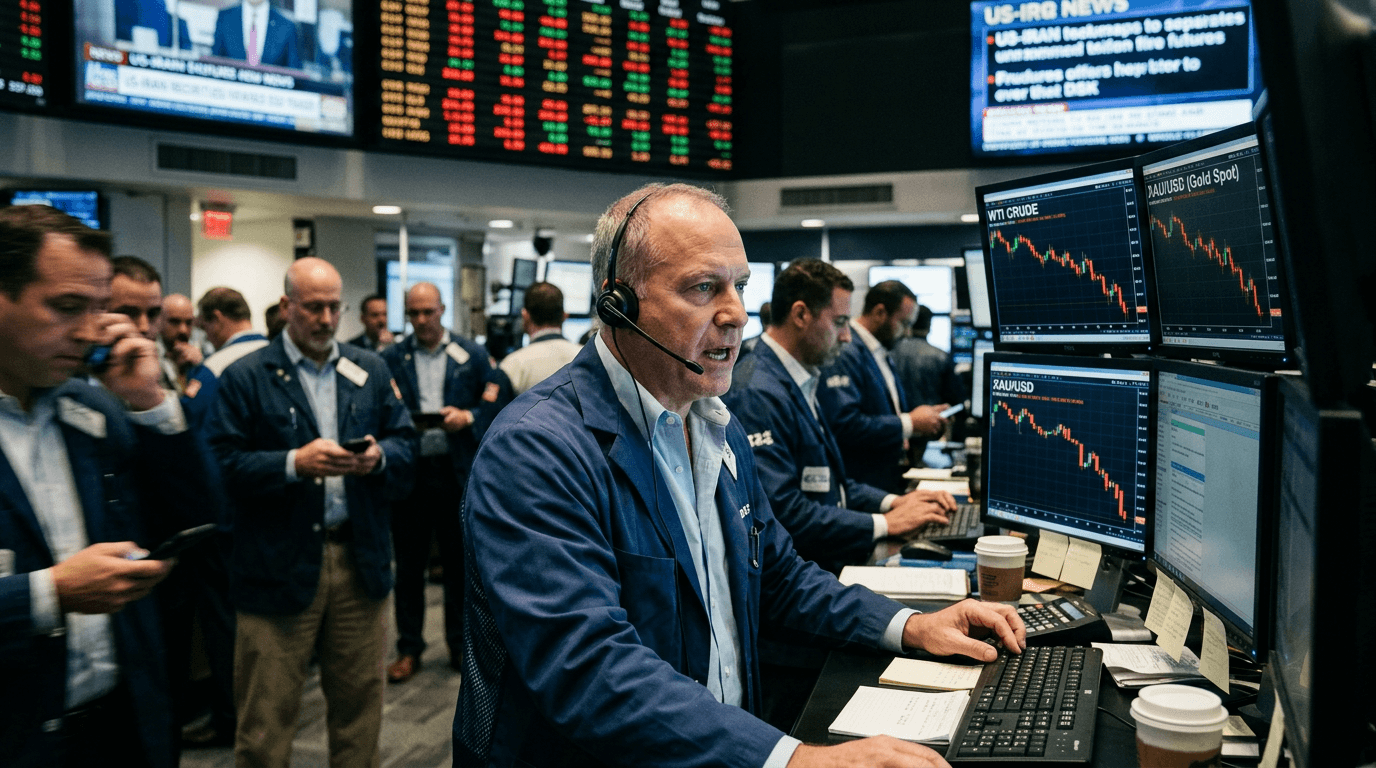
Oil and gold futures are sliding as traders rapidly unwind “war hedges” on signs that the U.S. and Iran are edging closer to a deal that could ease tensions and reopen key energy routes.[2][3] Brent and WTI crude have given back recent risk‑premium gains, while gold has softened as safe‑haven demand fades and capital rotates into risk assets like stock index futures.[2][3] For active traders, this is a textbook example of how geopolitical risk can be priced in and then abruptly priced out of global markets.
MARKET MOVE: WHAT’S HAPPENING IN OIL AND GOLD
In recent sessions, Brent crude futures dropped by roughly 5–6%, slipping back toward the high‑$90s per barrel, while U.S. WTI fell around 6% to the low‑$90s as optimism grew over progress in U.S.–Iran talks.[2] Reports suggest an agreement in principle that would see Iran reopen the Strait of Hormuz, a critical chokepoint for global oil flows, in exchange for security guarantees and potential sanctions relief.[3] As the odds of outright conflict recede, the “war premium” that had been built into crude prices is being rapidly unwound.[2][3]
Gold, which had benefited from elevated geopolitical anxiety and demand for hedging, has also eased as traders scale back defensive positions.[4] When investors no longer expect an immediate escalation, the urgency to hold gold as a crisis hedge declines, particularly if risk assets such as equities and credit are recovering.[3][4] That rotation can produce a double effect: pressure on gold and other safe havens, and support for stock index futures as capital shifts back into growth and cyclical exposures.[3]
Key takeaway: Oil and gold are not just moving on supply and demand data—they are reacting to changing probabilities of conflict and policy outcomes in real time.[2][3]
Why An Iran Deal Matters So Much For Prices
Iran is a significant oil producer with substantial spare capacity that has been constrained by sanctions and regional instability.[5] Any credible steps toward a deal that reduces sanctions or lowers the risk of supply disruption can materially shift the expected balance of global oil supply and demand.[2][3] The Strait of Hormuz, which Iran can influence, is one of the world’s most important maritime arteries for crude and refined products; keeping it open is crucial to stable energy flows.[2][3]
Markets have seen this movie before. The 2015 nuclear agreement between Iran and world powers, which limited Iran’s nuclear program in exchange for sanctions relief, paved the way for more Iranian barrels to re‑enter the market.[5] As expectations of that deal solidified, traders priced in lower medium‑term oil prices due to rising potential supply and reduced disruption risk.[5] Today’s talks are different in details but similar in market logic: perceived progress reduces the tail‑risk of conflict and the need for steep risk premiums.[2][3]
For gold, geopolitical stress is a key driver of safe‑haven bids alongside factors like real yields and currency trends.[4] When war risk rises, gold often rallies as investors seek insurance. When negotiations appear promising, that insurance looks less urgent, and the “geopolitical bid” in gold can evaporate even if macro fundamentals haven’t changed dramatically.[4]
Key takeaway: Iran headlines matter because they alter expectations about both physical oil supply and the broader geopolitical risk landscape that supports safe‑haven assets.[2][3][5]
THE MECHANICS OF UNWINDING “WAR HEDGES”
Many institutional traders and funds express geopolitical risk views through positions in futures and options rather than physical assets. Ahead of potential conflict, that can mean going long crude oil, long gold, long volatility, and defensively positioned in equities and credit indices.[2][4] These are “war hedges” or “risk hedges”—trades designed to profit if tensions escalate and to cushion portfolios if markets sell off.
When news flow shifts toward de‑escalation—such as reports of progress in U.S.–Iran peace talks or indications that key shipping lanes may reopen—those same traders rush to exit hedges.[2][3] Liquidation of long oil and gold futures can create sharp downside moves, especially when positioning is crowded, as stop‑losses and risk limits are triggered.[2][4] At the same time, short hedges in equity index futures may be covered, adding fuel to stock market rebounds.[3]
This unwinding is rarely linear. Intraday, you can see whipsaws as headlines, official comments, and leaks alter perceived probabilities. But the broader pattern is consistent: as the probability of worst‑case scenarios falls, the price of insurance (via crude, gold, and volatility) declines, while risk assets stabilize or rally.[2][3][4]
Key takeaway: Price action around geopolitical events is often driven as much by positioning and hedge unwinds as by changes in fundamental supply‑demand data.[2][4]
How Traders Can Navigate Geopolitical Risk
For active traders in both live and simulated environments, this episode highlights several practical lessons.
First, differentiate between structural and risk‑premium components of price. Structural factors include long‑term supply capacity, demand trends, and inventory levels. Risk premiums reflect temporary compensation for uncertainty, such as war risk or sanctions threats. When you see a rapid spike in oil or gold on geopolitical headlines, ask: how much of this is durable, and how much is a hedge that could unwind if talks progress?[2][3]
Second, think in scenarios rather than forecasts. One scenario: talks continue to make progress, leading to partial sanctions relief and a sustained reduction in the war premium—bearish for oil, neutral‑to‑soft for gold, and supportive of risk assets.[2][3][5] Another scenario: negotiations stall or break down, restoring the risk premium and potentially sending crude and gold sharply higher again.[2][4] Building trade plans around these scenarios—position sizing, entry levels, and clear invalidation points—can be more robust than betting on a single outcome.
Third, watch cross‑asset signals. If oil and gold are selling off while stock index futures and credit spreads are improving, that confirms a de‑risking of geopolitical fears and a rotation toward risk.[3][4] Divergences—like gold staying bid while oil fades—may signal more nuanced narratives, such as persistent inflation or monetary policy concerns.
Simulated trading environments are ideal for stress‑testing these approaches. You can practice:
- Trading the compression of risk premiums by shorting elevated volatility or selectively fading panic spikes.
- Hedging directional oil exposure with options during headline‑heavy periods.
- Testing correlation breakdowns between equities, oil, and gold under different geopolitical scenarios.
Key takeaway: Geopolitical trading requires scenario planning, cross‑asset reading, and respect for positioning, not just headline‑chasing.[2][3][4]
Positioning For What Comes Next
As the market re‑prices war risk around the Iran story, volatility and opportunity both tend to increase. For shorter‑term traders, mean‑reversion strategies may appear attractive after sharp one‑day moves, but they must be balanced against the reality that negotiations can fail and risk premiums can snap back quickly.[2][3] Longer‑term participants might focus on whether a lasting deal could unlock more Iranian supply and structurally cap oil prices, or whether lingering distrust keeps a residual risk premium embedded.[2][5]
For gold, the question is whether easing geopolitical stress will be offset by other supports, such as central bank demand, real interest rate trends, or currency moves.[4] If the “war hedge” component fades but macro uncertainty remains, gold may consolidate rather than collapse. If both geopolitical and macro risks recede, the metal could face a more extended period of range‑bound or softer pricing.[4]
Ultimately, episodes like this reinforce a central lesson: markets are constantly repricing probabilities, not certainties. Oil and gold did not move because a final deal was signed—they moved because the perceived odds of conflict versus compromise shifted in the collective mind of traders.[2][3] Understanding that probabilistic process, and how it interacts with positioning and cross‑asset flows, is essential for anyone looking to trade macro events with discipline rather than emotion.
Key takeaway: Focus on how changing probabilities, not headlines alone, drive repricing across commodities and risk assets—and use that lens to structure more resilient trading strategies.[2][3]