
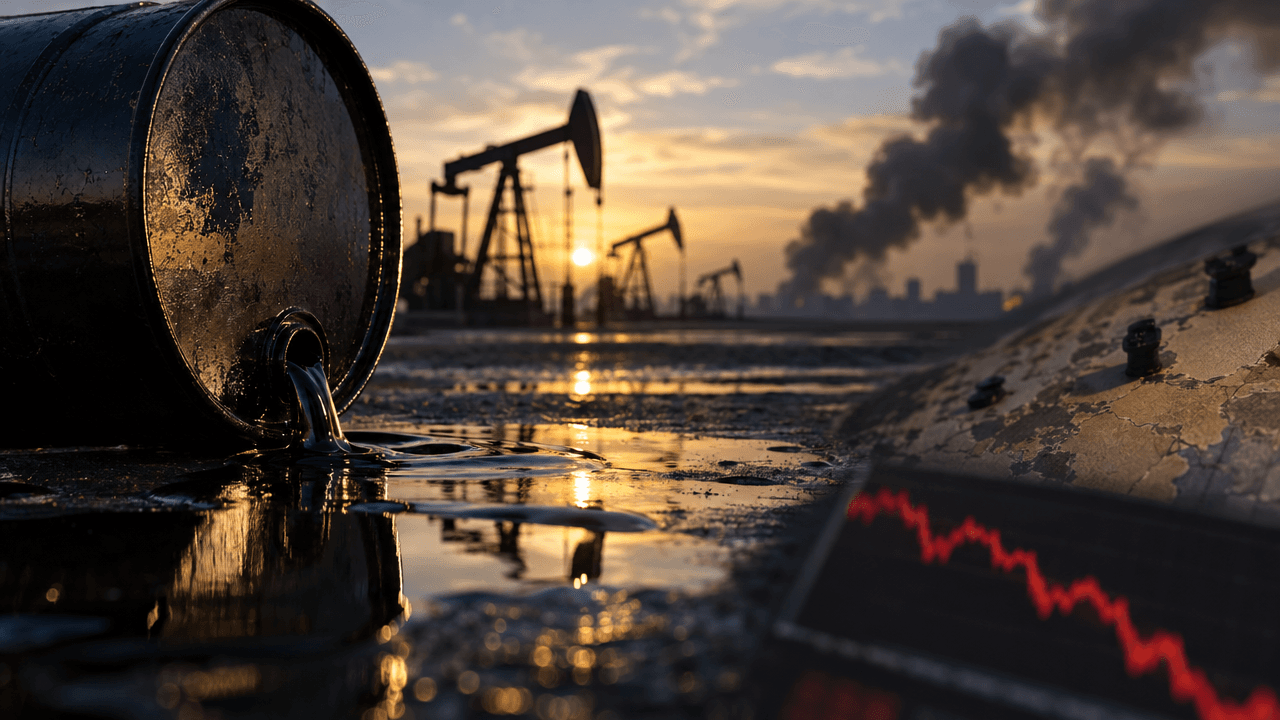
Oil’s slide back below $104 a barrel, even as Middle East tensions remain heightened, is a clear signal that traders are looking beyond headline risk and refocusing on broader demand, supply, and policy dynamics. That shift matters for anyone watching inflation expectations, equity volatility, or commodity risk, because energy prices sit at the crossroads of all three.
MARKET MOVE: OIL SLIPS BELOW $104
Global benchmark Brent crude recently traded around $103.87 per barrel, with US WTI near $101.12, marking a move below the $104 area for the third consecutive session.[1] This retracement comes after a period in which the conflict in the Middle East pushed prices back above $100 and reinforced fears of a sustained energy shock.[2][3] Earlier in the year, the Iran-centered war created what has been described as the largest supply disruption in the history of oil markets, briefly sending Brent above $120 and lifting the 2026 average price to roughly $90 versus about $70 last year.[2][8] Against that backdrop, today’s pullback below $104 looks less like a collapse and more like a moderation in a still-elevated price regime.[1][8]
For traders and investors, the key point is that the latest move is occurring within an environment of structural tightness rather than surplus. Even with prices off their recent peaks, the market is still digesting disrupted shipping routes, reconfigured trade flows, and persistent geopolitical risk. The price action is telling you that the risk premium embedded in crude is being recalibrated, not that the underlying risks have disappeared.
Why Prices Are Falling Even As Tensions Rise
At first glance, falling prices look counterintuitive when headlines still highlight missile strikes, escalations, and warnings around key energy infrastructure. But commodity markets constantly balance three forces: actual supply disruption, expectations about future disruption, and evolving demand conditions. In the current phase, slower global growth, tight monetary policy, and signs of cooling industrial activity are pulling in the opposite direction of war-driven supply fears. As a result, the net effect can be lower prices even while the news flow remains tense.
Since late February, conflict in the region has impeded energy trade through strategic chokepoints such as the Strait of Hormuz, forcing refiners to scramble for alternative cargoes and creating acute physical tightness.[4] At the same time, large consumers and producers have tapped strategic reserves and rerouted shipments in ways that mitigate the worst-case scenario of outright shortages.[4][11] Analysts note that, despite extreme pressure on energy markets, there have so far been limited confirmed outages of major producers, meaning the geopolitical risk premium is driven more by what could happen than what has already occurred.[11] When the market decides that immediate disruption risk is slightly lower than feared, that premium compresses, and futures can sink below previously defended levels like $104.
This dynamic was visible earlier in the month when new strikes on Saudi Arabian energy infrastructure and attacks on ships triggered a sharp spike: Brent jumped over 4% to around $109.29, while WTI rose above $104.[12] As traders digested the news and assessed actual damage and response capacity, prices retreated from those highs, illustrating how quickly risk premia can expand and contract in response to incremental information.[12] The latest move below $104 fits that pattern of fading panic, rather than a complete reversal of the structural story.
What This Means For Inflation And Risk Sentiment
Energy prices are a critical input into inflation expectations because they filter directly into fuel costs, freight rates, and eventually consumer prices. When Brent was briefly above $120 and the yearly average climbed from about $70 to roughly $90, that represented a meaningful shock to global price dynamics and central bank decision-making.[8] Even with crude now back closer to the low-100s, levels remain historically elevated, but the immediate pressure on headline inflation is softer than it was at earlier peaks.[1][8]
For bond markets, a gentle drift lower in oil can ease some of the strain on inflation-linked securities and rate expectations. Lower energy volatility tends to support risk sentiment in equities, especially in energy-intensive sectors such as airlines, logistics, and manufacturing. Conversely, if crude were to re-test the recent highs near $109 and beyond, the narrative would quickly shift back toward upside risks to inflation and potential policy tightening bias.[8][12] The current move below $104 is therefore best viewed as a modest positive for risk assets and a small relief valve for inflation fears, not a full reset of the energy story.
How Traders Are Positioning
In a headline-driven environment, many short-term traders initially chase momentum when conflict news breaks, piling into long crude futures or call options as prices spike. As the market matures into the “marathon” phase of a protracted conflict, positioning tends to become more nuanced, with greater use of options spreads, relative-value trades between Brent and WTI, and hedges across energy equities and currencies tied to oil exports.[8][9] The pullback below $104 suggests that some speculative long positions have been pared, while more sophisticated participants focus on carry, term structure, and correlations rather than pure directional bets.
For SimFi traders on platforms like E8 Markets, this is precisely the kind of environment where simulated strategies can be tested without real capital at risk. Practicing how to trade around key psychological levels like $100, $104, or $110 helps build discipline in managing entries and exits. Simulated accounts also allow experimentation with multi-asset approaches—linking crude moves to inflation hedges, index futures, or FX pairs exposed to oil—so traders can understand how energy shocks ripple across the broader market.
Practical Takeaways For Simulated And Real-world Traders
First, avoid trading headlines in isolation. A missile strike or diplomatic flare-up matters, but what ultimately drives price is whether supply, demand, and inventories move in ways that justify a sustained trend. The fact that crude can fall below $104 while tensions remain high shows that positioning and macro data are just as important as the news ticker.
Second, respect key levels. The round-number zone around $100 has psychological importance, and the recent behavior around $104–$109 offers a real-time case study in support, resistance, and failed breakouts.[1][12] Watching how price reacts when it approaches prior highs or lows can provide more insight than the latest headline alone.
Third, connect oil to broader macro themes. If crude stays contained near the low-100s rather than surging toward prior peaks, that tilts the balance slightly toward a more stable inflation path and less stress in risk assets. Traders can incorporate this into scenarios for bond yields, equity volatility, and sector rotation, even if they do not trade oil directly.
Finally, use the current episode to refine risk management. Practicing with simulated positions—setting stop-losses, sizing trades modestly, and stress-testing portfolios against renewed spikes toward $110 or $120—builds habits that translate directly to real-money trading. The lesson from recent months is clear: sudden price shocks are possible, but so are rapid reversals once the market reassesses risk.
Conclusion
Oil’s drop below $104 in the face of ongoing Middle East tensions is a reminder that markets are forward-looking, probability-weighted machines, not simple reflections of the day’s most dramatic headline.[1][2] As traders weigh persistent conflict risk against evolving demand, policy, and supply responses, the geopolitically driven risk premium in crude is being repriced rather than erased.[4][8][11] For both real and simulated traders, this is an opportunity to study how narrative, data, and positioning interact—and to prepare for the next phase, whether that is renewed upside driven by fresh disruption or a continued glide toward more stable energy prices. In a world where oil still anchors inflation expectations and risk sentiment, understanding this repricing is as important as tracking where the next headline comes from.