
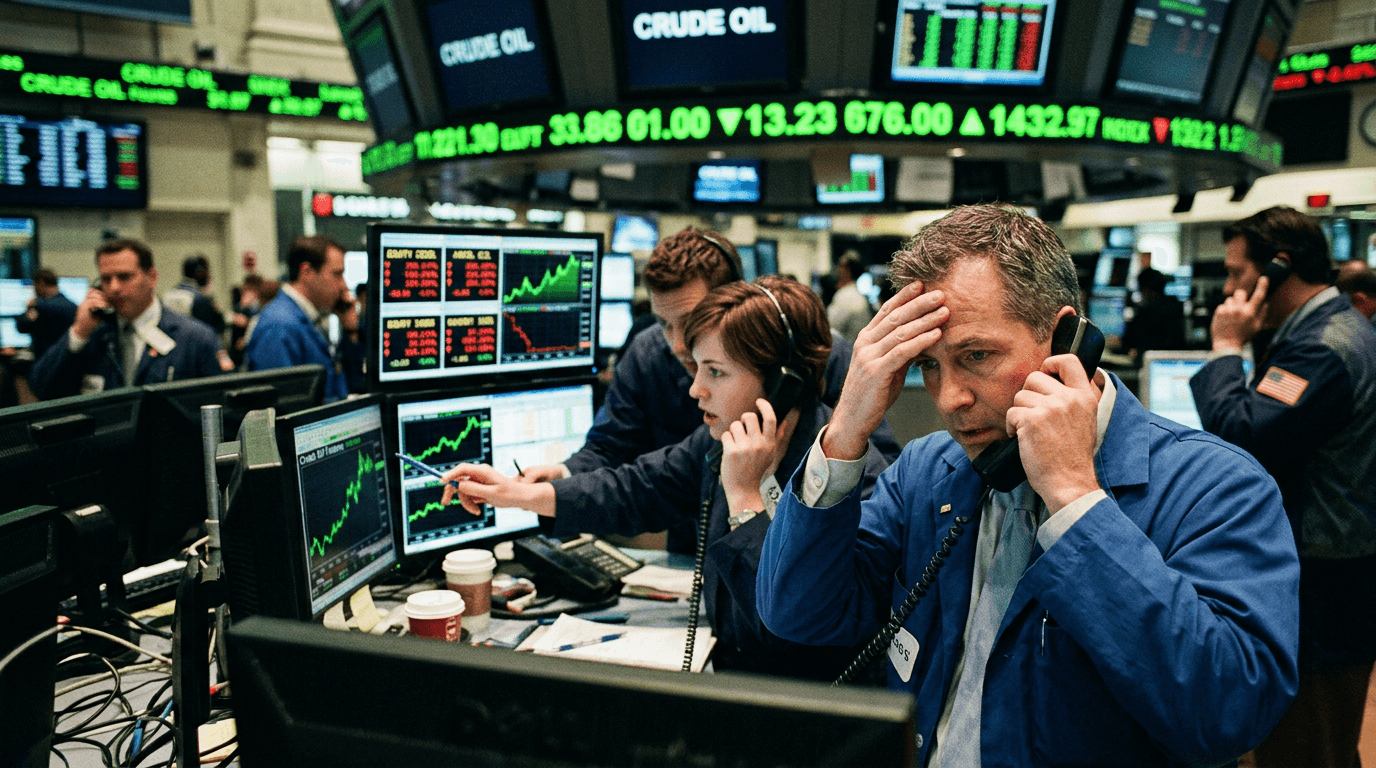
Crude oil futures ripped higher after fresh headlines of escalating conflict involving Iran, reigniting concerns about Middle East supply disruption, stoking inflation hedges, and putting renewed pressure on global equity markets. Energy-linked currencies strengthened, volatility picked up across futures curves, and traders were forced to reassess both their risk exposure and their assumptions about the path of interest rates.
Market Reaction: Oil Spikes As Risk Premia Return
Oil benchmarks have been grinding higher in recent sessions, supported by worries that intensifying conflict in the Middle East could disrupt supply and transit routes.[1] Brent futures recently closed nearly 5% higher in a single session after already gaining around 7% earlier in the week, reaching their highest levels since mid‑2024.[1] West Texas Intermediate (WTI) has followed a similar path, briefly pushing to its strongest levels since mid‑2024 as traders scrambled to reprice geopolitical risk.
The price action has been choppy but decisively skewed to the upside, with intraday swings reflecting a tug-of-war between fears of supply outages and periodic reassurances, such as discussions about emergency reserve releases.[1][2] The International Energy Agency has floated the idea of a historically large coordinated release of emergency oil reserves in the range of hundreds of millions of barrels, yet crude prices have remained elevated as military strikes in the region continue.[2]
Equity markets have not welcomed the move. In one recent session, oil prices were up about $5 per barrel for both Brent and WTI at the high end of their recent trading range, while major equity indices across Europe were down around 1% and U.S. stock futures also traded lower.[2] Government bond yields ticked slightly higher as traders priced in the risk that a sustained oil rally could keep inflation sticky for longer.[2]
For active traders, this is a classic “risk-off in equities, risk-on in commodities” pattern: capital rotates toward perceived inflation hedges and away from growth-sensitive assets, at least in the short term.
Why Middle East Tensions Feed Oil And Inflation Fears
The Middle East remains a critical hub for global oil production and, just as importantly, for shipping routes and chokepoints that move crude and refined products worldwide.[1][3] When conflict involving a major regional power like Iran escalates, markets do not wait for actual supply outages; they quickly build in a geopolitical risk premium.
Even the possibility of disruptions to exports, pipelines, or key shipping passages is enough to lift futures curves as refiners, airlines, and other large consumers rush to secure supply. That demand for price insurance shows up as higher prompt-month prices and wider spreads between near- and longer-dated contracts.
The macro link is straightforward but powerful: higher oil prices push up energy costs, which filter into transportation, manufacturing, and ultimately the prices consumers pay for goods and services.[3] As crude surges, investors begin to question how quickly inflation will fall back toward central bank targets and whether planned interest-rate cuts will be delayed or scaled back.[3]
Policymakers are watching closely. A European Central Bank Governing Council member has already warned that an Iran-related conflict and its impact on inflation could force interest rates higher sooner than previously expected.[2] That kind of commentary signals to markets that the inflation impulse from oil is being taken seriously at the policy level, amplifying the impact on bond yields and rate-sensitive assets.
Pressure On Equities And Risk Assets
For equities, a sharp oil spike is a double hit: it raises costs while threatening demand. Higher fuel and input costs squeeze profit margins for energy-intensive industries such as airlines, logistics, chemicals, and some manufacturers. At the same time, households facing higher gasoline and heating bills may cut back on discretionary spending, challenging retailers and consumer-focused firms.
As a result, equity indices often trade lower when oil jumps sharply on geopolitical headlines, especially if the move is seen as negative for global growth.[2][3] Investors also reassess valuations through the interest-rate channel: if higher energy prices keep inflation elevated, central banks may maintain restrictive policy for longer, increasing discount rates applied to future earnings.[3] Higher discount rates typically weigh more on growth and tech stocks, where valuations rely heavily on long-term cash flows.
The impact is not uniform, though. Energy producers, oilfield service companies, and some commodity-linked businesses can benefit from the price surge. This often creates an internal rotation within equities: investors trim broad index exposure but add to select energy names or commodity-related plays. Energy-heavy indices and markets with large export-oriented resource sectors may outperform.
Oil As An Inflation Hedge: How Markets Are Positioning
When crude rallies on geopolitical risk, oil itself becomes a focal point for inflation hedging. Traders and asset allocators look to:
- Oil futures and options to gain direct exposure to the commodity.
- Energy equities as leveraged plays on higher crude prices.
- Energy-linked currencies (sometimes called “petro-currencies”) whose terms of trade improve when oil rises.[1]
In the latest move, energy-linked currencies saw support alongside the spike in crude, reflecting expectations of stronger export revenues and improved current accounts for oil-producing countries.[1] That currency reaction reinforces the idea that the oil move is being perceived as more than a short-lived headline spike.
At the portfolio level, investors may also rebalance toward broader commodity indices or inflation-protected securities, aiming to offset the erosion of real returns if inflation proves more persistent. While these instruments do not track oil one-for-one, they can help build resilience against energy-driven price shocks.
For traders, the key is understanding that in periods of geopolitical stress, correlations can shift rapidly. Assets that usually move independently can suddenly trade in lockstep as the oil narrative dominates cross-asset flows.
Practical Takeaways For Active And Simulated Traders
Episodes like this are valuable case studies, whether you are deploying real capital or trading in a simulated environment:
1. Watch the linkage, not just the headline Do not focus only on the crude price print. Track how bond yields, equity futures, and FX pairs respond. When oil spikes on conflict risk, rising yields and weaker equity futures can signal that the market is treating the move as an inflation story, not just a short-term supply scare.[2][3]
2. Separate short-term spikes from structural shifts Geopolitical headlines can cause sharp intraday moves, but the lasting impact depends on whether production or transportation is truly impaired. News of potential reserve releases or diplomatic progress can quickly compress risk premia.[1][2] Scenario-testing in a simulated account can help you understand how your strategy behaves under both outcomes.
3. Reassess sector and factor exposure Higher-for-longer energy prices tend to favor value, commodities, and resource-heavy markets while challenging rate-sensitive growth stocks. Review your exposure to energy-intensive sectors versus beneficiaries of higher crude.
4. Stress-test for inflation and rates Use oil shocks as a trigger to re-run your assumptions about inflation and rate paths. Even if central banks do not immediately change policy, markets may price in a slower easing trajectory, affecting everything from duration trades in bonds to equity multiples.[3]
For SimFi traders, these environments are ideal for practicing disciplined risk management: setting clear stop levels, scaling into and out of positions as volatility changes, and documenting how your thesis evolves with each new headline. Because price action can be fast and emotional, having a structured plan is often the difference between learning from volatility and being overwhelmed by it.