
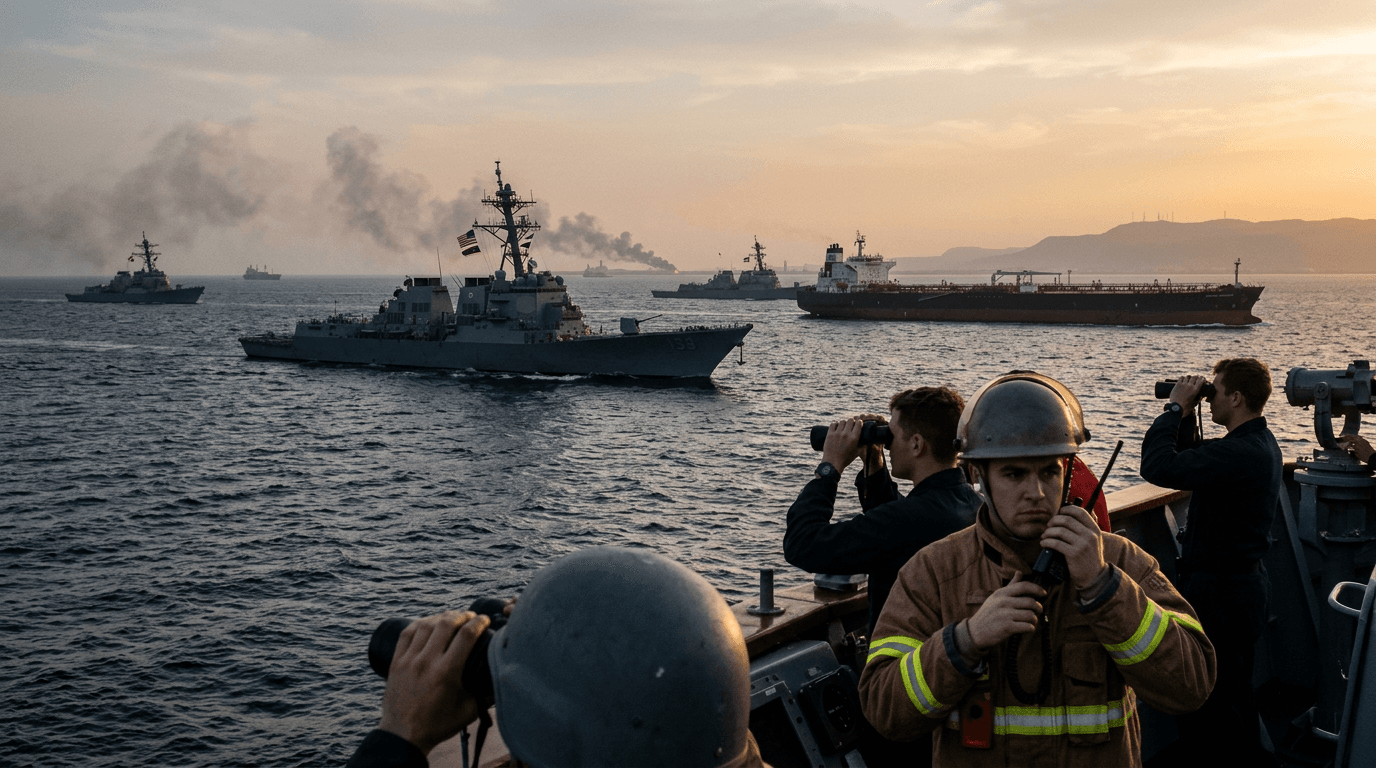
Oil markets were jolted higher as fresh strikes in the Strait of Hormuz pushed U.S. crude futures above $90 and sent Brent prices sharply higher, reigniting concerns about global energy supply and inflation across macro markets[7][9][10]. For traders and portfolio managers, this is not just another headline—it is a real-time stress test of how futures markets respond when a critical chokepoint for global oil flows is threatened[2][7].
Market Shock In A Key Oil Artery
The latest strikes in and around the Strait of Hormuz arrive on top of months of intermittent attacks, blockades and ship disruptions tied to the broader U.S.-Iran and regional conflict[1][6][10]. Each flare-up has tended to produce sharp, event-driven rallies in crude benchmarks, with Brent and West Texas Intermediate (WTI) repeatedly spiking several percent in a single session as traders repriced supply risk[1][4][6].
Recent episodes show how sensitive prices are to this corridor. At various points this year, U.S. crude has traded above $90 and even crossed the $100 threshold, while Brent has jumped toward or above the $100 mark as shipping through Hormuz stalled or was threatened[7][9][10]. These moves are not purely speculative; they reflect the market’s attempt to price the probability that barrels from the Gulf cannot reach end users on time.
The latest surge is particularly important because it comes after a period of cautious optimism that flows through Hormuz might normalize, with some vessels cautiously attempting transits and markets briefly retracing toward pre-war levels[14][15]. Renewed strikes have snapped that optimism, flipping sentiment back toward supply anxiety and risk-on positioning in energy futures[8][10][15].
Why The Strait Of Hormuz Matters
The Strait of Hormuz is a narrow waterway off Iran’s coast through which roughly a fifth of the world’s oil and gas supplies typically pass from the Persian Gulf to global buyers[2][7][10]. That concentration makes it one of the most systemically important energy routes on the planet. When tankers cannot move through Hormuz safely, the impact cascades across physical supply chains, futures markets and ultimately consumer prices[2][7][9].
In earlier phases of the conflict, near-closure of Hormuz and attacks on tankers in the region contributed to some of the steepest monthly oil price increases on record, with Brent gaining more than 50% in a single month at one point and U.S. crude settling above $100 for the first time since the early 2020s[7][9]. Even short-lived interruptions—like isolated strikes that delay or reroute a handful of vessels—can trigger multi-dollar intraday spikes as traders hedge against a worst-case scenario[1][4][5].
For energy-importing economies, this chokepoint risk translates into vulnerability. Every incremental dollar on crude eventually filters into transportation, manufacturing, and household energy costs, making Hormuz not just a regional security issue but a global macro driver[7][9][10].
Pressure On Energy Futures And Inflation
The immediate reaction to the latest strikes has been a broad-based rally in energy futures, with front-month WTI lifting above $90 and Brent jumping in tandem as traders price in renewed supply disruption and geopolitical risk premia[9][10][11]. Options markets tend to show rising implied volatility in these episodes, as participants pay up for upside calls and downside puts to manage tail risk around the conflict path.
Higher crude prices feed directly into refined product futures—gasoline, diesel and jet fuel—widening crack spreads and raising hedging costs for airlines, shipping firms and industrial users[7][9]. As these costs move higher, they can contribute to renewed inflation pressure at a time when many central banks are still wary of second-round effects from prior energy shocks[7][11].
Inflation-sensitive assets, from government bonds to equity sectors like discretionary consumption, can react quickly. Rising oil tends to pressure long-duration bonds and rate-sensitive equities, while benefiting energy producers, some commodity currencies, and volatility-linked strategies[7][9][11]. For macro traders, the Hormuz headlines are therefore not just a crude story; they are a catalyst for repricing across rates, FX and equity indices.
What This Means For Traders And Simulated Finance
For traders using live markets or simulated finance platforms such as E8 Markets, the latest surge offers a textbook example of geopolitical risk translating into futures price behavior[7][9][10]. Several practical lessons emerge:
1. Event risk can overwhelm technical setups. A well-formed trend or range can instantly break when a major supply shock hits the tape, underscoring the need to incorporate news and macro context into any technical strategy[1][4][7].
2. Liquidity conditions can change rapidly. In high-volatility periods, bid-ask spreads in energy futures and options can widen, slippage can increase, and margin requirements may rise as exchanges respond to risk[7][9]. Practicing execution in a SimFi environment can help traders understand how orders behave when markets gap or reprice quickly.
3. Correlation structures shift. When oil spikes on geopolitical news, correlations between crude and assets like inflation-linked bonds, commodity currencies, and energy equities often strengthen, while some diversifiers become less effective[7][9][11]. Simulated multi-asset portfolios allow traders to explore how a Hormuz-type shock impacts cross-asset P&L.
4. Risk management must be dynamic. Static stop levels or position sizes may not be sufficient in environments where headline-driven moves can be 5–10% in a matter of days[7][9]. Scenario analysis—asking “What if crude gaps $5 or $10 overnight?”—and testing responses in a simulated framework can prepare traders for similar real-world events.
Key Takeaways For Your Trading Playbook
The current Hormuz-driven rally reinforces several enduring principles that traders can integrate into their playbooks:
– Monitor geopolitics as a core input for energy trading. Strikes, blockades, and diplomatic shifts in the Gulf region can be as important as inventory data or OPEC decisions for price direction[1][6][10].
– Respect the power of chokepoints. Routes like Hormuz, the Suez Canal and key pipeline corridors concentrate risk; disruptions often lead to outsized price reactions relative to the number of barrels immediately affected[2][7][9].
– Anticipate inflation spillovers. Sustained crude prices above $90–$100 are not just an energy story; they can influence central bank expectations, yield curves, and sector rotations in equities[7][9][11].
– Use simulation to stress-test strategies. Practicing in a SimFi environment enables traders to rehearse responses to gap risk, volatility spikes and changing correlations without capital at risk, building discipline for live markets.
Conclusion
Oil’s surge on the back of fresh Strait of Hormuz strikes is a reminder that geopolitics and logistics remain central to energy pricing, even in an era of algorithmic trading and data-driven models[1][7][10]. When a corridor carrying around one-fifth of global oil and gas flows is threatened, the impact ripples far beyond crude charts, touching macro inflation, cross-asset correlations and risk appetite[2][7][9].
For traders, the challenge is not to predict every headline but to design strategies, risk frameworks and practice regimes that can withstand sudden, news-driven repricing. Simulated finance platforms offer a valuable laboratory for testing how futures, options and multi-asset portfolios behave under stress, turning headline volatility into a learning opportunity rather than a purely destabilizing force. In the months ahead, the evolution of the Hormuz situation—and the market’s reaction—will remain a crucial case study in how geopolitics and market microstructure intersect in real time[7][9][10].