
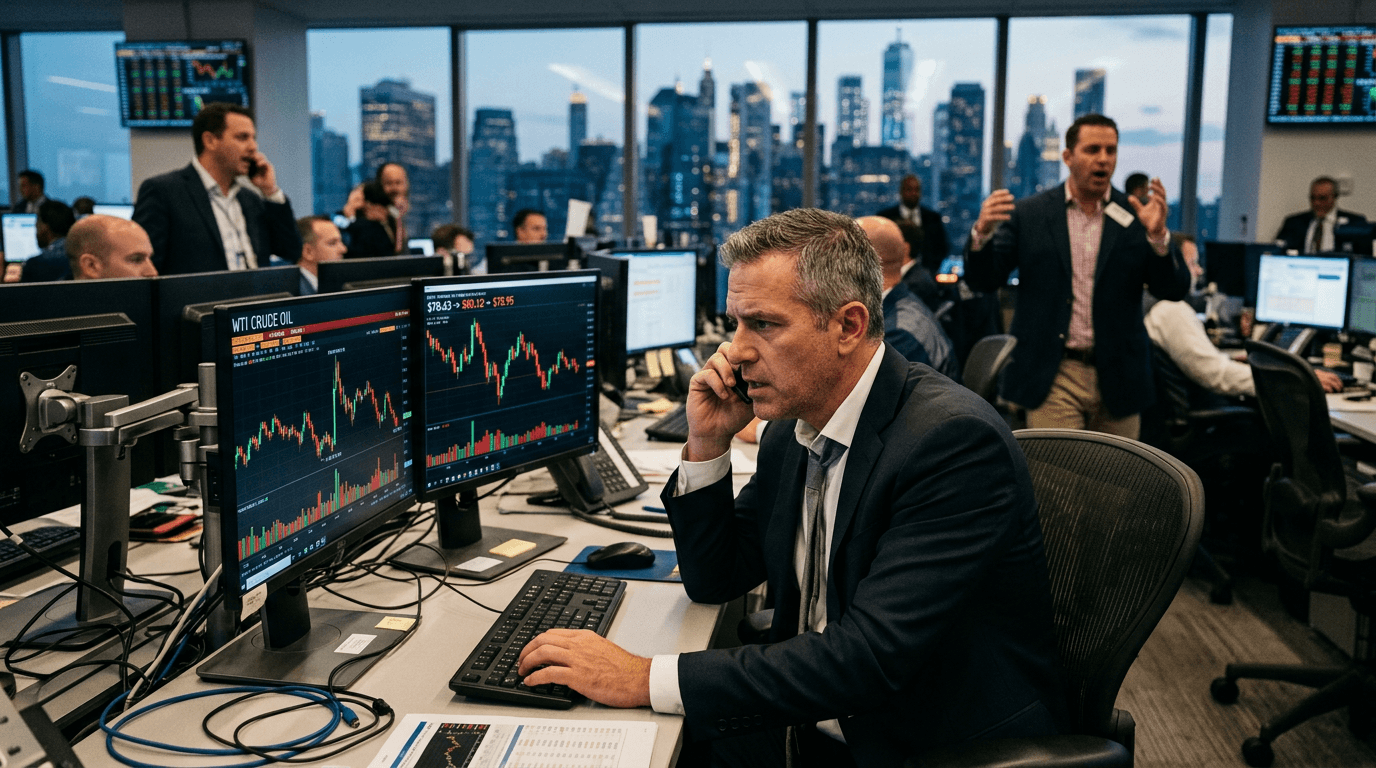
Oil futures are once again at the center of global market volatility as traders juggle conflicting signals: talk of an Iran cease-fire that eases war risk, and persistent concerns that Middle East supply routes could be disrupted again at short notice.[1][5][11] In recent sessions, crude prices have swung from sharp spikes on tension headlines to intraday drops of around 2% as cease-fire hopes briefly reduced the risk premium embedded in futures.[1][10] For traders, these moves are more than noise—they are reshaping expectations for inflation, interest rates, and the path of global risk assets.[6][9][15]
The Latest Swings In Oil Futures
The current episode began with a sustained conflict involving Iran and regional rivals, which at one point curtailed commercial shipping through the Strait of Hormuz, a chokepoint that normally carries about one-fifth of global oil supply.[5][11] Brent and WTI futures surged more than 40% month-on-month during the worst of the disruption, briefly trading above levels last seen in 2022 as traders priced in a potential supply shock.[5][3] As cease-fire discussions gained traction and partial reopening of shipping lanes was announced, the market rapidly faded part of that geopolitical premium, sending Brent and WTI down several percent in a single week.[1][10]
These swings highlight how quickly the narrative can flip from shortage fears to relief rallies and back again as headlines evolve.[11][15] Even as an initial cease-fire deal was announced, violations and retaliatory strikes kept traders on edge, leading to intraday reversals when new reports questioned the durability of the agreement.[4][14] The result is a market where oil futures can move 3–7% in a single session purely on geopolitical updates, before fundamental supply-demand data even enters the picture.[3][13]
Geopolitics, Supply Routes, And Price Volatility
The Strait of Hormuz remains the focal point of supply risk because any prolonged closure or attack on nearby infrastructure can immediately remove several million barrels per day from global flows.[5][11] Analysts have warned that in worst-case scenarios, Middle East output could drop to around 6 million barrels per day, implying one of the largest regional supply shocks in years.[5] Even the threat of such an outcome leads to higher insurance costs, rerouted shipping, and steeper futures curves as traders hedge against potential disruptions.[3][11]
At the same time, the cease-fire narrative introduces a second layer of uncertainty: the risk that markets overprice peace and underprice the chance of renewed conflict.[2][11] Statements from both sides signaling willingness to de-escalate have often been followed by new confrontations or missile launches, keeping risk sentiment fragile.[2][14] For oil traders, the challenge is distinguishing between temporary headline relief—such as a short extension of a cease-fire—and genuine structural changes that reduce supply risk over the medium term.[11][15]
Why Energy Futures Still Drive Global Risk Assets
Oil is not just a commodity; it is a macro variable that feeds directly into inflation, growth, and monetary policy expectations.[6][9][15] The recent surge in crude prices raised concerns that global inflation could re-accelerate just as many central banks were preparing to ease policy, forcing investors to reprice the timing and depth of rate cuts.[6][9] Higher energy costs filter through to transportation, manufacturing, and consumer prices, eroding real incomes and potentially dampening consumption.[9][12]
When oil futures spike, bond markets often react by pushing Treasury yields higher, reflecting fears of more persistent inflation and a more hawkish policy stance.[6][9][15] Conversely, sharp drops in crude—such as those seen when markets believed a durable Iran cease-fire was imminent—can lower inflation expectations, support rate-cut narratives, and trigger rallies in equities and credit.[1][10] This transmission mechanism explains why energy futures remain a key driver of global risk assets, even for investors who never trade commodities directly.[6][9][15]
Implications For Traders And Simulated Finance Strategies
For active traders and investors using simulated finance platforms, the current environment offers a rich laboratory for testing oil-linked strategies without real capital at risk. Volatile geopolitical conditions provide frequent stress tests for positions that are sensitive to macro shocks, including trend-following strategies in crude futures, relative value trades between Brent and WTI, and cross-asset plays that link oil moves with equity sectors such as energy, airlines, and industrials.[3][5][11]
Simulated trading also allows participants to experiment with risk management techniques tailored to geopolitical volatility, such as dynamically adjusting position sizes when intraday ranges expand or using options to cap downside during event risk windows.[3][12] Because oil shocks can spill over into broader markets, it is valuable to model scenarios where abrupt price spikes impact inflation expectations, bond yields, and currency pairs tied to energy-exporting economies.[6][9][15] Practicing these responses in a simulated environment helps traders refine their playbooks before deploying similar strategies in live markets.
Practical Takeaways For Oil Futures Participants
First, treat geopolitical headlines as catalysts, not standalone investment theses. A cease-fire announcement or missile launch should prompt scenario analysis: how likely is the event to alter actual physical supply over the next three to six months?[5][11][15] Linking news flow to concrete supply metrics—like export volumes, shipping traffic, and inventory changes—helps avoid overreacting to short-lived sentiment shocks.[2][8][11]
Second, monitor the futures curve, not just the front-month price. Steepening curves, with higher prices in near-term contracts, often signal that traders are embedding a strong risk premium for immediate supply disruptions.[3][11] A rapid flattening or inversion during cease-fire progress can indicate that the market is shifting back toward fundamentals such as demand growth and OPEC policy rather than pure geopolitical fear.[4][6]
Third, integrate cross-asset signals into your oil view. Rising crude alongside widening credit spreads and falling equity indexes suggests the market is worried about stagflation-style outcomes where inflation rises while growth slows.[6][9][12] By contrast, a decline in oil accompanied by lower bond yields and higher stock futures may reflect optimism that energy costs will ease and central banks can proceed with rate cuts.[1][10][15]
Looking Ahead
Oil futures are likely to remain sensitive to Iran cease-fire developments and broader Middle East tensions for months, as markets weigh the durability of diplomatic efforts against the persistent fragility of regional security.[1][2][11] Even if shipping through Hormuz normalizes, traders will continue to price some probability of renewed disruption, keeping a geopolitical premium embedded in crude benchmarks.[5][13] For both real and simulated traders, the key edge lies not in predicting every headline, but in building robust frameworks that connect oil price moves to inflation, rates, and cross-asset behavior—and in rehearsing those frameworks before the next shock hits.[6][9][15]