
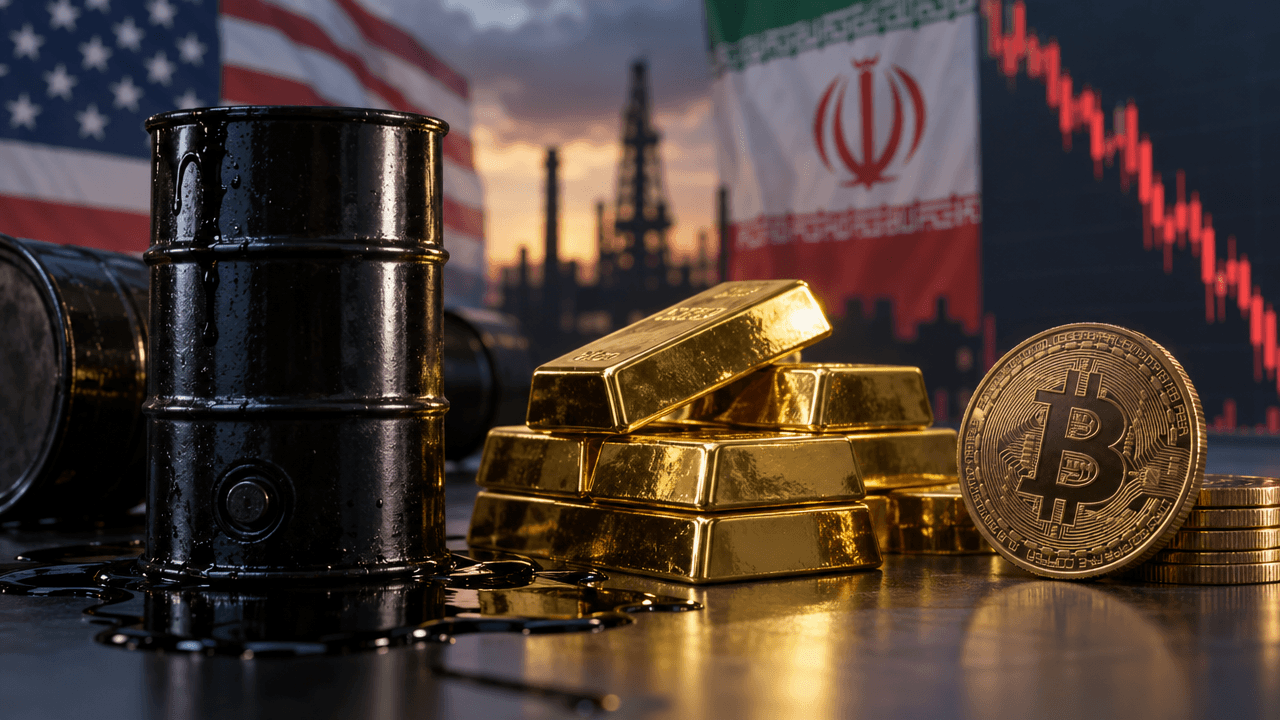
Markets rarely move on headlines alone. They move on changing expectations about what comes next. That dynamic was on clear display as shifting expectations for U.S.–Iran de-escalation sent crude oil sharply lower, gold higher and crypto markets back below $77,000. The contrasting reactions show how the same geopolitical development can affect different assets through entirely different channels.
The immediate market response followed reports and comments suggesting that diplomacy could reduce the likelihood of further military escalation. WTI crude fell more than 7% toward $96.50 per barrel, while Brent crude dropped roughly 9% toward $103.30. At the same time, gold recovered above $3,950 per ounce after recently touching a 13-month low near $3,891. Bitcoin declined approximately 1.7%, slipping below $77,000 despite the drop in energy prices. [1]
Why Oil Fell As De-escalation Expectations Rose
Oil prices include a geopolitical risk premium whenever traders fear disruptions to production, exports or shipping routes. Concerns involving Iran can affect expectations for supply across the Middle East, particularly around the Strait of Hormuz, a critical route for global energy shipments.
When investors began assigning greater probability to negotiations or a non-military resolution, some of that premium was removed quickly. Traders who had bought crude as protection against supply disruption moved to lock in gains, while others reduced bullish positions. The result was an aggressive decline rather than a gradual adjustment.
This reaction does not necessarily mean the physical oil market suddenly became oversupplied. Instead, it reflects a change in expected future conditions. If tensions ease, the market may anticipate fewer disruptions, reduced emergency buying and a lower probability of restrictions on regional exports.
For traders, the key lesson is that geopolitical oil rallies can reverse rapidly. A market that rises because of fear may fall just as quickly when the perceived threat diminishes.
GOLD’S DIFFERENT SAFE-HAVEN ROLE
Gold’s rebound appears contradictory at first. If de-escalation reduces geopolitical risk, why would a traditional safe-haven asset rise?
The answer is that gold responds to several forces at once. Lower oil prices can reduce inflation pressure, particularly if energy costs remain subdued. That can weaken expectations for aggressive interest-rate increases and support demand for non-yielding assets such as gold.
Gold also rebounded after a sharp sell-off. Following its decline to a one-year low, bargain hunters may have viewed lower prices as an opportunity to rebuild positions. In addition, uncertainty had not disappeared entirely. A potential diplomatic breakthrough is not the same as a finalized agreement, and markets remain vulnerable to renewed military threats or failed negotiations.
The recent move therefore illustrates an important principle: gold does not respond mechanically to “risk-on” or “risk-off” labels. Interest rates, inflation expectations, the U.S. dollar, positioning and confidence in diplomatic progress all influence its price.
Why Crypto Did Not Follow Oil Lower
Bitcoin’s decline alongside falling crude oil highlights its continued sensitivity to broader market liquidity and risk appetite. Although some investors view Bitcoin as a hedge against currency debasement or political uncertainty, it often trades like a higher-volatility risk asset during periods of macroeconomic stress.
Investors reassessing the U.S.–Iran situation were also weighing other pressures, including equity-market volatility, interest-rate expectations and recent crypto-specific selling. Bitcoin’s failure to benefit from lower oil prices suggests that traders were not treating the move as a straightforward improvement in financial conditions.
Technical levels added to the pressure. Market analysts identified the $76,000 to $76,600 area as an important support zone, while resistance was seen around $79,500 to $80,500. A break below support could encourage additional selling, whereas a sustained move above resistance would suggest that buyers had regained control. [2]
What Traders Should Watch Next
The most important variable is whether diplomatic expectations develop into verifiable progress. Markets can react strongly to a single statement, but lasting repricing generally requires concrete evidence such as formal negotiations, agreed conditions or a measurable reduction in military risk.
In oil, traders should monitor the durability of the decline, regional shipping conditions and signs of supply disruption. A temporary retreat in prices could reverse if talks fail or military tensions intensify.
In gold, attention should remain on real yields, the U.S. dollar and inflation expectations. A continued oil decline could support gold if it reduces pressure on interest rates, but a stronger dollar or renewed liquidation could limit the rebound.
In crypto, traders should avoid assuming that lower energy prices automatically create bullish conditions. Bitcoin may need to reclaim major resistance levels and attract broader risk capital before a durable recovery becomes more likely. Position sizing, predefined exits and scenario planning are particularly important when headline risk is high.
The Broader Market Lesson
The sharp divergence between oil, gold and crypto is a reminder that markets are not driven by one universal interpretation of geopolitical news. Oil focused on the possibility of improved supply conditions. Gold responded to lower inflation pressure, bargain hunting and unresolved uncertainty. Crypto reflected fragile risk appetite and technical selling.
For SimFi traders, the practical takeaway is to build a cross-asset framework rather than trading a headline in isolation. Ask what the news changes about supply, inflation, interest rates, liquidity and investor positioning. Then consider whether the initial price reaction is likely to persist or fade.
Geopolitical markets can change direction before the underlying story becomes clear. Traders who manage risk, wait for confirmation and understand each asset’s transmission mechanism are better positioned to navigate the volatility. The latest moves in oil, gold and crypto show that the headline may be shared, but the market reaction is never identical.