
1. Output ONLY article content in PLAIN TEXT format 2. NO preamble or intro like "Here is the article" 3. Use ALL CAPS for section headings on their own line 4. Separate paragraphs with blank lines 5. 3-5 main sections with clear takeaways 6. Engaging and educational tone 7. At the END (after all content), provide: - TITLE - EXCERPT - NEWSIMPACTSCORE
The search results provide good information about: - Oil prices at $81.64 (9% increase) - Brent crude at $85.85 - US-Iran military escalation - Strait of Hormuz closure affecting 20% of global supply - 10-11 million barrels removed daily - Impact on stocks (Dow -2.25%, S&P 500 -1%, Nasdaq -1%) - Gasoline prices to $3.25/gallon - Policy responses from IEA and US - Broader economic implications
I need to write about 800 words, structure it into 3-5 sections, be engaging and educational, and use plain text (no markdown).
Let me structure it: 1. Opening paragraph - establish the story 2. What's Driving the Surge - explain the geopolitical situation 3. Market Impact - discuss the financial consequences 4. The Transmission to Consumers - how this affects everyday people 5. Looking Ahead - what traders and investors should watch 6. Conclusion/Key Takeaways
I'll cite the search results appropriately throughout.
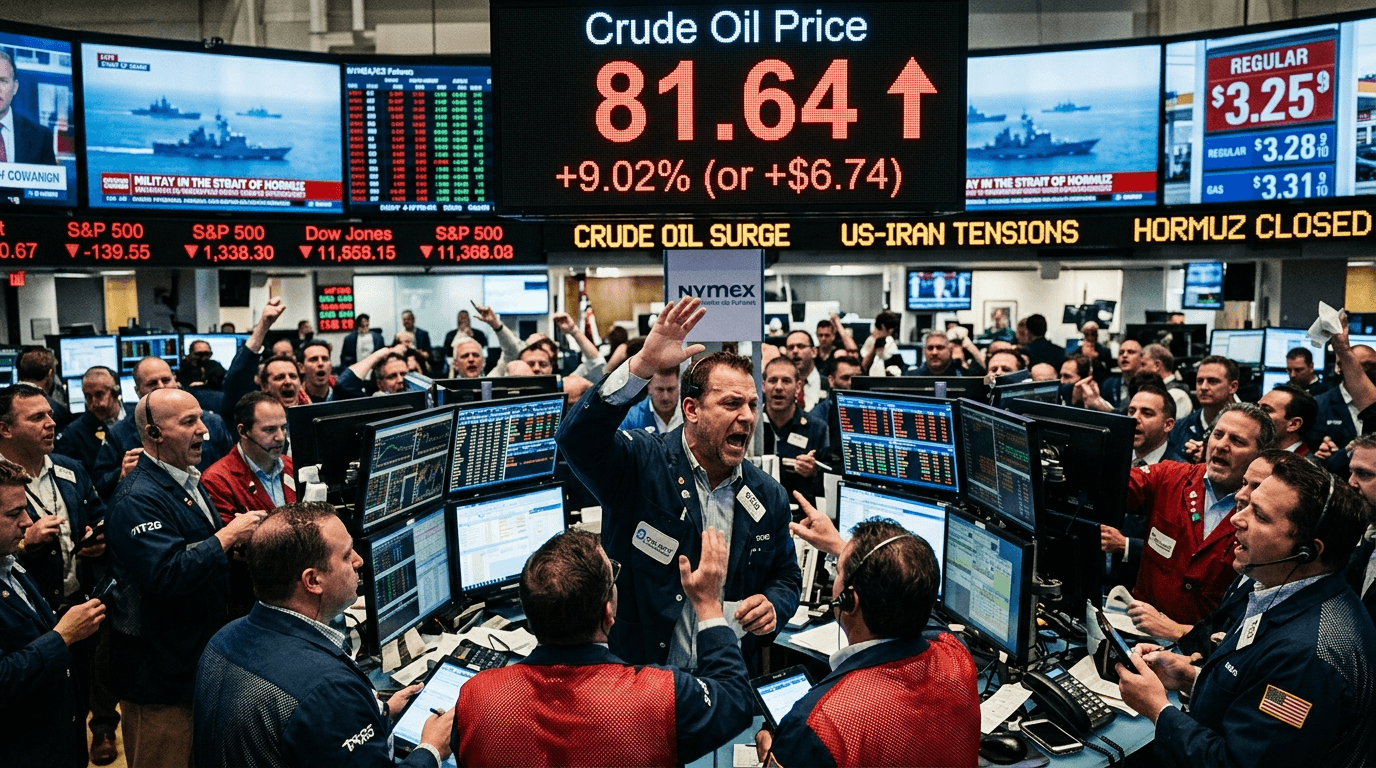
Oil prices have surged nearly 9% to reach $81.64 per barrel, marking their highest levels since summer 2024, as military tensions between the United States and Iran create a genuine energy crisis that extends far beyond commodity markets.[1] This is not speculation or temporary market jitters—this is a real supply shock with tangible infrastructure damage, port shutdowns, and closed shipping lanes that are reshaping market sentiment from cautious to urgent across the global financial system.[2] For traders, investors, and anyone monitoring the broader economic landscape, understanding the mechanics of this oil shock and its ripple effects through financial markets is critical for effective portfolio management and risk assessment.
The Geopolitical Trigger: Middle East Escalation Disrupts Global Supply
The surge in crude prices originates from an unprecedented disruption centered in the Middle East conflict zone. U.S. airstrikes on Iran, now entering their second week, have created persistent military uncertainty that extends beyond battlefield tactics into economic warfare over energy resources.[2] Iranian forces have responded by targeting critical oil infrastructure and vessels in vital shipping lanes, demonstrating that this conflict has evolved beyond military posturing into a direct assault on global energy supplies.
The most significant disruption is occurring at the Strait of Hormuz, a narrow passage facilitating approximately 20% of the world's daily oil supply.[1] With tanker traffic at a complete standstill due to ongoing military tensions, this strategic chokepoint has become the focal point of a global energy crisis. Analysts estimate that military actions have removed 10 to 11 million barrels per day from the global market—a substantial volume in a system that trades roughly 100 million barrels daily.[2] This magnitude of supply disruption leaves no room for complacency among traders or policymakers scrambling to respond.
Brent crude has climbed to $85.85 per barrel while West Texas Intermediate has surged 11% to $111.60.[1] The magnitude of these moves suggests markets are anticipating a prolonged period of elevated energy costs rather than a temporary spike, fundamentally altering how traders are positioning their portfolios and how analysts are recalibrating economic forecasts for the remainder of 2026.
How Oil Shocks Ripple Through Equity Markets
The immediate market reaction to the oil surge underscores a basic but powerful economic principle: rising oil prices hinder growth by raising business input costs and reducing consumer purchasing power.[2] On Thursday, the Dow Jones Industrial Average dropped 2.25%, while the S&P 500 and Nasdaq each fell over 1%, as investors absorbed the implications of sustained high energy prices destabilizing their portfolios.[2]
Airlines bore the brunt of the initial impact, as increased fuel costs—a critical input for an industry already strained by geopolitical concerns—led to severe losses across the transportation sector.[2] However, the damage extends beyond airlines. Energy shocks create cascading effects throughout the economy as higher input costs compress margins for manufacturers, transportation companies, and energy-intensive industries. This broader market reaction has forced investors to reassess valuations across numerous sectors.
Treasury yields have risen as investors adjusted their inflation expectations sharply upward, reflecting concerns that sustained high oil prices could constrain the anticipated interest rate cuts central banks were preparing for 2026.[2] This creates a challenging environment for monetary policymakers tasked with balancing inflation control against growth support. The market repricing indicates an acknowledgment that energy shocks can complicate the entire economic policy framework and force policymakers into difficult trade-off decisions.
The Immediate Impact On Consumer Spending
Energy costs function as one of the fastest transmission mechanisms for inflation throughout the broader economy. At the pump, this reality is immediate and painful for everyday consumers. U.S. gasoline prices have surged to $3.25 per gallon, a 9% increase from $2.98 just one week earlier.[1] By mid-March readings, some areas reached $3.58 per gallon, with particularly affected regions now seeing prices exceeding $4 per gallon—levels not seen since August 2022.[1]
When gasoline prices spike sharply, consumer purchasing power contracts rapidly. Households must allocate larger portions of their discretionary income to transportation costs, leaving less money for retail spending, dining, and other consumption categories that drive economic growth. This squeeze on household finances during a period of elevated inflation creates headwinds for consumer-facing businesses and threatens to dampen economic growth projections.
Policy Responses And Market Outlook
Recognizing the gravity of the situation, policymakers have begun coordinated responses. The International Energy Agency has announced a record release of 400 million barrels from strategic reserves, with the United States contributing 172 million barrels from its Strategic Petroleum Reserve over four months.[2] The Treasury Department has unveiled additional measures to counter rising energy prices, potentially involving futures market interventions or temporary export restrictions to bolster supply against current demand.[2]
OPEC has announced plans to increase output by over 200,000 barrels per day in April, following monthly increases exceeding 400,000 barrels.[2] Despite these interventions, uncertainty lingers about their market effectiveness. Should oil prices approach or exceed $100 per barrel and maintain that level, analysts warn that the global economy may struggle to absorb the impact without experiencing measurable slowdown in growth and employment.[2]
Traders and investors should closely monitor several critical factors moving forward: the duration of the Strait of Hormuz closure, the tangible effectiveness of government interventions, whether initial supply fears prove temporary or indicate sustained elevated pricing, and any escalation or de-escalation signals from the Middle East conflict zone. Positions in energy stocks, transportation sectors, and volatility products may experience substantial fluctuations as new developments unfold. The central question remains whether this represents a temporary shock or signals a prolonged period of elevated oil prices poised to reshape economic and market dynamics through the remainder of 2026.