
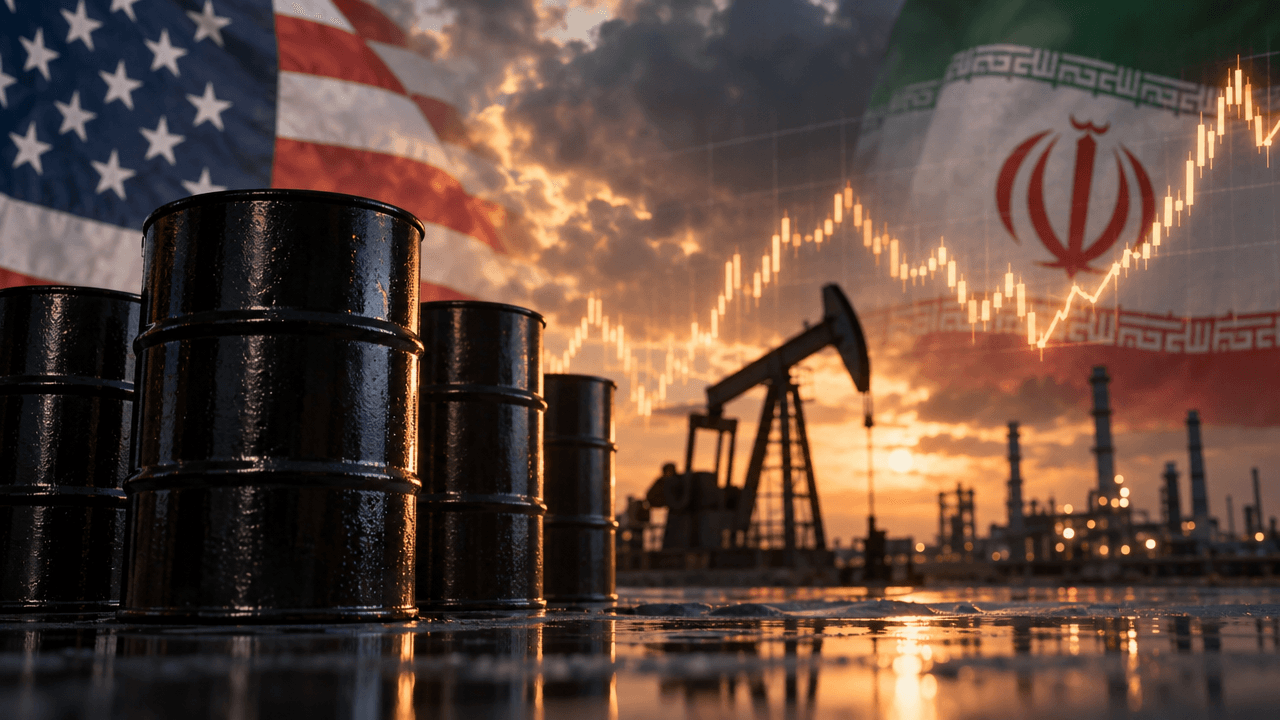
Oil prices have snapped back toward triple-digit territory as renewed U.S.-Iran tensions push geopolitical risk back to the center of the market narrative.[1][2][3] Brent crude has rebounded above $98 and recently traded in the $105–107 range, while WTI is hovering in the mid-$90s, reflecting a clear geopolitical premium being priced into energy markets.[1][2][3][4] The catalyst: President Trump’s rejection of a proposed peace deal with Iran, which would have aimed to reopen the Strait of Hormuz and ease months of supply disruption risk.[1][2][6][8][10]
MARKET SNAPSHOT: OIL’S GEOPOLITICAL PREMIUM RETURNS
Brent crude futures have climbed more than 1–2% in recent sessions, with prices pushing back above $98 and even testing above $106 per barrel at times.[1][2][3][4] U.S. benchmark WTI has followed suit, trading near $94 and recording daily gains in excess of 1–2% as traders reassess the probability of sustained supply interruptions from the Middle East.[1][3][10] This rebound comes after a period of volatility in energy markets, where prices had pulled back on hopes that diplomacy might stabilize flows.
The rejection of Iran’s peace proposal effectively removed a key “de-escalation” scenario from traders’ base cases, restoring a geopolitical risk premium that had started to fade.[1][2][6][8] Markets are not just reacting to headlines; they are repricing forward supply expectations for crude and refined products, particularly given that the Strait of Hormuz handles a significant portion of global seaborne oil trade.[2][7][9] For active traders, the move highlights how quickly sentiment can pivot when an anticipated diplomatic outcome fails to materialize.
Key takeaway: Short-term oil pricing is highly sensitive to shifts in geopolitical probability, and headline risk can reprice the market within hours, not weeks.
Geopolitical Risk And The Strait Of Hormuz
The Strait of Hormuz sits at the heart of this story.[2][7] Iran’s proposal reportedly centered on reopening this crucial shipping lane and reducing hostilities, which have already caused months of disruption risk and military exchanges.[2][6][12] Trump’s rejection keeps the door open to further tensions, reinforcing fears of additional strikes, blockades, or targeted disruptions in the region.[2][7][12]
Historically, any threat to Hormuz tends to translate directly into higher risk premiums for crude, as traders price the chance of production outages or transport bottlenecks into futures curves.[2][7][9] In recent weeks, episodes of renewed U.S.-Iran strikes have already pushed Brent back into the mid-90s, even before the latest rejection of the peace deal.[7][9][12] The current rebound above $98 fits that pattern: markets are signaling that the probability of a “messy” supply path is no longer negligible.
For traders, this environment emphasizes the need to distinguish between: - Structural factors (OPEC+ policy, U.S. shale production, demand growth) - Event-driven factors (sanctions, military incidents, diplomatic breakdowns)
Key takeaway: When chokepoints like Hormuz are in play, event-driven news can temporarily overshadow fundamentals and drive sharp directional moves.
Inflation Expectations And Macro Market Reactions
Higher oil prices feed directly into inflation expectations, especially when the move is driven by supply risks rather than robust demand.[7][9][12] With Brent above $98 and WTI in the mid-90s, markets must consider the impact on gasoline, diesel, and broader energy costs, particularly in economies where fuel prices are highly sensitive to crude benchmarks.[1][3][12]
Recent episodes of U.S.-Iran conflict have coincided with elevated diesel prices and renewed concerns about input costs for transportation, manufacturing, and logistics.[12] As crude ticks higher, bond markets may begin to price in stickier inflation, while central banks face a familiar dilemma: respond to energy-driven inflation or look through it as a temporary shock.
Equity markets often react unevenly to such moves. Energy producers and service companies can benefit from higher prices, while energy-intensive sectors feel margin pressure. Commodity-linked currencies—such as CAD, NOK, AUD, and certain EM FX—may see mixed effects, balancing improved terms of trade against higher global risk aversion and dollar strength.[7][9] Traders watching these cross-asset flows can use oil as a “stress barometer” for inflation-sensitive and risk-sensitive assets.
Key takeaway: Rising oil on geopolitical risk is not just an energy story; it is a macro theme that can influence bonds, equities, FX, and inflation expectations simultaneously.
Commodity-linked Currencies And Risk Sentiment
Commodity-linked currencies are particularly exposed to oil-driven sentiment swings, even when the underlying supply disruption does not directly affect their domestic production.[7][9] A sustained move with Brent above $98 and WTI near $94 tends to support oil exporters on a fundamental basis, but risk-off flows into safe havens can offset this effect, especially if geopolitical tensions escalate.[7][9]
For example, a spike in oil can: - Strengthen the currencies of major exporters over the medium term, via improved trade balances - Trigger short-term volatility and demand for defensive assets when war risk rises - Alter carry trade dynamics, as higher inflation expectations feed into rate projections
On a SimFi platform like E8 Markets, traders can explore these dynamics through simulated portfolios that combine crude futures proxies with FX and equity indices. By constructing scenario-based trades—such as long oil versus short airline equities, or long CAD against a basket of non-commodity currencies—participants can test how correlation structures evolve as geopolitical risk intensifies.
Key takeaway: Oil’s rebound is a live lesson in multi-asset connectivity; understanding how commodity shocks propagate through FX and equities can sharpen risk management skills.
How Simulated Traders Can Approach This Move
For traders using simulated environments, this episode offers a high-quality case study in managing headline risk and regime shifts. Rather than chasing every spike, simulated strategies can focus on structure, timing, and risk parameters.
A few practical approaches: 1. Build scenarios, not predictions Define bullish, base, and bearish paths for oil prices under different U.S.-Iran outcomes, and map likely reactions in related assets such as energy equities, EM FX, and inflation-sensitive bonds.
2. Stress-test positions Use simulated drawdowns to understand what happens if Brent moves from the high-90s to well above $110 on further escalation, or back toward $85 on surprise diplomacy.
3. Practice event-risk management Incorporate rules for reducing exposure around key political speeches, military updates, or diplomatic announcements, recognizing that gap risk can be elevated when conflict headlines dominate.
4. Focus on risk-reward, not just direction Experiment with spread trades (Brent-WTI, energy vs broader index) and options-inspired structures in simulation to learn how to express views with defined risk rather than outright leverage.
Key takeaway: SimFi platforms allow traders to turn volatile news into structured learning, building processes for scenario planning, risk control, and multi-asset thinking without real capital at risk.
Conclusion
Oil’s rebound above $98, driven by renewed U.S.-Iran tensions and the rejection of a proposed peace deal, underscores how quickly geopolitical risk can reshape market pricing.[1][2][3][6][8] With the Strait of Hormuz still at the center of global supply concerns, traders must account for the possibility of further disruptions and the resulting impact on inflation expectations, commodity-linked currencies, and risk sentiment across asset classes.[2][7][9][12] In this kind of environment, the edge lies not in predicting each headline, but in building robust frameworks for scenario analysis and risk management.
For participants in simulated finance, the current episode is an opportunity to study how a single geopolitical decision can ripple through energy, FX, equities, and bonds, and to refine strategies that can adapt to fast-moving, event-driven markets. By treating today’s oil rebound as a live case study, traders can be better prepared for the next time geopolitical risk pushes a key asset back toward the top of the market agenda.