
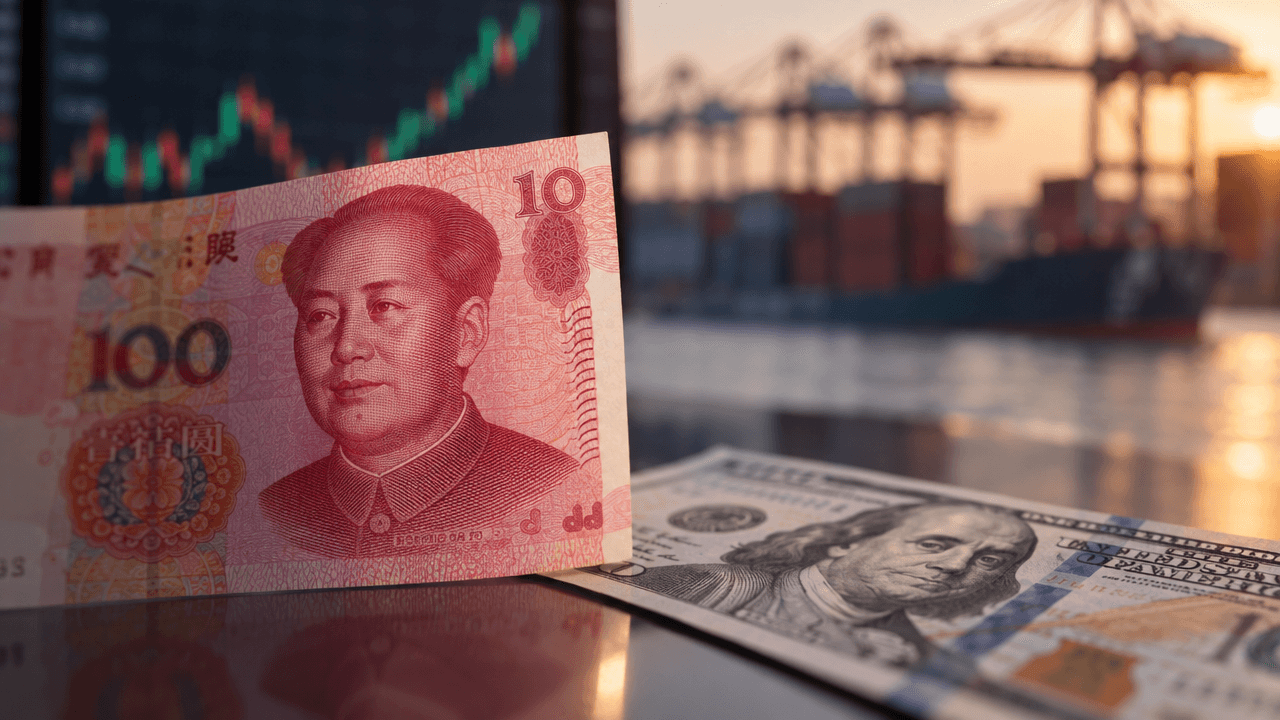
China’s yuan has reached its strongest level against the U.S. dollar since January 2023, marking a notable shift in the global foreign-exchange landscape. The onshore yuan briefly strengthened to 6.6897 per dollar on October 16 and was on track for a third consecutive weekly gain. The move has been supported by resilient Chinese exports, a softer dollar and expectations that global monetary policy may become more supportive of emerging-market currencies. [1]
The rally is significant because it comes despite concerns about China’s domestic economy, rising global bond yields and continued pressure on growth. Rather than reflecting one single catalyst, the yuan’s performance shows how trade flows, central-bank guidance and expectations for U.S. interest rates can combine to influence an exchange rate.
What Is Driving The Yuan Higher
China’s export performance has been the most important support for the currency. When Chinese companies sell goods overseas, they receive foreign currency—often U.S. dollars. Exporters that convert those dollars into yuan increase demand for the Chinese currency, creating a natural source of upward pressure.
Recent export resilience has therefore helped offset weaker sentiment toward China’s domestic economy. Analysts have noted that Chinese exports have continued to advance despite higher tariffs, international pressure to rebalance trade and a steadily appreciating yuan. [1]
The People’s Bank of China has also signaled a firmer stance through its daily reference rate. Before the market opened on October 16, the central bank set the yuan midpoint at 6.7220 per dollar, its strongest fixing since February 2023. China manages the yuan rather than allowing it to float freely, so the daily fixing provides an important indication of policymakers’ tolerance for currency strength. [3]
A stronger yuan can reduce the cost of imported commodities, technology and industrial inputs. It may also improve consumer purchasing power for Chinese households and companies buying goods from abroad. However, excessive appreciation can make Chinese exports more expensive for overseas customers, which means policymakers may prefer a gradual and controlled advance instead of a rapid rally.
The Dollar Factor
Currency pairs always involve two sides. The yuan’s gains have not been driven only by increased confidence in China; they have also reflected weakness in the U.S. dollar.
The dollar index has recently moved near an 18-month low, although profit-taking and comments from a Federal Reserve official have moderated its decline. [3] If investors expect U.S. interest rates to fall, or if they believe the Federal Reserve is becoming more concerned about economic growth than inflation, dollar-denominated assets can become less attractive.
Lower expected U.S. rates generally reduce the yield advantage of holding dollars. That can encourage capital to move toward other currencies, including the yuan, particularly when those currencies are also supported by strong trade balances.
For traders, this distinction matters. A currency may rise because its domestic outlook is improving, because its counterpart is weakening, or because both are happening at the same time. In the yuan’s case, export strength and dollar softness have reinforced one another.
Why Third-quarter Gdp Matters
The next major test for the yuan is China’s third-quarter gross domestic product report. Investors are looking for evidence that export strength is translating into broader economic momentum.
A Reuters poll reportedly placed the median forecast for third-quarter GDP growth at 4.4%, slightly above the 4.3% recorded in the second quarter. [13] A result above expectations could support the yuan by suggesting that China’s economy is stabilizing. Stronger-than-expected industrial production, retail sales or fixed-asset investment would provide additional confirmation.
A weaker report could produce the opposite reaction. China’s economy has been described as having a “two-speed” structure: foreign trade remains resilient, while domestic consumption and investment face downward pressure. [13] If the data highlights this imbalance, traders may question whether the yuan’s rally can continue without additional policy support.
The market will also assess whether policymakers respond to disappointing data with interest-rate cuts, liquidity measures or other forms of stimulus. Such measures could support growth but might also place downward pressure on the yuan by reducing domestic yields.
What Traders Should Watch Next
The first signal is USD/CNY price action. A move lower in the exchange rate represents yuan appreciation, while a move higher indicates yuan weakness. Traders should watch whether the pair can remain below the 6.70 area and whether the PBOC continues setting a firm daily midpoint.
The second signal is the dollar’s broader trend. Even strong Chinese data may not lift the yuan if U.S. yields rise sharply or investors return to the dollar as a safe-haven asset. Conversely, continued dollar weakness could extend the yuan’s advance even if China’s domestic data remains mixed.
The third signal is the durability of export growth. Export-driven currency strength can continue as long as overseas demand remains firm and exporters convert sufficient foreign-currency receipts. But tariffs, slower global growth or a deterioration in trade relations could weaken that support.
For SimFi traders, the practical lesson is to avoid treating a major currency move as a one-directional opportunity. Build scenarios around the GDP release, define risk before entering a position and monitor both China-specific developments and Federal Reserve signals. A bullish yuan setup might require resilient growth data, stable trade flows and continued dollar weakness. A bearish setup could emerge from disappointing GDP, rising U.S. yields or renewed concern about global risk.
The Bigger Market Message
The yuan’s strongest level since early 2023 is an important market development, but it is not proof that China’s economic challenges have disappeared. Instead, it reflects a temporary balance between strong external trade, a softer dollar and cautious policy management.
The next phase of the move will depend on whether China’s domestic economy begins to match the strength of its export sector. If it does, the yuan may have room to appreciate gradually. If not, policymakers may seek to limit the currency’s gains while supporting growth.
For now, traders should focus less on the headline level and more on the forces behind it. Exchange rates often move before the full economic story becomes clear. Understanding those drivers—trade flows, interest-rate expectations, central-bank signals and economic data—can help traders approach the yuan with discipline rather than simply chase momentum.