
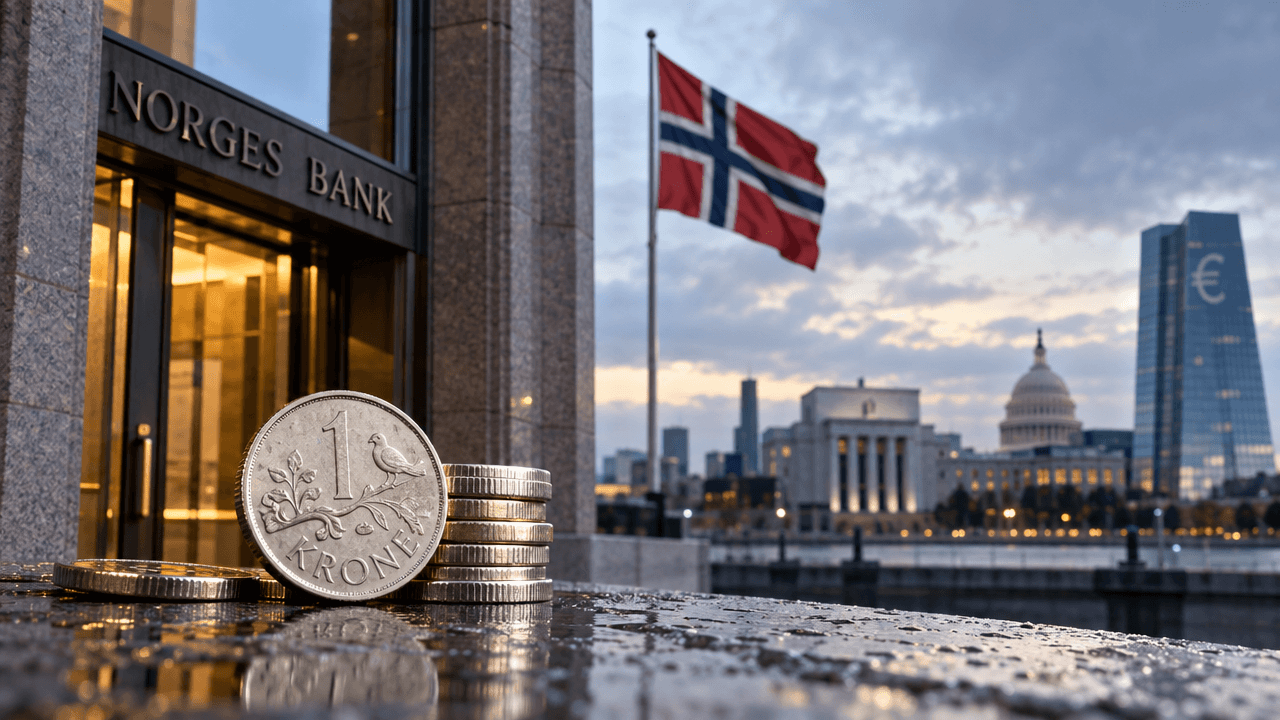
Norway’s central bank has kept its policy rate unchanged, but its message was far from neutral. Norges Bank left the rate at 4.5% after its 4 November meeting while warning that borrowing costs could rise again if inflation remains too high. The decision supports the Norwegian krone and highlights how central banks are following increasingly different paths as they respond to domestic inflation, growth, and currency pressures. [1]
The Decision Behind The Headline
Norges Bank’s decision to pause was widely expected. The more important development was the guidance surrounding it. Policymakers said inflation remained markedly above the bank’s 2% target and that restrictive monetary policy was still needed to bring price growth down within a reasonable time horizon. The bank also stated that it was prepared to raise the policy rate if the inflation outlook warranted further action. [2]
This is a significant distinction for markets. A rate hold can suggest that policymakers believe previous increases are beginning to work. However, a hold accompanied by a warning about future tightening tells investors that the central bank is not ready to declare victory over inflation.
Norges Bank raised its policy rate from 4.25% to 4.5% in September. Maintaining that higher rate in November allows the bank to observe how households, businesses, and financial markets respond before deciding whether another increase is necessary. At the same time, the central bank is keeping the option of further tightening firmly available. [6]
Why Inflation Remains The Priority
Norges Bank’s central challenge is that inflation has stayed above target for an extended period. Consumer-price inflation was reported at 3.4% in September, while core inflation, which excludes energy costs and taxes, remained at 3%. Both measures were above the bank’s 2% objective. [12]
Core inflation is particularly important because it can provide a clearer view of underlying price pressures. Energy prices can move sharply from month to month, but persistent core inflation may indicate that price increases are spreading through services, wages, rents, and business costs.
The central bank also pointed to the rapid rise in business costs over recent years. Companies facing higher labor, financing, materials, and operating expenses may attempt to protect profit margins by raising prices. If employees then seek higher wages to compensate for increased living costs, inflation can become more persistent.
That risk explains why Norges Bank is willing to tolerate a period of elevated interest rates. Policymakers want to prevent temporary inflation pressures from becoming embedded in wage and pricing behavior. The cost of doing so is weaker demand, more expensive credit, and potential pressure on interest-rate-sensitive parts of the economy.
What It Means For The Norwegian Krone
The prospect of higher Norwegian interest rates generally supports the krone. When investors expect local assets to offer relatively attractive returns, demand for the currency can increase. The November decision therefore gave the krone additional support, particularly because the central bank sounded more hawkish than a simple rate pause would suggest.
Currency markets respond not only to what a central bank does, but also to what it signals about the next several meetings. A central bank that holds rates while preparing markets for a possible increase may prevent traders from aggressively pricing imminent rate cuts.
The krone’s performance will also depend on factors beyond monetary policy. Norway is a major energy exporter, so oil and gas prices influence export revenues, government finances, business investment, and the country’s external balance. A weaker energy market could limit currency gains even if Norges Bank maintains a firm policy stance. Conversely, stronger energy prices could reinforce demand for the krone while adding to domestic economic activity.
For traders, this creates a two-sided market. Hawkish interest-rate expectations may support NOK, while falling commodity prices or concerns about slowing growth may restrain it.
The Broader Central-bank Divide
Norway’s stance is part of a wider story: monetary policy is becoming increasingly divergent across economies. Central banks do not respond to global headlines in exactly the same way because inflation, wage growth, housing conditions, currencies, and economic momentum differ from country to country.
A rate pause in Norway does not automatically mean that the next move must be lower. In this case, the bank is balancing persistent inflation against a cooling economy. Other central banks may be cutting rates because inflation has eased, while Norges Bank may need to keep rates higher for longer or tighten further.
These differences can create opportunities in foreign exchange markets. Traders compare expected interest-rate paths rather than focusing solely on current rates. If markets believe Norges Bank will remain more restrictive than another central bank, the krone may benefit against that currency. But expectations can change quickly when inflation data, employment figures, or commodity prices surprise investors.
Practical Takeaways For Traders
First, distinguish between a rate hold and a dovish rate hold. Norges Bank’s decision was a pause with a tightening option, not a clear signal that easing is close.
Second, monitor inflation data closely. A renewed increase in headline or core inflation could strengthen expectations for another hike. Sustained disinflation, by contrast, could reduce the need for further tightening.
Third, track Norway’s economic activity and business costs. Weak growth may eventually limit how aggressively the bank can raise rates, even if inflation remains uncomfortable.
Fourth, watch oil and gas prices when assessing NOK positions. Currency exposure linked to Norway cannot be analyzed through interest rates alone.
Finally, manage risk around policy meetings and economic releases. A hawkish message can strengthen the krone initially, but currency moves may reverse if markets judge that the economy cannot withstand higher rates.
Norges Bank has not committed to another increase, but it has made clear that inflation remains the deciding factor. For investors, the message is straightforward: Norwegian rates are likely to stay elevated, and the door to further tightening is open. Until underlying inflation shows convincing signs of returning toward 2%, the krone and Norway’s monetary policy will remain closely watched.