
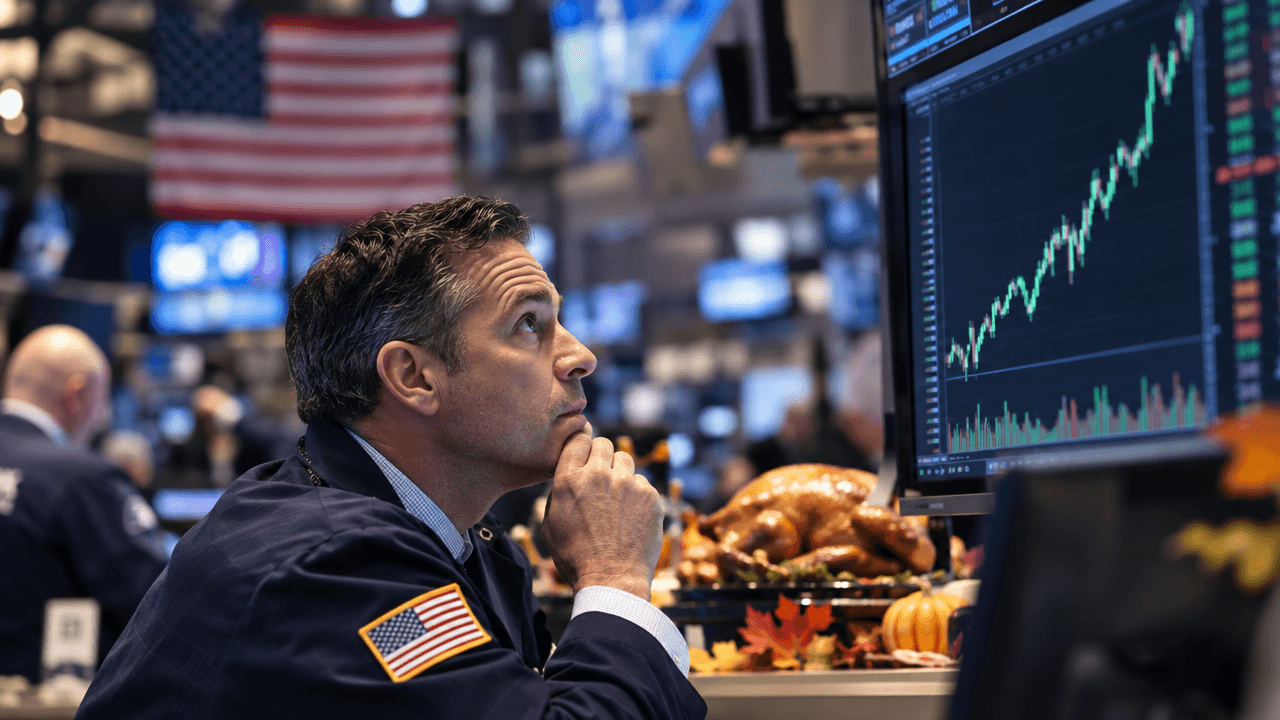
After a volatile stretch for technology shares, U.S. equity futures pointed sharply higher on Friday as investors returned from the Thanksgiving holiday. Dow futures gained roughly 1.2%, while S&P 500 futures climbed about 1.8%, signaling a stronger potential opening for Wall Street. The rebound was most pronounced in technology-linked contracts, reinforcing the possibility that traders were stepping back into the artificial intelligence trade after recent selling pressure. [11]
The move comes ahead of a shortened post-Thanksgiving session, when U.S. stock markets are scheduled to close at 1:00 p.m. Eastern Time. [5] With fewer hours available for trading and many market participants still away from their desks, price movements could become larger and less orderly than usual.
What Is Driving The Rebound
The immediate catalyst appears to be renewed demand for beaten-down AI and technology stocks. AI-related shares have recently faced questions about whether enormous investments in data centers, semiconductors, and computing infrastructure will generate adequate returns. Those concerns contributed to a volatile week, with investors reassessing high valuations and the sustainability of rapid spending growth.
Friday’s futures action suggests that at least some traders viewed the pullback as an opportunity rather than the beginning of a deeper deterioration. Nasdaq-linked futures rose more than 2% in early trading, while S&P 500 and Dow contracts also moved higher. [1] A rebound of this size can reflect both fresh buying and short covering, as traders who had bet on further declines close those positions.
However, a strong futures market does not guarantee a strong close. Futures indicate expectations before the cash market opens, but the direction can change quickly once individual stocks begin trading and liquidity conditions become clearer.
Why Thin Liquidity Matters
The shortened holiday session creates a different trading environment from a normal Friday. Trading volume is often lighter after Thanksgiving, and the early close limits the time available for institutions to adjust positions. Reuters reported that volumes were expected to remain light because U.S. markets were operating for only a half-day. [4]
Lower liquidity can amplify both gains and losses. In a heavily traded market, a large order may be absorbed by many buyers and sellers with limited price impact. When fewer participants are active, the same order can move prices more sharply. This can produce fast rallies, sudden reversals, and wider differences between buying and selling prices.
For short-term traders, the key lesson is that percentage gains may not tell the entire story. A market that rises nearly 2% on modest volume may reflect a temporary imbalance rather than broad conviction. Traders should monitor volume, market breadth, and whether gains extend beyond a small group of large technology companies.
The Ai Trade Faces A Key Test
The AI sector remains one of the most important drivers of market sentiment. Its companies have helped lead the broader equity market higher, but their valuations also make them especially sensitive to changes in interest rates, earnings expectations, and investor confidence.
Friday’s rebound may indicate that buyers still believe the long-term AI growth story is intact. Attractive valuations after a pullback can draw investors back into companies with strong revenue growth, expanding data-center demand, or strategic positions in the semiconductor supply chain.
At the same time, the market is asking increasingly demanding questions. How quickly will AI investments produce cash flow? Which companies will capture the economic benefits? Are businesses spending because the technology is productive, or because they fear falling behind competitors?
Those questions will not be answered by one positive session. A durable recovery would likely require continued strength across multiple trading days, supportive company guidance, and evidence that earnings growth is keeping pace with elevated expectations.
What Traders Should Watch
The opening reaction will be important, but the closing behavior may be more informative. If stocks hold their early gains despite low participation, it could suggest that buyers are regaining control. If the market fades quickly, the rally may have been driven primarily by short covering or temporary dip buying.
Traders should also watch market breadth. A healthy rebound would ideally include participation from financials, industrials, consumer companies, and other sectors alongside technology. If the gains remain concentrated in a few AI leaders, the broader market may still be vulnerable to a change in sentiment.
For SimFi traders, the session offers a useful risk-management exercise. Reduce position sizes when liquidity is uncertain, define invalidation levels before entering a trade, and avoid assuming that futures gains will continue after the opening bell. A shortened session can also make it easier for a trader to overreact to rapid price changes.
One practical approach is to wait for the first move to develop before taking a position. Traders can compare the opening range with volume and breadth, then decide whether the market is showing continuation or rejection. This disciplined process is often more reliable than chasing a large premarket percentage move.
A Rebound, Not A Verdict
The recovery in U.S. equity futures provides an important test of investor confidence, particularly in AI and high-growth technology shares. It shows that buyers remain willing to return after a sharp pullback, but it does not eliminate concerns about valuations, spending, or future earnings.
The shortened post-Thanksgiving session may produce a positive headline while still delivering challenging conditions for active traders. The most useful signal will be whether the market can hold gains with broad participation and improving volume.
For now, the rebound points to renewed risk appetite. The next stage will depend on whether that appetite survives thinner liquidity, profit-taking, and the larger fundamental questions surrounding the AI investment cycle.