
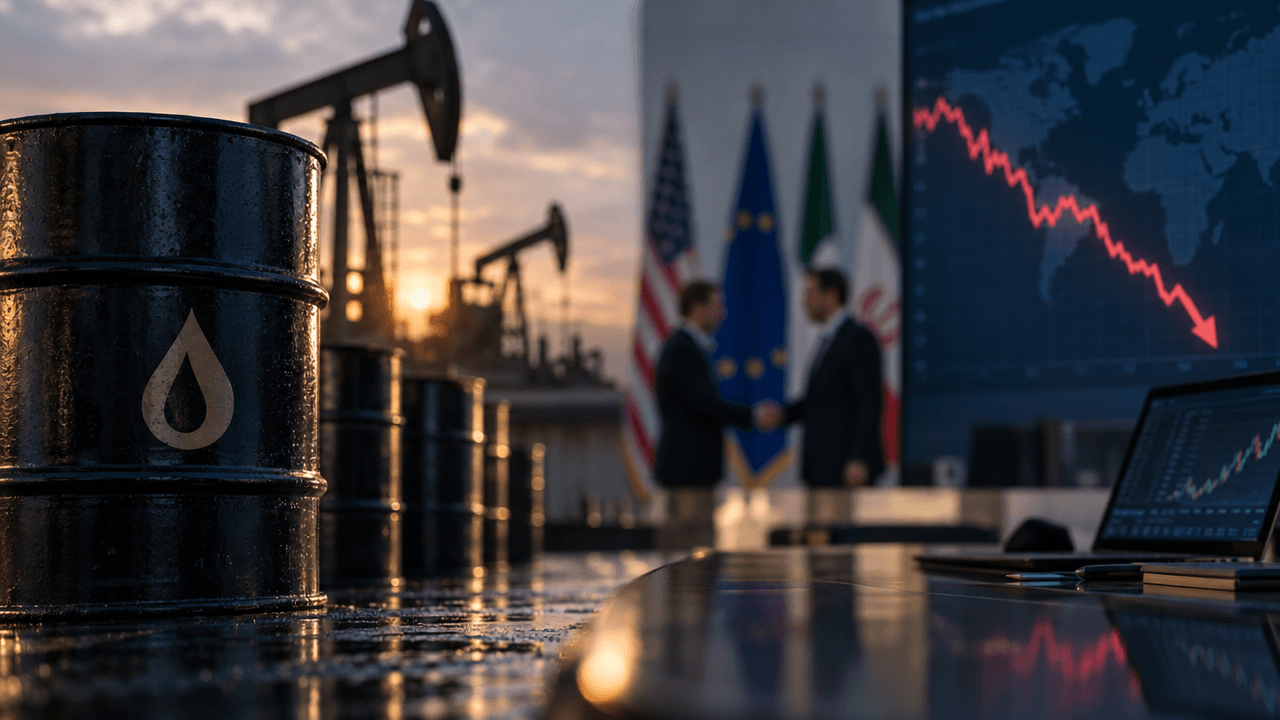
Oil’s sudden plunge is a reminder that crude prices are shaped not only by barrels in storage, production quotas, and consumption forecasts, but also by expectations about geopolitical risk. On November 2, Brent crude fell roughly 7.6% to settle near $104.77 per barrel, while West Texas Intermediate dropped 7.4% to $96.46. It was the sharpest daily decline for WTI since late July. [1]
The catalyst was renewed optimism that the United States and Iran could pursue diplomacy to end a conflict that has disrupted Middle East energy markets for months. As investors reassessed the likelihood of further escalation, part of the premium previously built into oil prices rapidly disappeared.
Why Oil Fell So Sharply
Oil markets had been pricing in the possibility that the conflict could worsen, interrupting crude production, exports, or shipping through strategically important routes. That uncertainty created a geopolitical risk premium: an additional amount traders were willing to pay because future supply looked less secure.
Diplomatic signals changed that calculation. Iranian officials indicated that their government had authority to engage in negotiations, while U.S. leaders signaled a preference for giving diplomacy more time. Qatar-mediated discussions also produced proposed language for a possible agreement, although no final breakthrough had been confirmed. [2]
For oil traders, even the possibility of improved relations can have an immediate effect. Futures prices reflect expectations about future supply and demand, not just current physical availability. If negotiations reduce the chance of military escalation, traders may expect fewer disruptions, lower insurance and transportation risks, and a potential stabilization of regional exports.
That helps explain why crude fell more than 7% in a single session. The move was not necessarily a sign that global demand had collapsed. Instead, it reflected a rapid repricing of risk.
Inflation And Interest-rate Expectations
Lower oil prices can influence the broader economy through fuel, transportation, manufacturing, and household energy costs. When crude becomes cheaper, gasoline and diesel prices may eventually decline, reducing one source of pressure on consumer prices.
That could support lower inflation expectations, especially if the oil decline persists and spreads through the supply chain. For central banks, weaker energy prices may reduce the need to keep interest rates restrictive in order to contain inflation. Markets can respond by increasing expectations for future rate cuts or by reducing expectations for additional rate hikes.
However, the transmission is not instantaneous. Retail fuel prices often adjust with a delay, and the overall inflation effect depends on the size and duration of the oil move. A one-day selloff may have limited economic impact if crude quickly rebounds. A sustained decline would matter more for consumers, businesses, and monetary policy.
Traders should therefore distinguish between an immediate market reaction and a lasting macroeconomic trend. Diplomacy headlines can move prices quickly, but inflation forecasts require confirmation from energy markets and economic data.
What It Means For Stocks And Other Assets
The oil selloff creates winners and losers across financial markets. Energy producers may face pressure because lower crude prices can reduce revenue, cash flow, and expected profit margins. Shares of exploration and production companies, oilfield-service firms, and some energy-focused funds may be particularly sensitive.
The effect is not uniform. Integrated energy companies with refining, chemicals, or trading operations may be better insulated than firms whose earnings depend heavily on upstream production. Investors also need to consider each company’s hedging strategy, debt burden, production costs, and geographic exposure.
Outside the energy sector, lower oil prices can provide relief to industries that consume substantial amounts of fuel. Airlines, transportation companies, logistics operators, manufacturers, and some consumer businesses may benefit if energy expenses decline.
Rate-sensitive assets could also receive support. If investors interpret cheaper oil as a reason for less restrictive monetary policy, government bonds, growth stocks, real estate-related securities, and other assets that respond to interest-rate expectations may gain. Lower energy costs can also improve household purchasing power, potentially supporting consumer demand.
For traders, the key lesson is that one commodity move can create very different outcomes across sectors. A falling oil price is negative for some companies but constructive for businesses and assets exposed to lower costs and easier financial conditions.
Risks That Could Reverse The Move
Diplomatic optimism is not the same as a completed agreement. Negotiations can stall, conditions can change, and military tensions can return. The market may also be underestimating how quickly supply can normalize if restrictions are lifted or shipping routes reopen.
Iran’s energy infrastructure, export capacity, and access to international markets would all influence the practical effect of any agreement. Even if political leaders reach an understanding, implementation could take time. Conversely, a fresh escalation could restore the risk premium just as quickly as it vanished.
Supply and demand fundamentals remain important as well. A weaker global economy, rising inventories, or lower refinery demand could keep prices under pressure. Strong consumption, production outages elsewhere, or renewed shipping disruption could provide support.
This uncertainty makes risk management essential. Traders should avoid treating a dramatic one-day move as a guaranteed new trend. Monitoring settlement prices, trading volume, futures-curve structure, inventory reports, currency movements, and additional diplomatic announcements can provide a more complete picture.
Practical Takeaways For Simfi Traders
For SimFi participants, the episode offers a useful exercise in cross-market analysis. Start with the catalyst, then map the likely transmission path: diplomacy affects geopolitical risk, geopolitical risk affects oil, oil affects inflation expectations, and inflation expectations influence interest rates and sector performance.
Avoid chasing the first move. Instead, define a scenario plan. Continued diplomatic progress could keep pressure on crude and support rate-sensitive assets. A breakdown in negotiations could send oil higher and revive inflation concerns. A mixed outcome may produce volatile, range-bound markets.
Position sizing matters especially when headline risk is high. Use predefined entry levels, invalidation points, and maximum-loss limits rather than relying on conviction alone. Simulated trading is valuable because it allows traders to test these decisions without exposing real capital.
The oil plunge is significant because it shows how quickly markets can reprice geopolitical uncertainty. Whether the decline becomes a durable trend will depend on actual diplomatic progress, the restoration of energy flows, and confirmation from inflation and demand data. For now, the clearest lesson is that successful trading requires more than predicting direction: it requires understanding how one headline travels through the entire financial system.