
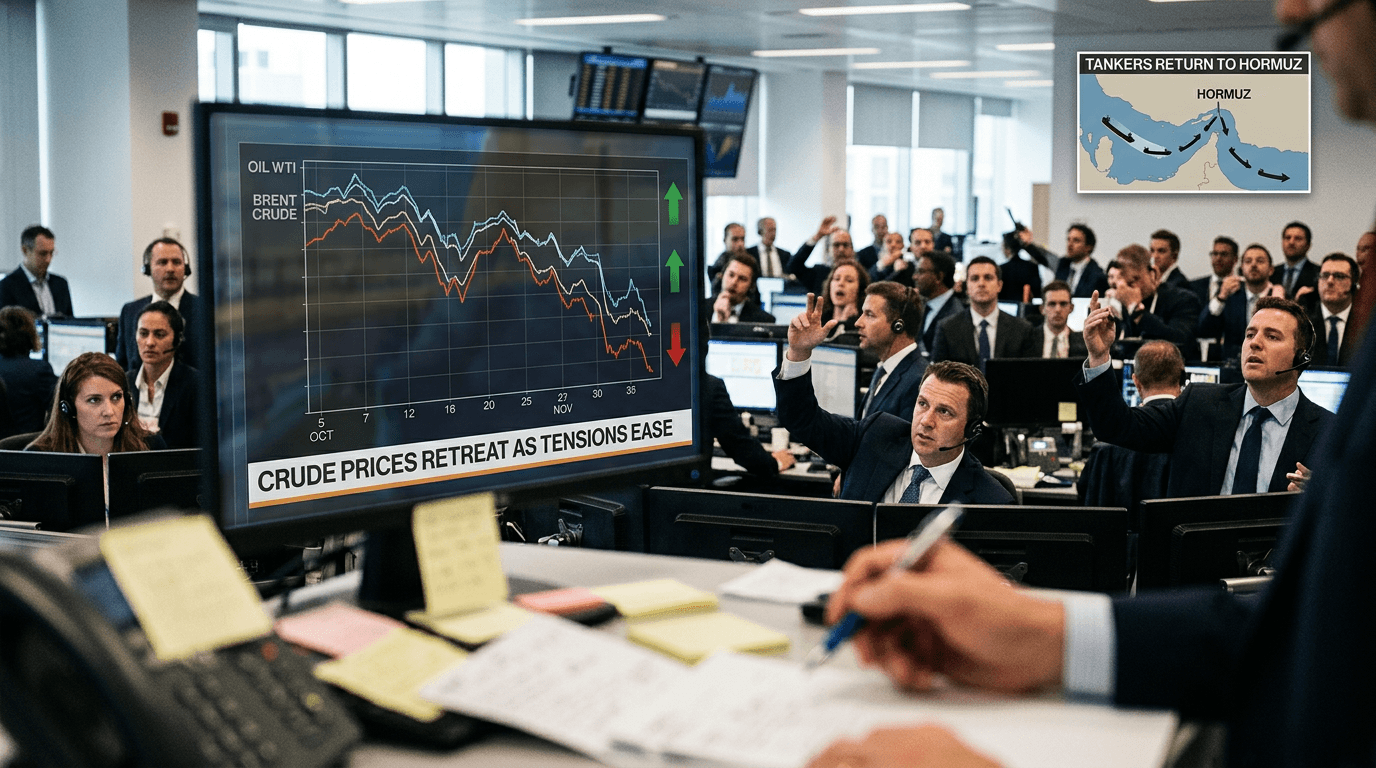
Oil prices are giving back some of their recent war‑driven gains as signs emerge that US‑Iran tensions are easing and tanker traffic is gradually resuming through the Strait of Hormuz. For traders who have been navigating headline‑driven spikes, the market is now starting to reprice a lower geopolitical risk premium, with ripple effects across energy futures, inflation expectations, and commodity‑linked currencies.
Market Reaction: From War Premium To Partial Normalisation
Earlier in the conflict, fears of a prolonged disruption in Middle East supply sent crude prices sharply higher, with Brent previously trading above $110 per barrel as flows through Hormuz were severely curtailed[1]. As reports now point to a pause in hostilities and a controlled reopening of key shipping lanes, that “war premium” is beginning to unwind.
In practice, this means front‑month crude futures are retreating from recent highs, volatility is cooling, and time spreads that had blown out on supply fears are starting to compress. The move is not just a directional price story; it is also a repricing of tail risk. Traders who were paying up for upside protection via calls are seeing those options lose value as the probability of extreme supply shocks declines.
For equity markets, the easing in oil prices offers some relief to energy‑intensive sectors such as airlines, transport, and manufacturing. At the same time, energy producers and oilfield service names may see recent outperformance moderate as expectations of sustained triple‑digit crude prices are re‑examined.
Why The Strait Of Hormuz Matters So Much
The Strait of Hormuz is one of the world’s most critical energy chokepoints, with around 20% of global oil and gas shipments typically passing through this narrow waterway between the Persian Gulf and the open ocean[2]. During the recent conflict, daily vessel transits through the strait fell by roughly 90% to 95%, effectively choking off a large chunk of seaborne supply[1].
This collapse in traffic was not only about physical risk from potential attacks; skyrocketing insurance costs and uncertainty about naval protection also kept many tankers away[1][2]. As US efforts focused on degrading Iranian naval capabilities and escorting tankers through the area, the groundwork was laid for a phased reopening of the route[2].
Now, as shipping lanes begin to reopen and more vessels cautiously resume voyages, traders are repricing the probability that oil flows will move back toward normal levels. A reopening of Hormuz can ease fuel price pressure worldwide, although market participants stress that the real test is whether flows return smoothly or face recurring disruptions and policy surprises[3]. In other words, the direction of travel is positive, but the risk is not fully gone.
Implications For Inflation, Central Banks, And Bonds
One of the biggest macro stories behind the oil spike was its potential to re‑ignite inflation at a time when many economies are trying to engineer a soft landing. Higher fuel and transport costs feed quickly into headline CPI, inflation expectations, and ultimately into bond yields and central bank policy debates.
As crude retreats from its war‑driven highs, some of that pressure eases. Breakeven inflation rates in bond markets are likely to edge lower as traders mark down worst‑case scenarios for energy‑driven price spikes. This in turn can take some of the urgency out of hawkish central bank narratives, particularly in economies that are already seeing core inflation trend down.
For rate traders, the shift shows up in a softer path for expected policy rates and a modest bid for longer‑dated government bonds. However, because oil remains elevated relative to pre‑conflict levels in many scenarios[1], the inflation story does not simply vanish; it becomes more about “less upside risk” than a clean return to pre‑shock conditions.
CURRENCY AND CROSS‑ASSET MOVES
The easing in energy prices and risk premium is also visible in FX. Commodity‑linked currencies such as the Canadian dollar (CAD) and Norwegian krone (NOK), which tend to benefit from higher oil prices, may see some of their recent support fade as crude normalises. That does not necessarily mean aggressive weakness, but it can cap upside against currencies of large oil importers.
For major importing economies, lower oil prices are broadly supportive for trade balances and growth margins. Currencies like the Japanese yen or Indian rupee can gain some fundamental backing from reduced import bills, even if other drivers like interest rate differentials still dominate day‑to‑day moves.
In equities, lower energy prices can rotate leadership away from pure commodity plays and back toward consumer‑oriented and cyclical sectors that benefit from cheaper fuel and improved real incomes. Credit markets may also welcome the move, as lower energy costs relieve pressure on corporate margins, especially in transportation and logistics.
What Traders Should Watch Next
For traders, the key question is not just “Is Hormuz reopening?” but “How stable is the reopening?” A partial restoration of flows can still leave the market vulnerable to renewed headlines, while a genuinely durable de‑escalation would justify a more sustained removal of risk premium from the curve.
A few practical angles to monitor
First, watch shipping and insurance data. Daily tanker transits and insurance premia for voyages through the Strait of Hormuz offer a real‑time check on whether risk is truly receding or simply pausing[1][2]. A steady rise in transits with falling insurance costs would confirm a structural improvement.
Second, track the term structure in crude futures. Backwardation that was driven by near‑term supply fears may flatten if traders gain confidence that barrels will flow. A sudden re‑steepening could be an early warning sign that fresh disruptions are being priced in again.
Third, keep an eye on volatility. As geopolitical stress eases, implied volatility in energy markets typically drifts lower, affecting the pricing of options and structured products. For active traders, that can mean shifting from pure volatility plays toward more directional or relative value ideas.
Finally, consider cross‑asset confirmation. If oil is falling on improved supply prospects, you would expect to see some combination of firmer bond markets, softer breakevens, a modest pullback in oil‑linked currencies, and a bid for energy‑sensitive equities. If those signals diverge, it may suggest that another narrative—such as concerns about global growth—is driving the move.
Practical Takeaways For Active And Simulated Traders
For discretionary traders and those practising in simulated environments, this episode is a textbook case of how geopolitical risk translates into market pricing and then unwinds as information changes. A few actionable lessons stand out.
Building scenarios around chokepoints like Hormuz is crucial. Understanding how much supply is at risk, how long disruptions might last, and what policy responses are possible helps shape more robust trade ideas and risk management plans.
Risk sizing around event‑driven trades matters as much as the direction. War‑related moves can be sharp and emotional, but they can also reverse quickly when tensions ease. Using simulated accounts to test different stop‑loss levels, option hedges, and position sizes can be valuable preparation for trading such environments live.
Cross‑asset thinking is essential. The story is not just oil; it is also about bond yields, breakevens, central bank expectations, credit spreads, and FX. Practising how a single geopolitical headline can ripple through all of these markets is one of the most effective ways to build an integrated macro framework.
Ultimately, the retreat in oil on signs of easing US‑Iran tensions and the gradual reopening of Hormuz is a reminder that markets are constantly repricing probabilities, not certainties. The opportunity for traders lies in understanding how those probabilities evolve—and being ready, both intellectually and in terms of risk management, when the narrative shifts again.