
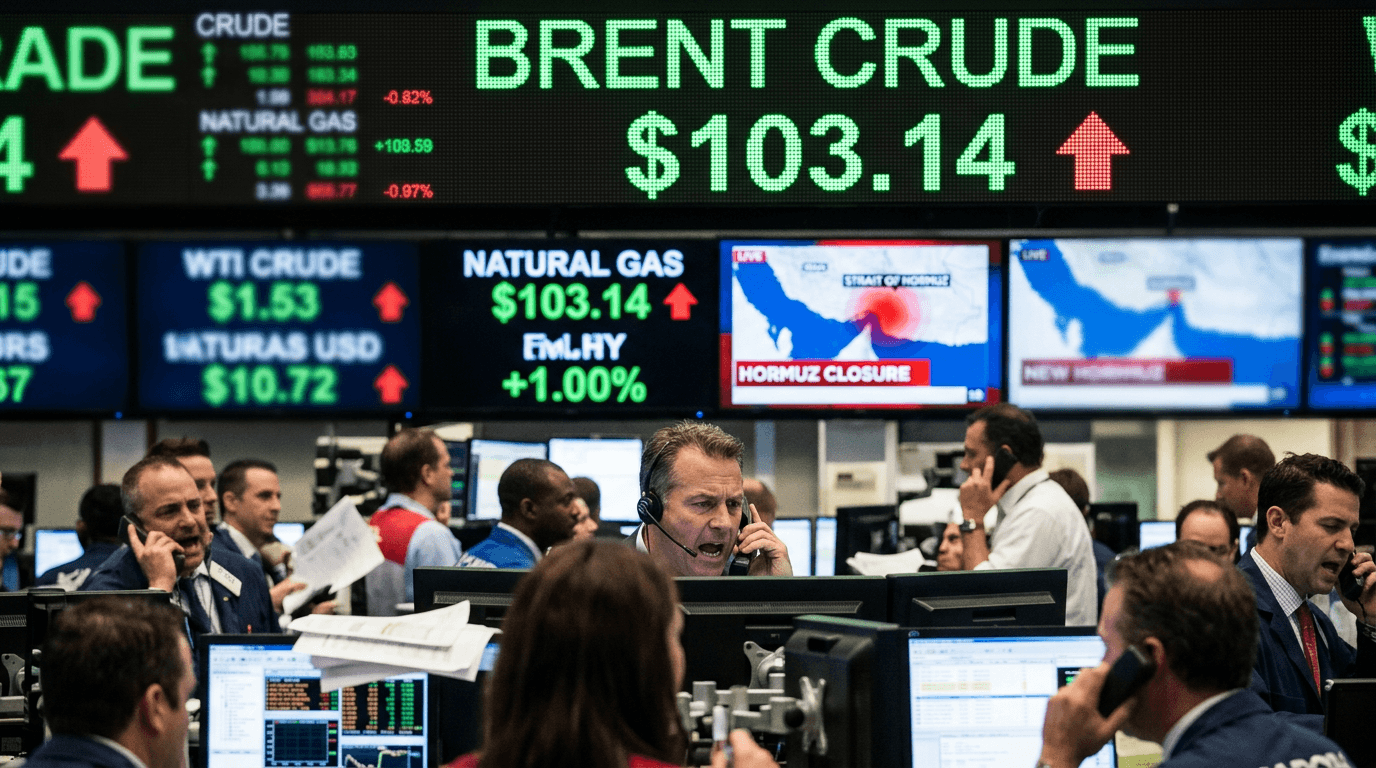
Historic Strait of Hormuz Closure Sends Oil Prices Soaring: Energy Markets Under Pressure
---
In a dramatic turn of events, the global oil market is navigating uncharted waters as geopolitical tensions have led to the effective closure of the Strait of Hormuz—one of the most critical energy corridors on the planet. Brent crude has skyrocketed to $103.14 per barrel, marking a 2.67% increase, while WTI crude has surged by 3.11% to $98.71. This unprecedented situation has left traders grappling with the stark reality that around 20% of the world's seaborne oil supply is now obstructed, unable to reach global markets. The complete shutdown of this vital passage is a historic milestone, underscoring the need to understand the far-reaching implications and responses to this disruption for anyone monitoring global economic trends or managing investment portfolios.
Unfolding Crisis at the Strait of Hormuz
Situated between Iran and Oman, the Strait of Hormuz has become the epicenter of rising geopolitical tensions. Recent aggressive actions by Iran have escalated from mere threats to concrete actions, including reported strikes on commercial vessels and mine-laying activities in the strait. As of mid-March 2026, approximately 500 tankers and a total of 4,000 vessels are ensnared in the Persian Gulf, transforming what was once a theoretical risk into a palpable crisis impacting every major economy worldwide.
This chokepoint's importance is monumental. Under usual circumstances, the strait facilitates the transit of about 20 million barrels of oil daily, accounting for roughly one-fifth of all global seaborne oil trade. To put this in perspective, the U.S. recently decided to release 172 million barrels from its Strategic Petroleum Reserve over a span of 120 days, equating to just over 1.4 million barrels daily. This stark contrast highlights the limitations of government interventions in fully compensating for the supply shortfall from a closed strait.
A Broader Supply Chain Disruption Beyond Oil
While oil remains in the spotlight, the closure of the Strait of Hormuz signals a broader global crisis. This crucial waterway is responsible for transporting about 30% of the world’s liquefied natural gas and a significant portion of the global fertilizer supply. Consequently, beyond rising heating and fuel costs, consumers worldwide are bracing for potential food supply disruptions due to restricted fertilizer availability. Agricultural markets are already reacting, with traders factoring in reduced crop yields and elevated production costs for upcoming seasons.
Reopening this critical passageway involves complex challenges that extend beyond military efforts. Experts emphasize that the shipping crisis is further exacerbated by infrastructure damage and the complete economic paralysis gripping the region. Most airports and financial districts are inoperative, presenting a multifaceted challenge that defies simple solutions. The White House, along with international partners, is urgently searching for a diplomatic resolution, aware that a prolonged closure threatens regional economic stability and global market equilibrium.
Oil Market Volatility and Price Dynamics
The oil market’s response to these developments has been both dramatic and telling. Brent crude has experienced extreme volatility, fluctuating between $80 and $120 per barrel in recent trading sessions. This volatility has become a focal point, as market players attempt to factor in various resolution scenarios amidst substantial uncertainty. The 2.67% rise to $103.14 for Brent and the 3.11% uptick to $98.71 for WTI reflect the market’s ongoing adjustment to recalibrate risk premiums.
When the International Energy Agency announced a collective release of 400 million barrels from strategic reserves by member countries, the market’s initial response was surprisingly bearish. Rather than welcoming the increased supply, traders saw this as an indication that global authorities deemed the situation severe enough to warrant extraordinary measures. This reaction highlights how market sentiment operates during crises: unprecedented interventions often signal severity rather than confidence in imminent resolution.
Strategic Responses and Market Projections
The U.S. decision to release 172 million barrels from emergency reserves represents a significant policy move, yet analysts acknowledge this only addresses roughly half of the daily supply disruption caused by the strait's closure. This partial mitigation strategy buys time but fails to resolve the core issue. The oil market is already pricing in a new equilibrium where prices are unlikely to revert to pre-crisis levels in the near term.
Experts suggest that even with optimistic resolution scenarios, crude oil is unlikely to trade below $70 to $80 per barrel in the foreseeable future. Some analysts point to potential long-term solutions, such as increased Venezuelan oil production if political conditions improve and infrastructure is rebuilt. Similarly, the emergence of Russian oil and gas from sanctions could eventually exert downward pressure on prices. However, these scenarios will take months or years to materialize and hinge on uncertain diplomatic and political developments.
Key Considerations for Traders and Investors
For market participants, several critical considerations arise from this crisis. First, the Strait of Hormuz closure represents an authentic supply shock without straightforward technological or logistical solutions. Second, the geopolitical dimension indicates that resolution timelines depend on factors entirely external to market mechanics. Third, volatility is likely to persist as new information surfaces regarding military developments, diplomatic progress, or infrastructure damage assessments.
The energy market is now contending with a new structural reality where geopolitical premiums are embedded into oil prices until a clear resolution is in sight. Traders should closely monitor diplomatic channels, track shipping activity for signs of normalization, and recognize that government reserve releases offer temporary relief rather than permanent solutions. For investors with longer time horizons, the current environment presents both risks and opportunities, contingent on portfolio construction and beliefs about resolution timelines. The Strait of Hormuz crisis has fundamentally reshaped the risk-reward landscape for global energy markets.
---
NEWSIMPACTSCORE: 9