
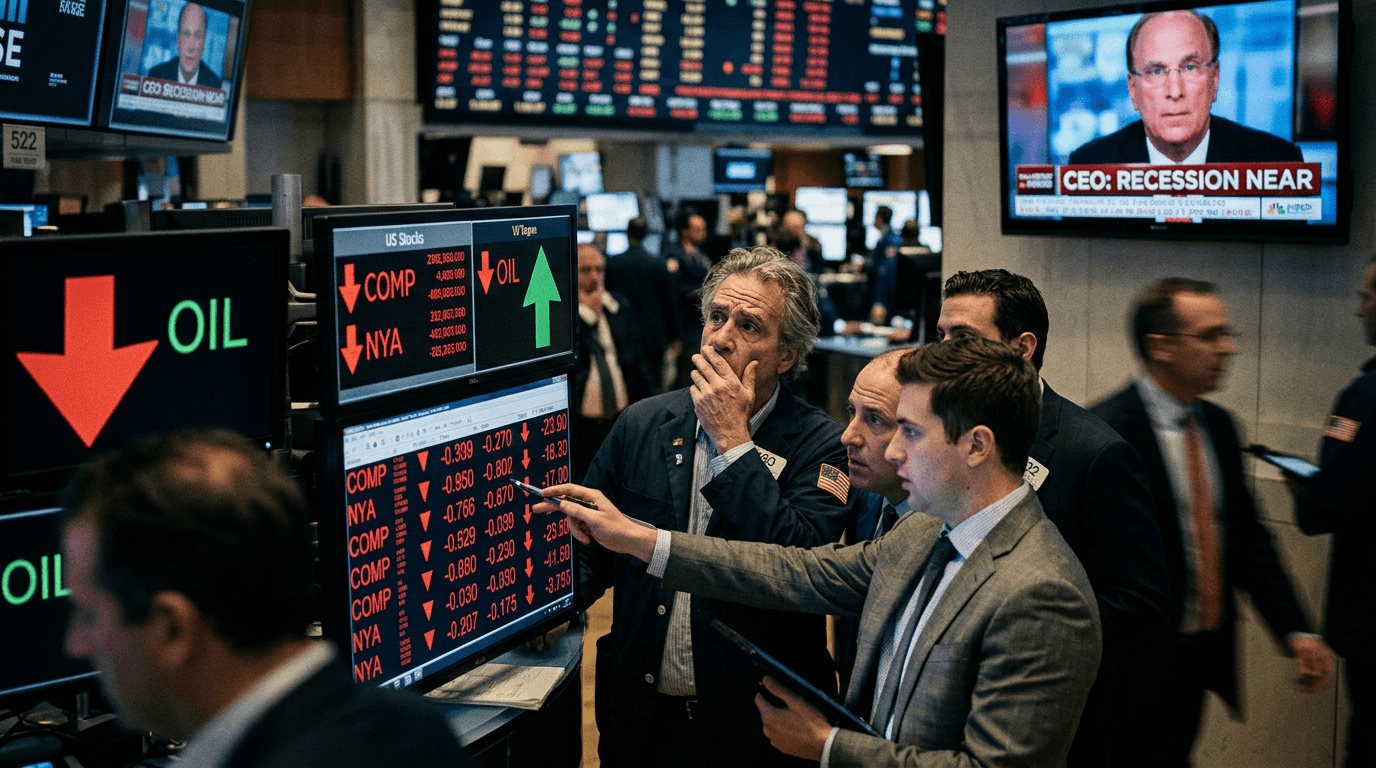
U.S. stock markets faced significant headwinds on Thursday as a fresh surge in crude oil prices amplified recession fears across Wall Street. The combination of rising energy costs and cautionary remarks from major institutional leaders like BlackRock's CEO Larry Fink created a perfect storm of selling pressure. Major equity indices slid into the red, with growth stocks and consumer discretionary names bearing the brunt of the selloff. This market dynamic reflects a critical tension in today's economy: as crude rallies, investors worry that elevated energy costs will choke off consumer spending and corporate profitability, ultimately tipping the economy into recession.
The Oil-recession Connection
Oil prices and recession fears share a complicated relationship in modern markets. When crude surges rapidly, it typically signals either strong economic demand or geopolitical disruption. While strong demand might seem bullish, energy price spikes create immediate headwinds for businesses and consumers. Transportation costs rise, input expenses increase for manufacturers, and consumers see higher prices at the pump—all of which compress margins and purchasing power.
The logic is straightforward: oil is embedded in nearly every sector of the economy. Higher energy costs function as a hidden tax on growth. Companies that were comfortably profitable at $85 per barrel face margin compression at $95. Consumers who budgeted for fuel at one price level suddenly have less discretionary income. Airlines, shipping companies, manufacturers, and retailers all feel the pressure simultaneously. Historical data shows that rapid oil rallies often precede economic slowdowns, which is precisely why oil's recent strength has alarmed traders and strategists alike.
What makes today's move particularly significant is the speed and magnitude of the oil rally. When crude climbs $5 to $10 in a single session without obvious fundamental catalysts, market participants interpret it as a warning signal. It suggests supply concerns, geopolitical tension, or liquidity pressures that could cascade through financial markets.
Blackrock's Recession Warning Moves The Needle
When Larry Fink, CEO of BlackRock—one of the world's largest asset managers overseeing trillions in investments—suggests the economy is "very close, if not in, a recession," it carries substantial weight. Fink doesn't make casual proclamations. His statements reflect not only BlackRock's sophisticated internal research but also the collective anxiety of major institutional investors globally.
Such warnings from influential industry figures create a feedback loop. Other investors begin questioning their positioning. Risk managers tighten models. Allocators rebalance toward defensive assets. The psychological impact alone can shift market direction, as it validates the fears already brewing beneath the surface. When a figure of Fink's stature voices recession concerns, it gives permission to other large investors to act on those anxieties they may have been hesitant to express.
The timing of this warning matters. Coming as oil rallies and inflation concerns resurface, it suggests that BlackRock's data is showing weakness beneath the headline numbers. Employment might be softening, credit conditions tightening, or consumer confidence weakening—the invisible signals that precede official recession declarations.
Defensive Rotations And Market Positioning
The market's response confirmed the depth of concern. Retail stocks like Leslie's (LESL) dropped 6% as investors fled cyclical names dependent on consumer discretionary spending. This is textbook defensive rotation. When recession risks rise, traders abandon growth stories and instead seek boring, stable businesses with predictable cash flows. Utilities, consumer staples, and healthcare typically outperform in such environments.
Simultaneously, safe-haven assets saw inflows. Government bonds, gold, and low-volatility dividend stocks attracted capital. The VIX spiked as option premiums reflected increased uncertainty. This combination—weakness in growth names coupled with strength in defensive sectors—is the unmistakable signature of a risk-off market.
The broader implication is that despite recent market rallies, underlying anxiety about economic prospects hasn't dissipated. It's merely been dormant, waiting for a trigger. Oil's surge and BlackRock's warning provided exactly that catalyst.
What This Means For Traders
For SimFi traders and real-world investors alike, this environment demands careful positioning. It's crucial to understand which holdings are truly recession-resistant and which merely appear safe. A dividend stock that slashes its payout during a downturn offers no protection. Conversely, companies with durable competitive advantages and fortress balance sheets tend to weather recessions effectively.
This is also an opportune moment to review portfolio construction. Are you adequately diversified across sectors and asset classes? Do you have meaningful positions in defensive names? Are your growth holdings reasonably valued, or do they depend on optimistic economic scenarios?
Volatility often creates opportunity for disciplined traders. While panic selling creates attractive entry points for quality assets, it also rewards those positioned defensively. The key is matching your risk tolerance with your positioning.
Navigating Uncertainty Ahead
Markets now face a crucial test. If recession fears prove overblown and economic data stabilizes, relief rallies could reward aggressive investors who held or bought during today's selloff. Conversely, if warning signs multiply, this could represent an early indication of a more significant market repricing. The next round of economic data—employment figures, consumer spending reports, and corporate earnings—will clarify which scenario is unfolding.
The intersection of rising oil prices and recession warnings demands respect. While not every oil rally triggers a downturn, and not every recession warning proves accurate, the combination merits serious attention from traders and investors managing capital today.