
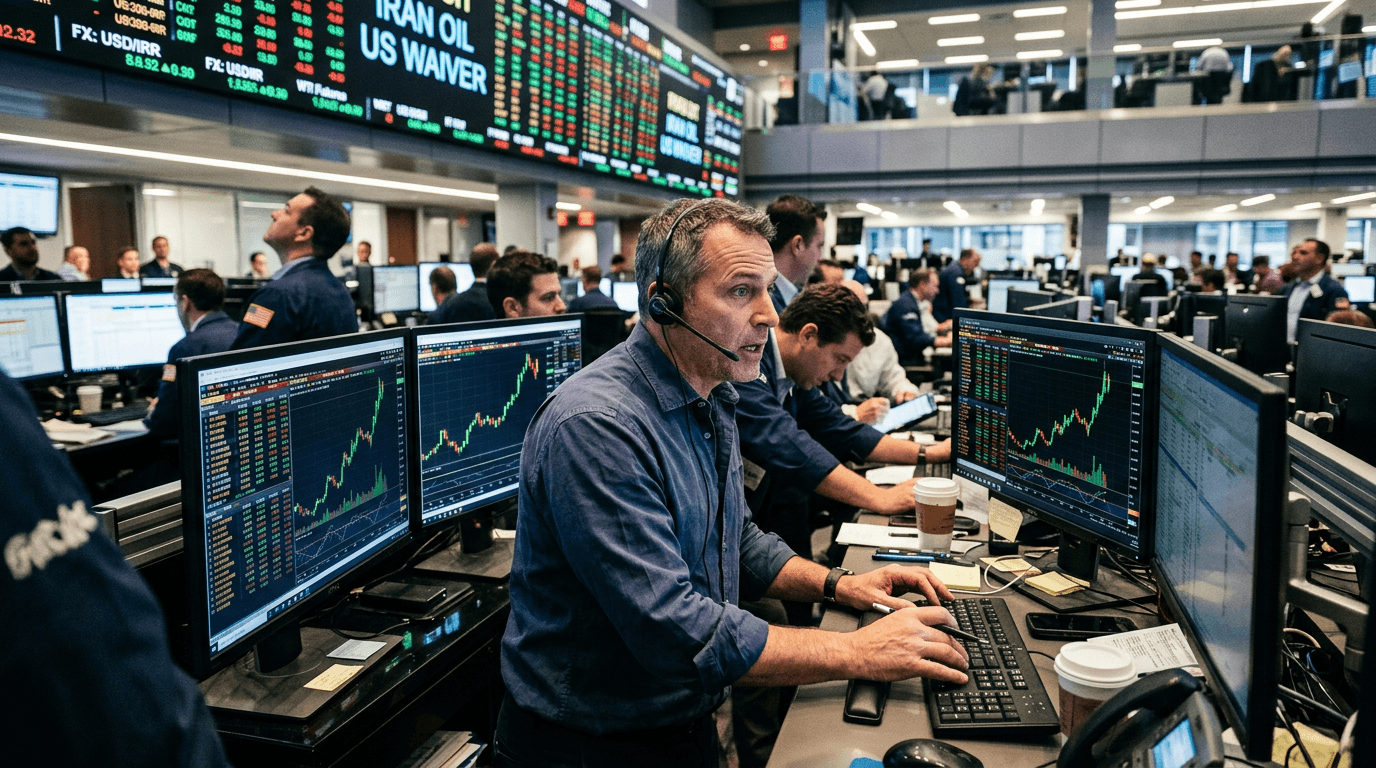
Oil markets are once again reminding traders that geopolitics rarely delivers a straight line. Headlines about U.S. sanctions waivers on Iranian oil triggered a sharp readjustment in expectations, with prices first lurching lower on the prospect of more supply and then rebounding as investors reassessed what the waiver really means for flows, risk premia, and macro conditions overall. This kind of whipsaw is exactly where a clear framework can help traders separate signal from noise.
What Actually Happened With The Iran Sanctions Waiver
The U.S. Treasury issued a temporary waiver allowing Iranian crude and petroleum products to be produced, delivered, and sold for a limited period, broadly through mid‑August.[4][8] The measure forms part of a wider U.S.-Iran arrangement aimed at easing regional conflict and keeping key shipping routes open.[8][9][15] In practical terms, the waiver partially reopens a supply channel that had been heavily constrained by sanctions, at least for the duration of the license.[4][8]
Market reaction was immediate. As traders digested the prospect of additional barrels hitting the market, crude prices initially traded lower, reflecting expectations of looser supply in the coming months.[7][9][15] However, prices then bounced as participants focused on implementation risks, the temporary nature of the waiver, and the broader geopolitical tension still surrounding U.S.-Iran relations, all of which support a continued risk premium in energy markets.[6][8] The result was a sharp intraday readjustment in positioning rather than a clean, one-directional trend.
For traders, the key point is that the waiver is time‑bounded and conditional, not a full normalization of Iranian oil trade. That distinction matters for how much of a lasting impact this news can have on the global supply-demand balance and on longer‑dated futures contracts.
Why Sanctions Waivers Move Oil So Quickly
Iran remains a significant potential supplier in global oil markets, and sanctions historically have had a major impact on its export volumes and revenue.[5][11][14] When restrictions tighten, Iranian exports fall, tightening global supply and supporting prices; when waivers or relief measures appear, the market begins to price in the reverse, at least at the margin.[5][14] Even before actual barrels move, expectations alone can shift prices because oil trades on forward-looking assessments.
A waiver also changes the competitive dynamics among producers. Additional Iranian barrels—real or anticipated—can pressure OPEC+ cohesion and influence decisions by other major exporters on whether to extend or relax their own production cuts.[4][5] That uncertainty can increase volatility as traders try to anticipate if others will offset new Iranian supply or allow it to push prices lower.
Importantly, not every headline barrel becomes a realized barrel. Compliance by buyers, shipping constraints, financing, and political pushback can all limit how much oil actually reaches the market under a waiver.[8][14] This gap between theoretical and realized supply is one reason prices may rebound after an initial sell‑off: once traders account for frictions, the net supply shock may be smaller than first feared.
Futures Curves, Volatility, And Positioning
News like a sanctions waiver rarely affects just the front-month oil contract. It ripples across the futures curve, altering the shape between near‑term and longer‑dated prices. If traders expect a temporary increase in supply that fades after the waiver expires, front‑month contracts might come under more pressure than longer maturities, flattening or even inverting parts of the curve. If they doubt the waiver’s durability or scale, the curve may revert as the market prices the shock as a short‑lived event.
This environment often sees a pickup in implied volatility in crude options as hedgers and speculators reposition around new geopolitical scenarios.[6] Commercial players may buy downside protection against a potential supply surge, while macro funds may add upside calls to express views that ongoing tensions will keep a floor under prices.[6] The combination can widen option skews and create opportunities for volatility-focused strategies.
Positioning data typically lags but can still be useful context. A market that enters a headline shock with crowded speculative longs is more vulnerable to a sharp flush lower and then a rebound as weak hands are washed out. Conversely, a market where funds are already underweight energy may see less follow‑through on bearish news and faster stabilization once the initial reaction fades.
Inflation, Rates, And Fx: Why This Matters Beyond Energy
Oil is a key input to global inflation expectations and thus to interest rate markets. A sustained move lower in crude due to additional supply would help ease headline inflation pressure, giving central banks more room to remain on or move toward a dovish stance. A rebound in prices, however, complicates that picture and can keep inflation risk premia elevated in bond yields even if core inflation is slowly cooling.
Foreign exchange markets also respond quickly. Higher oil prices typically support currencies of major producers and commodity exporters—such as the Canadian dollar or Norwegian krone—while pressuring large importers whose trade balances worsen when energy costs rise. Conversely, if markets conclude the waiver meaningfully boosts supply and caps prices, the benefit can shift toward net importers, easing pressure on their current accounts.
The U.S. dollar sits at the intersection of these dynamics. On one side, lower inflation via cheaper energy can support expectations for easier Fed policy, potentially weighing on the dollar. On the other, any flare‑up in U.S.-Iran tensions or broader risk aversion tends to drive a flight to safety into dollar assets.[6][9] The rebound in oil after the waiver headlines shows that the inflation and risk channels can pull in opposite directions, requiring traders to be precise about which narrative they are trading.
Practical Takeaways For Traders And Simulated Strategies
For active traders and SimFi participants, the Iran-sanctions waiver headlines highlight several practical lessons:
1) Trade the structure, not just the headline. The difference between a full sanctions removal and a temporary, conditional waiver is enormous. Always read the details—duration, scope, and enforcement—before sizing a directional bet.[4][8]
2) Separate flows from expectations. The market often moves on expectations of future supply long before physical flows change. Simulated strategies can model scenarios where actual export growth is slower or smaller than the headline implies, testing how price might mean‑revert.
3) Watch cross‑asset feedback loops. Oil, inflation expectations, yields, and FX are tightly linked. A strategy that is long crude but also long a vulnerable oil‑importer currency may be internally inconsistent unless the thesis explicitly accounts for that tension.
4) Use volatility, don’t fear it. Headline shocks tend to increase realized and implied volatility. In a SimFi environment, traders can practice implementing spread trades along the curve, option structures, or cross‑commodity pairs that aim to take advantage of dislocations rather than simply guessing direction.
5) Build a geopolitical playbook. Events around Iran, the Strait of Hormuz, and sanctions policy are recurring features of energy markets, not one‑offs.[6][11][14] Having a pre‑defined playbook—with scenarios, key data to watch, and preferred expressions—can reduce emotional decision‑making when the next headline hits.
Conclusion
Oil’s rebound after the Iran-sanctions waiver headlines underscores how quickly markets can overshoot on first impressions and then retrace as traders digest the underlying details. A temporary waiver that is narrow in scope, logistically constrained, and embedded in an unstable geopolitical context may not justify a lasting bearish view on crude, even if it briefly shakes confidence. For futures, inflation expectations, and FX, the episode is a reminder that energy shocks are multi‑dimensional and require thinking across assets, time horizons, and scenarios. In both live and simulated trading, those who approach these events with a structured, cross‑market framework are better positioned to turn volatility into opportunity rather than surprise.