
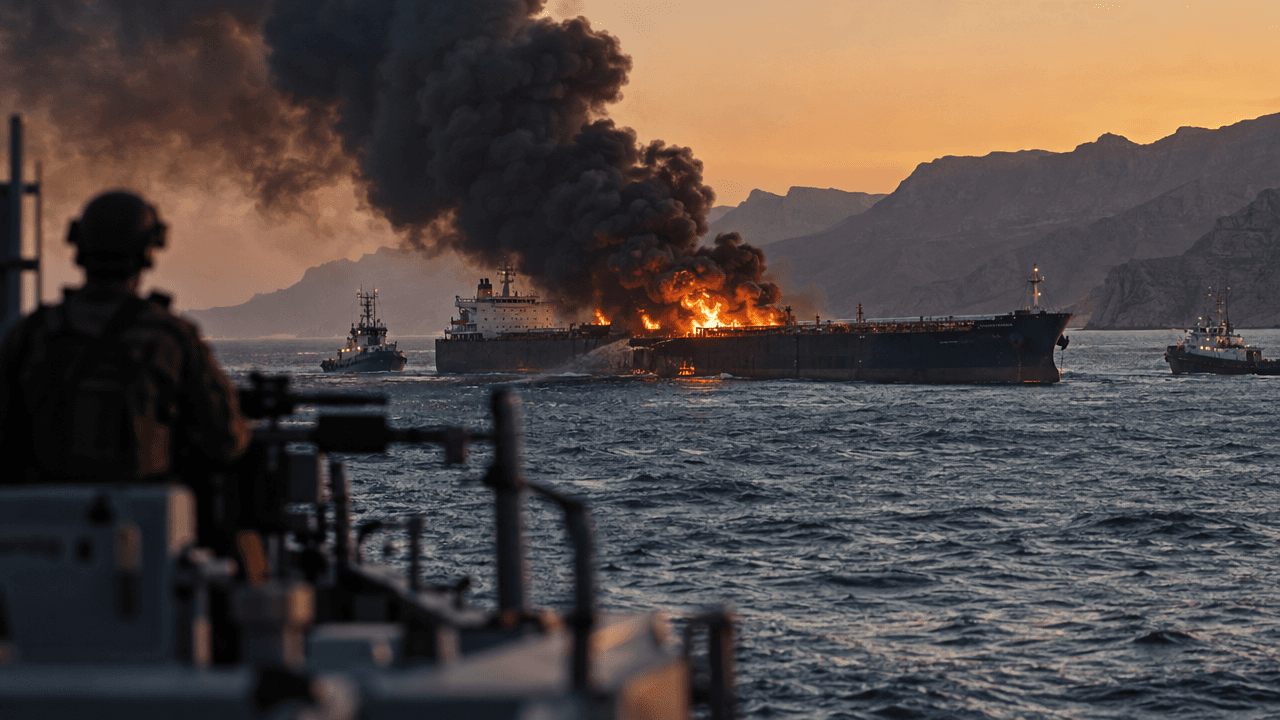
Oil prices climbed sharply as a tanker attack in the Strait of Hormuz revived fears that escalating regional tensions could disrupt one of the world’s most important energy corridors. Brent crude traded near $116 per barrel and was on track for a fourth consecutive monthly gain, while West Texas Intermediate remained above $100. [1][3]
The immediate market reaction reflects more than the damage to one vessel. Traders are pricing in the possibility that repeated attacks could make shipping through the waterway slower, more expensive, or temporarily unsafe. In oil markets, even a perceived threat to future supply can raise prices before any barrels are physically removed from the global market.
Why The Strait Of Hormuz Matters
The Strait of Hormuz connects the Persian Gulf with the Gulf of Oman and the wider Arabian Sea. It is a critical export route for crude oil and refined fuels produced by Gulf nations. Any security incident in the area can therefore affect producers, shipping companies, refiners, airlines, manufacturers, and consumers worldwide.
The latest incident involved a tanker reportedly hit by explosive devices attached by a small boat, according to the United Kingdom Maritime Trade Operations organization. [2] The event adds to a series of attacks and maritime warnings that have increased uncertainty for vessels operating through the region.
Oil markets respond particularly strongly to risks involving chokepoints. A chokepoint is a narrow transportation route through which a large volume of global trade must pass. If traffic is delayed or rerouted, available supplies can tighten in key regions even when total production has not yet fallen.
The potential impact extends beyond crude. Tanker insurance premiums may rise, crews may demand additional security, and ships may take longer routes around exposed areas. Those costs can eventually feed into gasoline, diesel, jet fuel, and petrochemical prices.
Why Oil Prices Are Rising
The latest rally is being driven by a supply-risk premium. This premium represents the extra amount traders are willing to pay for oil because future availability has become less certain.
Brent crude was reported near $116 per barrel, with prices heading toward a monthly increase of roughly 11% to 13%, depending on the market measure and point in the trading session. WTI was also positioned for a strong monthly advance of approximately 14%. [2][3]
The market is not necessarily saying that a full closure of the Strait is inevitable. Instead, prices are reacting to a wider range of possible outcomes. A limited incident could cause only a brief price spike. A campaign of repeated attacks could disrupt shipping schedules. A broader military escalation could threaten exports, production facilities, and regional infrastructure.
This is why oil can rise rapidly on news that does not immediately change production figures. Energy traders are constantly assessing what might happen next, and the possibility of a larger disruption can influence futures prices today.
The advance also reflects momentum. With Brent heading for a fourth straight monthly gain, trend-following traders may add to long positions, while producers and consumers adjust hedging strategies. Strong upward momentum can amplify the initial response to geopolitical news.
What Traders Should Watch Next
The most important question is whether the latest attack remains an isolated event or becomes part of a sustained pattern. Traders should monitor official maritime advisories, reports of additional incidents, vessel traffic through the Strait, and any changes to insurance or freight costs.
They should also track physical market indicators. These include regional crude differentials, tanker rates, refinery margins, inventory data, and delivery schedules. A lasting disruption would likely appear in several of these measures rather than in the futures price alone.
The futures curve is another useful signal. If near-term contracts rise more sharply than later-dated contracts, the market may be responding to immediate scarcity concerns. If longer-dated prices also move substantially higher, traders may be assigning greater probability to a prolonged disruption.
Currency markets and central-bank expectations matter as well. Higher energy prices can increase inflation pressure, particularly in countries that import substantial volumes of oil. If fuel costs remain elevated, investors may reassess interest-rate expectations, consumer spending forecasts, and the outlook for transport-heavy industries.
Implications For Simfi Traders
For SimFi traders, this event provides a practical lesson in managing headline risk. Geopolitical markets can move quickly, and a trade based solely on the first news report may carry significant execution risk.
A disciplined approach begins with defining the trade thesis. Is the position based on a short-term volatility spike, a sustained supply disruption, or a broader trend in energy prices? Each thesis requires a different timeframe and risk limit.
Position sizing is especially important when oil is moving rapidly. Traders should calculate potential losses before entering a position and avoid increasing exposure simply because prices are rising. Stop levels should account for normal volatility while still protecting the trading account from an unexpectedly sharp reversal.
It is also useful to identify invalidation signals. For example, a position expecting continued upside may need to be reconsidered if shipping resumes normally, diplomatic tensions ease, or additional supply reaches the market.
Finally, traders should remember that oil prices can fall even during a geopolitical crisis. If the market concludes that supplies remain available, the risk premium can unwind quickly. Profit-taking, emergency stock releases, weaker demand, or a stronger dollar can all pressure crude lower.
The Bigger Market Picture
The Strait of Hormuz attack has placed supply security at the center of the oil market once again. Brent’s move near $116 and its potential fourth consecutive monthly gain show how strongly traders are responding to uncertainty. [8]
The next stage will depend on whether security risks intensify and begin to affect actual flows. Until that becomes clearer, volatility is likely to remain elevated. For traders, the key lesson is straightforward: geopolitical headlines can create opportunity, but only when paired with careful position sizing, multiple data checks, and a clearly defined exit plan.