
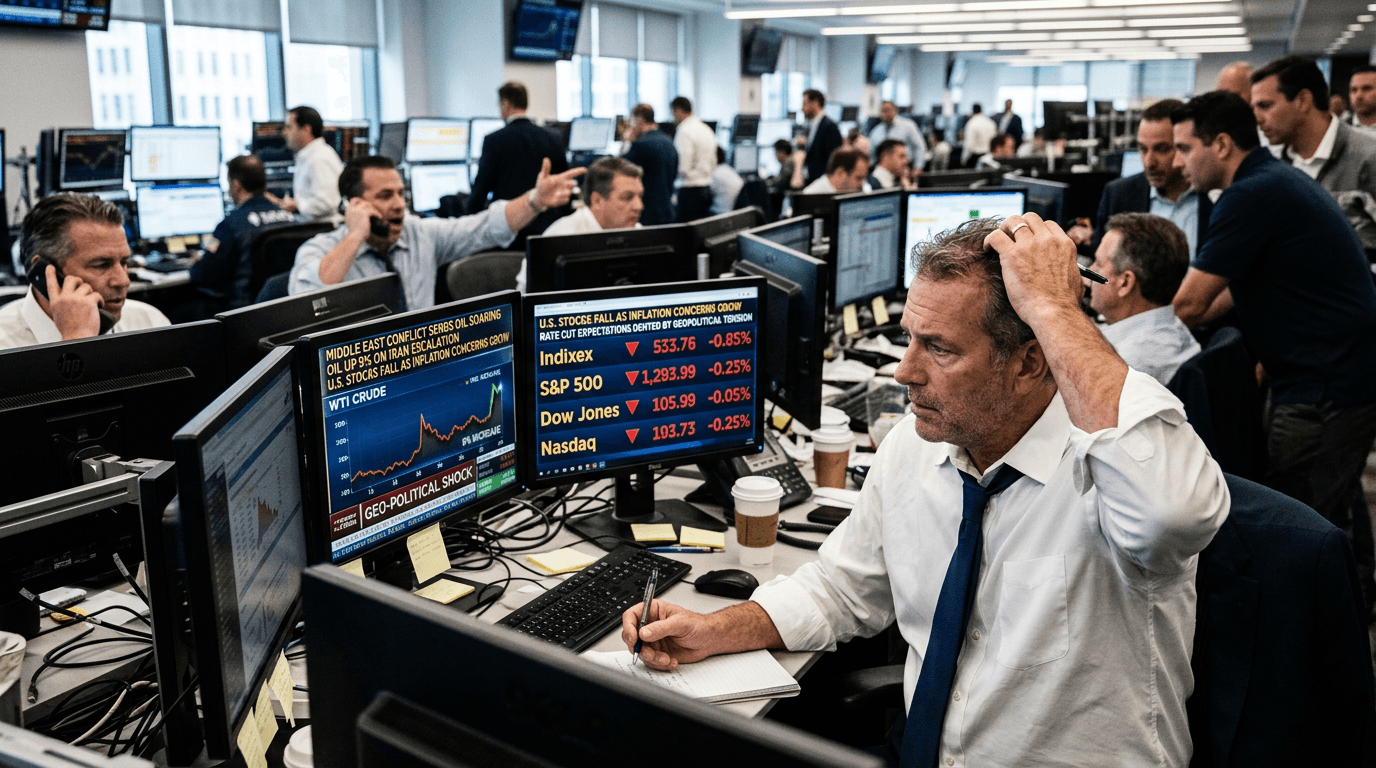
A 9% one-day jump in crude oil, pushing U.S. benchmarks into the mid‑$80s and Brent even higher before retracing, is more than just a volatile headline move—it is a fresh shock to energy costs that is rippling through U.S. equities and reigniting worries about inflation and interest-rate cuts.[3][6][8] As traders and investors recalibrate to this new risk environment, understanding how geopolitics feeds into prices and policy expectations is essential.
Oil Spike Rooted In Middle East Turmoil
The latest surge in oil is directly tied to the intensifying war involving Iran, which has upended production and shipping across the Middle East.[3] Concerns over potential attacks have slowed tanker traffic through the Strait of Hormuz—a chokepoint that carries roughly a fifth of global oil flows and a large share of liquefied natural gas exports.[6][8] When a corridor moving around 20 million barrels per day is threatened, even incremental disruptions can have outsized price effects.
Earlier in the conflict, crude briefly traded near $119 per barrel as supply fears peaked, before dropping back below $90 when markets sensed a possible de‑escalation.[3] The latest 9% spike to the mid‑$80s underscores that, despite intermittent retracements, energy markets remain extremely sensitive to military news and diplomatic signals. Each flare-up effectively reprices the “geopolitical risk premium” embedded in oil futures.
From Energy Costs To Inflation Expectations
Oil is a foundational input for the global economy: it powers transport, heats homes, and feeds into the production and distribution of food and manufactured goods. Historically, sustained oil‑price spikes have pushed inflation higher and growth lower, as households and firms absorb higher costs.[8] That pattern is visible today in elevated gasoline, diesel, and jet fuel prices, which continue to squeeze consumers and businesses worldwide.[2][3]
In the U.S., the average price of regular gasoline remains significantly above pre‑war levels, even after some recent easing.[2] This persistence matters for inflation expectations. When consumers see fuel costs stay high, they tend to assume broader prices will also remain elevated. In financial markets, similar logic plays out through inflation-linked bonds and swaps: a sharp move in crude often lifts breakeven inflation rates, signaling that investors now expect a slower path back to central bank targets.[8]
That, in turn, complicates the interest-rate outlook. Prior to the latest spike, markets had been pricing in a relatively smooth trajectory of rate cuts as inflation cooled. Higher energy costs challenge that narrative. If inflation expectations drift upward, policymakers may feel compelled to delay or scale back easing, and traders adjust rate-futures pricing accordingly—revising the timing and magnitude of anticipated cuts.[3][8]
Why Us Stocks Sold Off
Equity markets typically struggle when oil and inflation risks rise together. Since the Iran conflict began, global stock prices have declined and volatility has increased, reflecting concerns about higher input costs and tighter financial conditions.[3][8] The latest 9% jump in crude has fed into a renewed equity sell‑off, especially in sectors most exposed to fuel and transport expenses.
For U.S. companies, higher energy prices can squeeze profit margins if costs cannot be passed on fully to customers. Airlines, logistics firms, manufacturers, and consumer discretionary names are particularly vulnerable. At the same time, expectations of slower rate cuts lift bond yields, which tend to compress equity valuations by raising discount rates on future earnings.[8] The combination—higher costs and higher yields—is a challenging backdrop for broad stock indices.
Sector performance is not uniform, however. Energy producers and some commodity-linked businesses can benefit from higher prices, while defensive sectors such as utilities and consumer staples may attract flows as investors seek resilience. The rotation echoes earlier episodes, such as the 2022 surge following Russia’s invasion of Ukraine, when oil neared $140 on an inflation‑adjusted basis and energy names outperformed much of the market.[1][8]
Bonds, Commodity Futures And The Rate Path
Bond markets have responded to the conflict and energy shock with higher yields across major advanced economies, reflecting both increased inflation risk and diminished confidence in a rapid return to low rates.[8] Short-maturity yields move as traders reprice the near-term policy path; longer-maturity yields embed a higher term premium as geopolitical and inflation uncertainties rise.
In commodity markets, futures curves for oil and gas have been repeatedly reshaped by shifting expectations about the duration and severity of supply disruptions. Analysts have warned that a prolonged closure of the Strait of Hormuz could push crude toward $150 per barrel, exceeding past peaks near $147 in 2008.[3] Even if that scenario does not materialize, the mere possibility forces the market to price a “fat tail” of upside risk.
European energy futures have also seen sharp moves, with oil spiking around 8% and benchmark gas prices jumping roughly 20% on one recent escalation day.[6] For portfolio managers, these cross‑regional shocks matter because they feed into global inflation and growth assumptions, influencing asset allocation across bonds, equities, and commodities.
What Traders Can Do In A Simulated Environment
For traders and students of the market, this kind of geopolitically driven volatility is an opportunity to deepen understanding of cross‑asset dynamics without taking undue real‑world risk. The current environment highlights several key lessons that can be explored in a simulated finance setting.
First, scenario analysis is essential. Traders can map outcomes ranging from quick de‑escalation to prolonged conflict and assess how each would affect oil, inflation expectations, rate paths, and equity sectors. Second, it is important to study transmission channels: how moves in crude influence breakeven inflation, Treasury yields, growth-sensitive stocks, and currencies of energy importers versus exporters.[3][8]
Third, risk management must adapt to higher volatility. Position sizing, diversification across asset classes, and the use of options for hedging sudden price gaps become more critical. Simulated trading environments allow participants to test these tools under stress conditions—large one‑day moves, gap risk around news events, and shifting correlations—without the emotional and financial strain of live exposure.
Finally, time horizons matter. In the short term, headlines about the Strait of Hormuz or diplomatic talks can drive intraday swings of several percentage points.[3][6] Over longer horizons, the key question is whether elevated energy prices persist enough to entrench inflation and slow growth, or whether supply adjusts and prices normalize. Differentiating between these time frames helps traders avoid overreacting to noise while still respecting genuine regime shifts.
The latest 9% spike in crude, its impact on U.S. stocks, and the repricing of inflation and rate expectations are all reminders that markets remain tightly bound to geopolitical risk. By studying how energy shocks propagate through prices and policy, traders can build more robust frameworks—whether they are managing real portfolios or refining strategies in a simulated environment.