
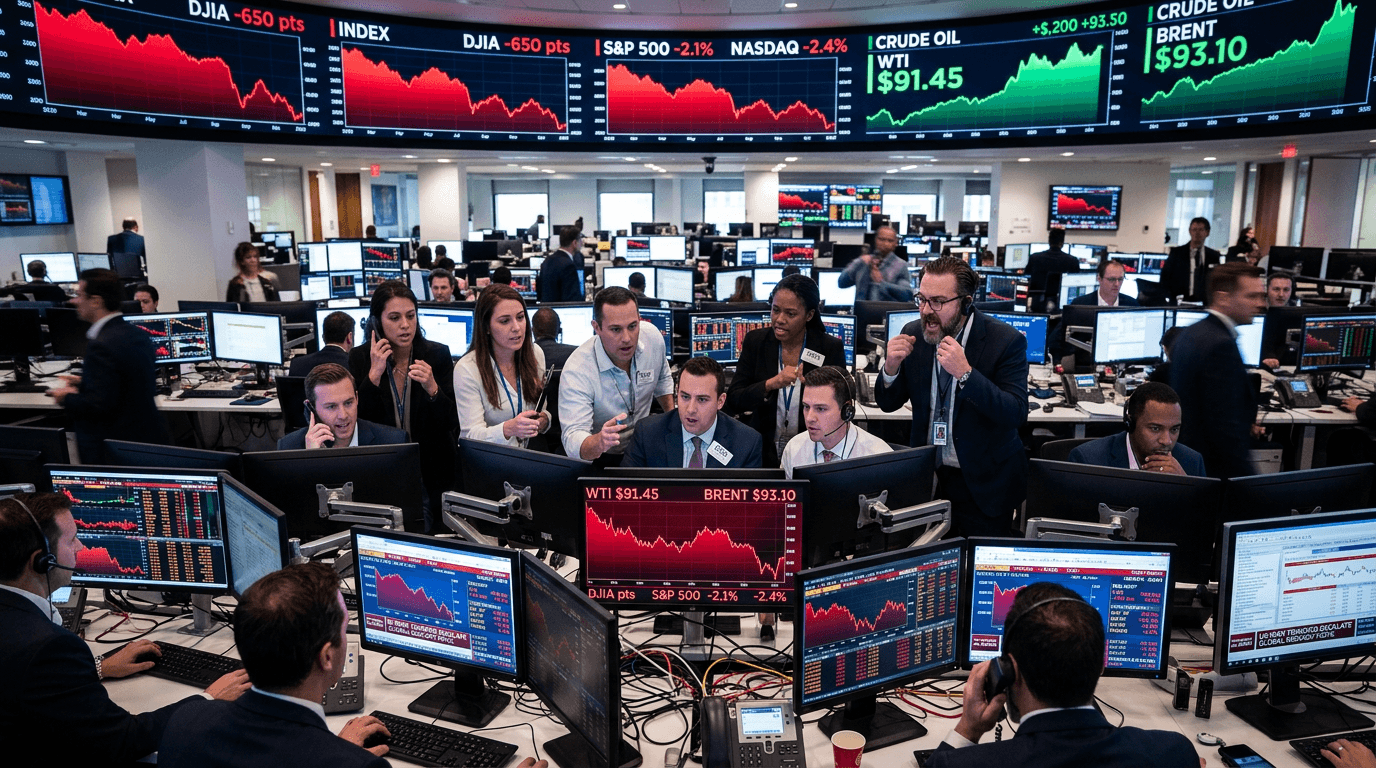
Renewed fighting between the United States and Iran has once again reminded markets how quickly geopolitics can move prices, sentiment, and risk appetite. Oil has surged above $90 a barrel as tanker attacks and strikes around the Strait of Hormuz raise fears of supply disruption, and investors have responded by rotating aggressively out of risk assets and into perceived havens.[10][12][14] Equities across the US, Europe, and Asia have sold off, bond yields have jumped in a sharp global sell-off, and the US dollar has strengthened against risk-sensitive currencies.[1][8][11] For traders, this is a classic risk-off episode driven by a geopolitical shock, but with modern liquidity, leverage, and algorithmic trading amplifying every headline.
Global Risk-off: How Markets Are Repricing Risk
The renewed kinetic conflict has focused attention on the Strait of Hormuz, a narrow chokepoint through which a large share of global seaborne crude flows each day.[1][2][9] Any perceived threat to shipping in this corridor tends to be priced immediately as a higher risk premium in oil and related assets. With reports of tanker and infrastructure strikes, crude benchmarks have pushed above $90 and towards multi-week highs, reflecting both actual and potential supply risk.[10][12][14] Higher energy prices feed directly into inflation expectations and growth concerns, which is why the shock is not confined to commodity markets. Equities in major regions have fallen as investors reduce exposure to cyclical sectors, travel and airlines, and emerging markets that are particularly vulnerable to higher input costs and funding stress.[1][8]
The fixed income response highlights how nuanced “safe haven” behavior can be. In this episode, bond yields have risen as investors demand higher compensation for inflation and fiscal risks, even as they reduce equity exposure. That combination—falling stocks and rising yields—signals a stagflation-style worry rather than a simple growth scare. At the same time, the US dollar has gained ground as global investors seek liquidity and funding safety, pressuring risk FX such as commodity and emerging-market currencies.[7][11][14] For traders, the lesson is that not all risk-off environments look the same; the pattern of moves across stocks, bonds, FX, and commodities tells you what type of risk the market is most concerned about.
Why Oil Shocks Hit Everything
Oil price spikes matter because they operate like a tax on the global economy. When crude jumps from the 70s and 80s into the 90s or beyond in a short period, energy-intensive sectors see immediate margin pressure, and consumers face higher transportation and utility costs.[2][6] This squeezes discretionary spending and can dampen growth, especially in economies that import most of their energy. For central banks already struggling to balance inflation control with growth support, another energy shock complicates the policy outlook and can delay rate cuts or even resurrect the possibility of further tightening.[2][6]
Different regions react differently depending on whether they are net importers or exporters. Oil-exporting economies and their currencies can benefit from higher prices, but even they face heightened volatility and political risk premia. Import-heavy economies in Asia and Europe are typically more vulnerable to an oil spike, as their trade balances and corporate profitability are more directly exposed.[8][9] Equity investors respond by adjusting sector allocation—reducing exposure to airlines, logistics, and chemicals while favoring energy producers and select commodity names. The result is a broad but uneven risk-off move, where index-level declines can mask dramatic rotations beneath the surface.
Asset correlations also tend to change during energy-led shocks. Historically, sharp oil spikes associated with geopolitical stress have increased the correlation between equities and high-yield credit, while sometimes reducing the traditional stock–Treasury hedge if inflation fears dominate. That means strategies relying on past correlation patterns may underperform precisely when risk management is most critical. Traders who understand how macro shocks propagate through cross-asset relationships are better positioned to avoid crowded trades and position for the next phase of the move.
Implications For Different Asset Classes
In equities, the headline is straightforward: global indices are lower, volatility is higher, and defensives and energy-related names are outperforming cyclical growth stories.[1][8] But the nuance lies in how quickly expectations can adjust. Earnings estimates for energy-intensive sectors may be revised down, while analysts upgrade forecasts for integrated oil majors and select commodity producers. For active traders, this opens relative-value opportunities—long energy vs. short industrials, or long quality defensives vs. leveraged cyclicals—rather than just a simple “sell everything” mindset.
In fixed income, rising yields during a risk-off move often surprise newer traders who expect bonds to rally automatically. When the shock is inflationary and tied to commodities, markets may price higher inflation breakevens and term premia, pushing long-term yields up even as growth expectations soften.[6][11] Credit spreads can widen as investors demand more compensation for default risk, especially in lower-rated issuers and emerging-market borrowers that face higher funding costs. Positioning matters: portfolios heavy in long-duration bonds can see mark-to-market losses even if credit risk remains low.
In FX, the pattern has been classic: the US dollar strengthens, while high-beta and carry currencies (such as some emerging-market and commodity-linked FX) underperform.[7][11][14] This reflects a combination of safe-haven demand, repatriation flows, and reduced appetite for leveraged carry trades when volatility rises. For traders, FX often reacts first and fastest to geopolitical headlines, making it a key channel for expressing macro views with tight risk controls.
Lessons For Traders In A Simulated Environment
For traders using a SimFi environment, events like this are invaluable real-time case studies in macro risk management. The goal is not just to “trade the news” but to understand how different assets respond at each stage of a shock: initial headline, confirmation, policy reaction, and eventual normalization. A simulated account lets traders practice building and unwinding cross-asset positions—such as long oil, short airlines, and long USD against risk FX—without the psychological pressure of real capital at risk.
Scenario planning is crucial. Traders can construct playbooks that define how they respond if oil breaks above key levels, if equities drop a certain percentage, or if bond yields move sharply higher. Pre-defined rules around position sizing, stop-losses, and correlation risk help prevent emotional decisions when markets are moving quickly. In a SimFi setup, backtesting these rules across past geopolitical shocks (including previous Middle East conflicts or supply disruptions) can reveal how robust a strategy really is under stress.
Risk management is the common denominator. Volatility spikes can widen spreads and reduce liquidity, leading to slippage and gaps. Simulated trading allows participants to rehearse how they would adjust leverage, tighten stops, or reduce concentration when volatility regimes shift. It also encourages traders to think in terms of portfolio risk rather than single trades—understanding how multiple positions may be implicitly long or short the same macro factor.
What To Watch Next
Looking ahead, traders will focus on whether the conflict escalates or stabilizes, and how policymakers respond. Further disruption to the Strait of Hormuz or regional infrastructure could push oil higher still, intensifying inflation and growth concerns.[1][2][9][12] Conversely, signs of de-escalation or credible diplomatic progress could unwind some of the risk premia embedded in energy and risk assets. Central bank communication will be critical: a more hawkish tone in response to higher energy prices could weigh further on bonds and equities, while a patient stance might limit the damage to risk sentiment.
For active traders, the key is flexibility. Markets can transition quickly from panic to relief, turning profitable hedges into laggards if positions are not adjusted as conditions change. Maintaining a clear framework—understanding what type of shock this is, which assets are most exposed, and how policy might evolve—helps distinguish signal from noise. In a simulated environment, each headline and price swing becomes a training opportunity, sharpening skills that can later be applied to live capital.
Ultimately, episodes like this underscore how interconnected modern markets are. A regional conflict can ripple through oil, inflation expectations, bond markets, currencies, and equities within hours. Traders who treat geopolitics as part of their regular risk framework, rather than an occasional surprise, are better positioned to navigate the next shock—whether it starts in the Middle East, another key commodity region, or an entirely different corner of the global economy.