
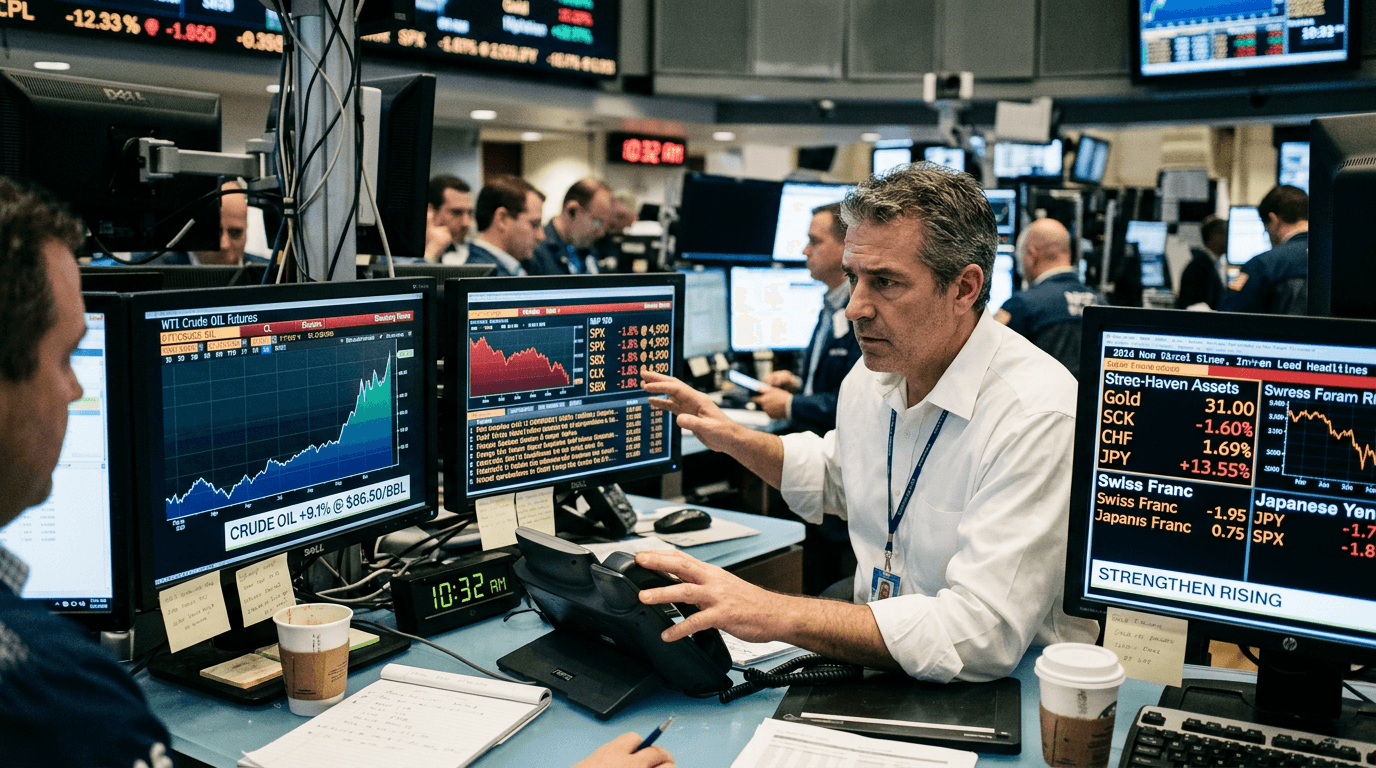
Oil prices are back in the spotlight, with crude futures surging roughly 9% as tensions between the United States and Iran escalate, pushing West Texas Intermediate (WTI) into the low‑$80s and Brent into the mid‑$80s. The move has rattled global risk sentiment, pressuring US and European equity indices while driving renewed demand for classic safe havens like gold and the Japanese yen.
Why Oil Futures Are Spiking
Oil markets are hypersensitive to any conflict that threatens supply routes, and few chokepoints matter more than the Strait of Hormuz, the narrow passage through which a significant share of global seaborne crude flows.[5] When Iran–US tensions rise in this region, traders immediately reassess the probability of disruptions to shipping and insurance costs for tankers, repricing risk into futures curves.[5]
Historically, each flare‑up between the US and Iran has sparked a spike in crude, whether driven by direct military exchanges, attacks on infrastructure, or restrictions on shipping lanes.[3][4] Recent escalations have included missile and drone activity as well as strikes on strategic assets, all of which feed the narrative that supply could be constrained, even if barrels are not yet removed from the market.[3][6]
A 9% intraday jump in futures is a classic “risk premium” move rather than a pure demand story. Traders are not suddenly expecting global consumption to explode; they are pricing in higher odds of: - Disruptions to exports from the Gulf - Higher freight and insurance costs - Potential sanctions or retaliatory production cuts
For active traders, the key point is that geopolitical risk can reprice oil futures far faster than macro data alone. That makes position sizing, stop‑loss discipline, and scenario planning essential when trading energy contracts or correlated assets in a simulated or live environment.
How Higher Oil Weighs On Equities
Equity markets dislike sharp, unexpected increases in input costs, and crude is a foundational input for the global economy. When oil spikes, it acts like an additional tax on consumers and businesses, squeezing margins and discretionary spending.
The immediate reaction to the latest surge has been pressure on major US indices and European benchmarks, with risk‑off sentiment concentrated in: - Energy‑intensive sectors such as airlines, transportation, and manufacturing - Consumer discretionary names exposed to higher fuel and logistics costs - Growth stocks that are sensitive to higher inflation and bond yields
Oil spikes can also complicate the inflation outlook. If higher energy prices feed through to headline inflation, they can influence expectations for central bank policy, potentially keeping interest rates higher for longer. That, in turn, can weigh on valuation multiples, particularly for high‑duration assets like tech and growth equities.
Not all equity groups move the same way, though. Energy producers and some commodity‑linked names may benefit from higher oil prices, as their revenue outlook improves. For traders, this creates an important internal rotation: - Energy and select commodity stocks can act as partial hedges - Industrials, airlines, and consumer names may underperform - Index futures can mask sharp divergences at the sector level
In a SimFi environment, this is a powerful learning opportunity: traders can test hedging strategies, such as pairing long positions in energy with short exposure to vulnerable sectors, and observe how correlations behave during periods of stress.
Safe Havens Back In Focus: Gold, Yen, And Beyond
Whenever geopolitical risk intensifies, markets tend to revert to familiar safe havens. In the current episode, safe‑haven flows into gold and the Japanese yen have picked up as oil surged and risk assets sold off.
Gold often benefits from a combination of geopolitical uncertainty and concerns about inflationary pressures, both of which are in play when energy prices jump. Historically, Middle East tensions that push oil higher have coincided with robust bids for bullion as investors seek an asset outside the fiat and credit system.[5]
The Japanese yen plays a similar role in FX markets. In risk‑off episodes, investors often unwind carry trades funded in yen and rotate into lower‑volatility assets, driving the currency higher against risk‑sensitive peers. During spikes in US–Iran tensions, this pattern has tended to repeat, with yen strength aligning with weakness in equities and strength in oil.[3][5]
US Treasuries also typically attract demand as investors seek safety and liquidity, although the interaction between higher inflation risk (from oil) and safe‑haven demand (from geopolitics) can create cross‑currents in yields.
For traders, the big picture is that a sudden oil shock rarely stays confined to the energy complex. It reverberates across: - Equities (risk‑off) - FX (yen and sometimes Swiss franc strength) - Commodities (gold and, indirectly, other metals) - Rates (competing forces on yields)
Trading Implications In A Simulated Environment
A simulated trading environment is an ideal place to explore how these cross‑asset linkages behave without real‑world capital at risk. When oil futures spike on geopolitical headlines, several practical strategies can be tested:
1. Correlation and hedging experiments Set up simultaneous positions in: - Crude oil futures or oil‑linked CFDs - Major equity indices (e.g., US or European indices) - Gold or gold‑linked products - Key FX pairs such as USD/JPY
Track how P&L moves across the book when new headlines hit. This helps build an intuitive feel for which assets tend to move together and which can serve as hedges during energy shocks.
2. Event‑driven playbooks Backtest how markets reacted to previous US–Iran flare‑ups and similar geopolitical shocks.[3][4][6] Use that historical behavior to sketch a playbook: - What typically happens in the first hour after the headline? - How do moves evolve over 1–3 days? - Which assets mean‑revert fastest, and which trends persist?
With simulated capital, traders can test whether buying volatility, fading initial moves, or riding momentum has historically produced better outcomes during these events.
3. Risk management under stress Volatility clustering is common around geopolitical shocks: big moves tend to be followed by more big moves. Use this environment to practice: - Dynamic position sizing (smaller size in higher volatility) - Wider but clearly defined stop‑losses - Avoiding concentration in a single theme (e.g., all trades tied to oil)
These skills are critical when markets transition suddenly from calm to stressed conditions.
Final Thoughts
The latest spike in oil futures on escalating US–Iran tensions is a textbook example of how geopolitical risk can ripple through markets: crude surges, equities wobble, and safe havens like gold and the yen attract renewed interest.[3][5][6] For traders, the value lies not just in reacting to the headline, but in understanding the chain reaction across asset classes.
In a SimFi setting, you have a unique opportunity to turn this volatility into a learning laboratory. By tracking correlations, testing event‑driven strategies, and refining risk management in real time, you can build a robust playbook that will serve you well when similar shocks hit in the future—whether driven by geopolitics, policy decisions, or unexpected macro data.