
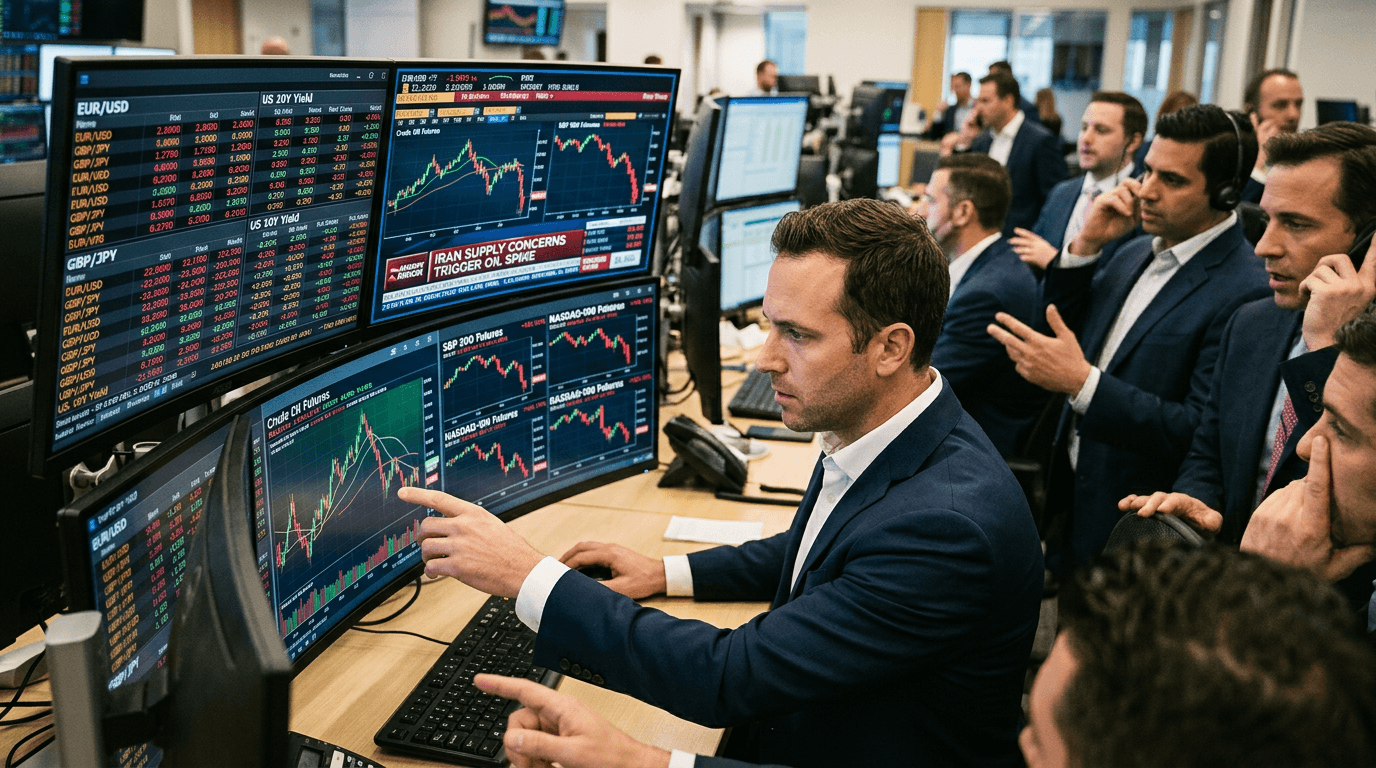
Oil is back at the center of the macro story as fresh Iran conflict headlines drive a sharp repricing across energy, FX, and futures markets. A roughly 9% jump in crude has pushed WTI into the mid‑$80s and Brent toward the high‑$80s, as traders rapidly rebuild a geopolitical risk premium into prices and reassess global growth, inflation, and policy paths.[2][1] The result: risk sentiment is wobbling, with commodity‑linked currencies firming, rate expectations shifting, and equity index futures under pressure.[2][1]
Geopolitical Shock Hits Oil
The immediate trigger for the spike is the latest escalation involving Iran, a key player in Middle East politics and a central actor around the Strait of Hormuz, one of the world’s most critical energy chokepoints.[1][2] Roughly one‑fifth of global petroleum supply and about 20 million barrels of oil per day normally flow through this narrow waterway, along with around 15% of global LNG.[2][4] Any hint of disruption there commands market attention.
Importantly, markets are reacting not just to actual barrels off the market, but to a higher probability of future disruption. That probability gets capitalized into an oil “risk premium” on top of already tighter fundamentals after months of firm demand and disciplined OPEC+ supply management.[1][2] Estimates suggest current prices embed a sizable geopolitical premium equivalent to several weeks of fully halted flows through Hormuz.[2]
This is not the first spike of the conflict. Earlier phases saw crude futures briefly trade above $100 per barrel as worst‑case scenarios were priced in, before partial reversals as contingency plans emerged and fears were reassessed.[3][4] The current move back into the $80s highlights how sensitive energy markets remain to every incremental headline.
Why Fx Traders Care About An Oil Spike
For FX traders, an oil shock is rarely just a commodity story; it is a global terms‑of‑trade shock that creates clear winners and losers. Oil‑exporting countries tend to see stronger currencies as higher prices improve trade balances and fiscal positions, while major importers face pressure from deteriorating balances and higher input costs.[1][5]
Historically, large commodity exporters such as Canada and Norway often benefit when crude rallies, with the Canadian dollar (CAD) and Norwegian krone (NOK) finding support as higher oil revenues boost growth and external balances.[1] During the 2022 Russia‑Ukraine shock, Brazil’s real became one of the world’s best‑performing currencies as markets rewarded its commodity‑rich profile, a pattern some analysts expect to repeat in the current Iran conflict.[5]
On the other side, heavy importers in Asia and Europe can come under strain as energy costs squeeze consumers and corporates. That raises questions about growth and forces central banks to choose between fighting higher inflation or supporting weaker activity. Emerging markets that rely heavily on imported energy are especially vulnerable: a sustained oil shock can widen current‑account deficits, add FX pressure, and push local central banks into more aggressive tightening.[1][2]
Safe‑haven dynamics layer on top of this. Geopolitical stress tends to support the U.S. dollar and safe‑haven currencies like the Swiss franc, while also lifting gold and other precious metals as part of the so‑called “debasement trade.”[2][5] In practice, this can produce a complex FX tape: commodity exporters bid, fragile importers sold, and safe havens resilient, all at once.
Futures Markets: Oil, Rates, And Equity Index Flows
The oil shock is not occurring in isolation. It is immediately visible in futures pricing across asset classes, from crude contracts to index and rates futures.
In energy, front‑month WTI and Brent futures have jumped sharply, with volatility elevated and curves often flipping into deeper backwardation as near‑term scarcity risk is priced more aggressively than longer‑dated supply.[1][2] That backwardation can create roll yield opportunities or costs, depending on whether traders are long or short the front end.
On the rates side, higher oil prices feed directly into inflation expectations. Breakeven rates on inflation‑linked bonds tend to rise when markets anticipate a sustained energy shock, and nominal yields can move higher as investors demand compensation for future price pressures.[1][4] That, in turn, feeds into rate‑futures pricing: traders may reduce the probability of near‑term rate cuts or even price in additional tightening if central banks are seen as needing to lean against an inflation resurgence.[2][4]
Equity index futures are reflecting the classic “stagflation scare” mix. Higher input costs weigh on margins and consumer spending, pressuring broad indices, while energy sector futures and related equities often outperform on improved cash‑flow expectations.[1][4] In recent sessions, U.S. stock index futures have traded lower as oil rallied, even as energy stocks and oilfield services names gained, underscoring the rotation under the surface.[1][2]
FX derivatives are reacting as well. FX options volumes have picked up as traders look to hedge gaps and exploit the jump in implied volatility, even though higher option prices and short‑lived opportunities make execution more challenging.[6] For macro and cross‑asset traders, this is a full‑spectrum volatility event.
TRADING PLAYBOOK: NAVIGATING OIL‑DRIVEN RISK SENTIMENT
For discretionary and systematic traders alike, an oil‑driven geopolitical shock is less about predicting headlines and more about preparing for regimes. A few practical principles stand out in this environment.
First, position sizing becomes critical. When daily ranges expand sharply in crude, FX, and equity futures, leverage that felt conservative in calmer markets can quickly become dangerous.[1] Smaller, more flexible sizing helps traders survive the inevitable noise and whipsaws.
Second, risk management needs to account for gaps and illiquidity. Hard stop‑loss orders can protect against catastrophic moves but may suffer poor fills when markets gap on headlines; softer, discretionary exits require discipline and a clear framework to avoid emotional decision‑making.[1] Pre‑planning “if X, then Y” scenarios—such as further escalation, partial de‑escalation, or policy intervention—can reduce impulsive trades when volatility spikes.[1]
Third, cross‑asset awareness is no longer optional. Index or FX traders who ignore the crude tape risk being blindsided by moves that are actually energy‑driven. Watching key levels in WTI and Brent, along with inflation expectations and rate‑futures pricing, provides context for risk sentiment in equity and FX markets.[1][2][4] For instance, a renewed surge in oil alongside rising breakevens and falling equity futures is a very different environment from a benign, growth‑driven rally in commodities.
Finally, simulated trading environments can be particularly valuable during geopolitical shocks. They allow traders to test playbooks around commodity‑FX pairs, index futures, and rate‑sensitive strategies without real capital at risk, while still experiencing the fast feedback loop of live‑like volatility. That helps refine execution, risk limits, and scenario responses before deploying in real markets.
What To Watch Next
From here, the path of markets will hinge on three main dimensions: the severity and duration of any disruption around the Strait of Hormuz; the policy response from major central banks; and how quickly growth expectations adjust.
Signs of sustained physical supply disruption—such as confirmed shipping bottlenecks or extended closures—would likely support a higher and stickier oil risk premium, with ongoing pressure on inflation expectations and rates markets.[1][2] Conversely, credible de‑escalation or alternative supply arrangements could see some of that premium bleed out, with oil, commodity FX, and inflation hedges retracing recent gains.[3][4]
Central banks will be watching whether the oil shock translates into second‑round effects on wages and core inflation. If they judge the move as temporary, they may look through it; if not, the path for rate cuts could become shallower or more delayed, especially in economies already battling above‑target inflation.[2][4]
For traders, the lesson is clear: oil is once again a primary driver of global risk sentiment. Understanding how crude, FX, rates, and index futures interact in a geopolitical shock is no longer a niche skill set—it is a core edge. Those who combine that cross‑asset perspective with disciplined risk management and robust scenario planning will be best positioned to navigate whatever the next Iran headline brings.