
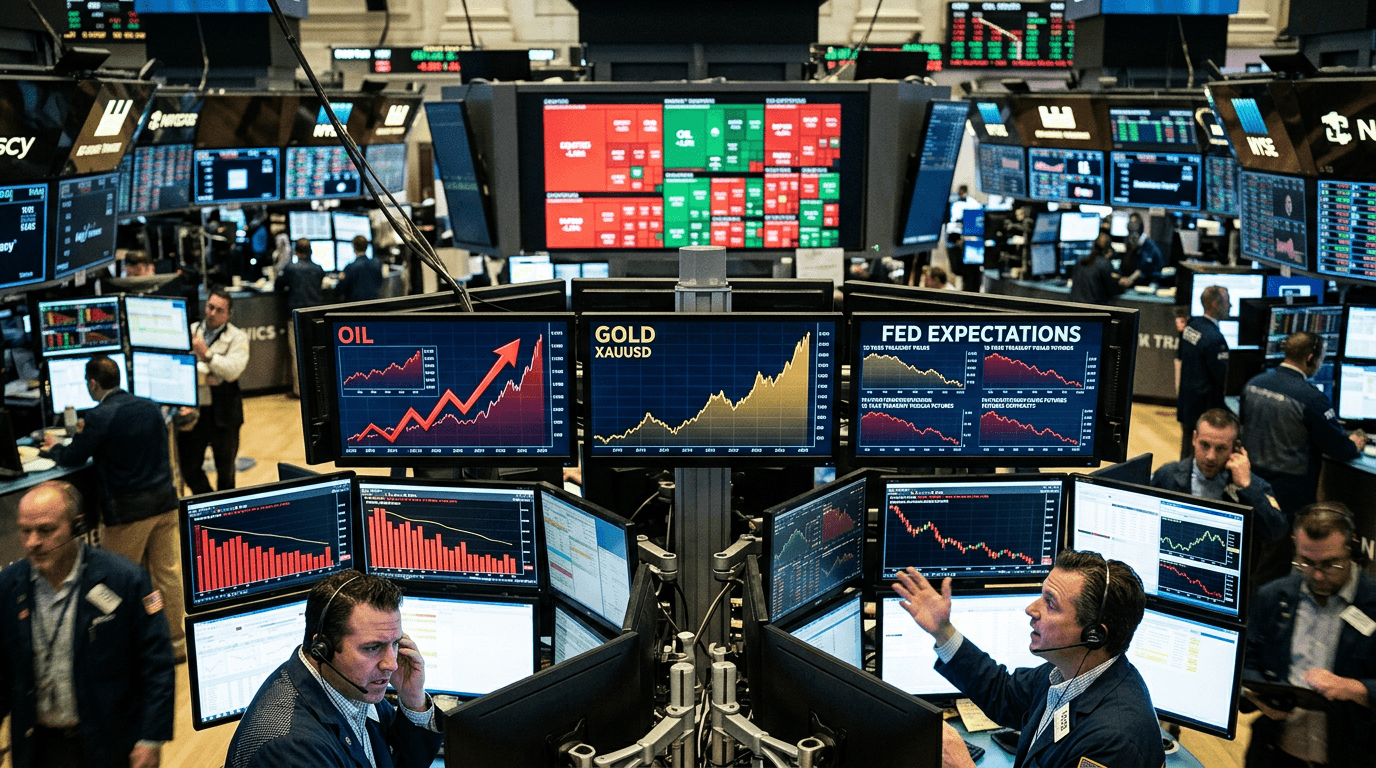
A sharp jump in oil prices and escalating tensions involving Iran have flipped the market mood from “risk on” to “risk off” almost overnight. WTI crude spiked as much as 9% to its highest level since mid‑2024, triggering a late‑session sell‑off in US equities and a surge in demand for gold and other safe havens.[1][3] The move is reverberating across oil, index, and rates futures as traders rapidly reprice near‑term inflation risks and the odds of a more cautious Federal Reserve.[1][5]
WHAT SAFE‑HAVEN FLOWS REALLY MEAN
When geopolitics heat up, markets often default to a familiar script: a “flight to quality” out of risk assets and into instruments that investors trust to hold value during stress.[2][3] These safe havens typically include gold, US Treasuries, the US dollar, the Japanese yen, and the Swiss franc.[2][3] They share common features: deep liquidity, strong sovereign backing, or a long track record as stores of value.
In the latest episode, traditional havens are doing exactly what textbooks suggest. Gold is catching strong bids as investors rotate out of equities and higher‑beta assets, while safe‑haven currencies and government bonds see renewed interest.[1][2][3] This reflects both a desire to reduce portfolio volatility and a search for assets less directly exposed to Middle East risk.
Gold sits at the center of this rotation. It benefits from two simultaneous forces: geopolitical anxiety, which supports it as a crisis hedge, and rising inflation worries as oil climbs, which reinforces its role as a store of purchasing power.[1][5] At the same time, investors remain mindful that higher real yields can cap gold’s upside, creating a delicate balance between safe‑haven demand and rate expectations.[1][5]
Key takeaway: Safe‑haven flows are not abstract—they represent real capital rotation that reshapes correlations, volatility, and liquidity across gold, FX, and rates. Understanding this pattern is crucial for any trader trying to navigate geopolitical shocks.[2][3]
Oil Spike, Inflation Fears, And A More Cautious Fed
The current move in crude is not just a story about supply routes and regional tensions; it is also an inflation story. Disruptions around key shipping lanes and energy infrastructure raise the risk that a larger share of the world’s crude supply becomes constrained, pushing benchmark prices higher.[1][6] Markets know from past episodes that sustained energy spikes tend to feed into headline inflation, transportation costs, and, eventually, consumer prices.
That is why the shock is quickly showing up in rates futures. Traders are pricing in a bump in near‑term inflation and dialing back expectations for aggressive Fed easing.[1][4][5] In previous Middle East flare‑ups, similar patterns emerged: safe‑haven demand lifted the dollar, while probabilities shifted toward either fewer cuts or a potential hike, depending on how persistent the inflation impulse looked.[4]
For policymakers, the challenge is familiar but uncomfortable. On one side, higher oil operates like a tax on consumers and corporate margins, which can weigh on growth. On the other, it risks keeping inflation “sticky,” especially if energy remains elevated for longer. That combination argues for caution: it can justify staying restrictive for longer, even as growth shows signs of strain.[1][5]
Gold finds itself pulled between these forces. Geopolitical risk and higher inflation expectations support it, but any significant repricing of real yields in a more hawkish direction can limit how far and how fast it can run.[1][5] This tension explains why gold often trades in sharp bursts around geopolitical headlines, followed by periods of consolidation as the rates market reassesses.
Key takeaway: When oil spikes on geopolitical news, do not just watch crude—watch breakeven inflation, real yields, and Fed expectations. The relative moves between these markets often set the tone for gold, indices, and FX.[1][4][5]
How Risk Assets And Currencies Are Reacting
The immediate reaction in equities has been classic risk‑off: a broad sell‑off led by cyclical sectors and high‑beta names, particularly those sensitive to energy costs and global trade.[1][3] Index futures are moving in tandem, with implied volatility picking up as traders hedge downside risk and recalibrate positioning.
In credit, risk premia tend to widen when geopolitical uncertainty rises, particularly in high‑yield and emerging‑market debt. While the magnitude depends on how far the conflict escalates, the direction is usually consistent: investors demand more compensation to hold riskier paper during periods of uncertainty.
On the currency side, safe‑haven demand often supports the US dollar, especially when it is combined with expectations of tighter or less accommodative Fed policy.[2][4] Other traditional refuges like the yen and Swiss franc can also benefit, although their performance varies depending on interest rate differentials and local policy settings.[2][3] Emerging‑market currencies and those tied to global growth usually come under pressure.
For gold and other precious metals, volatility typically increases during these episodes. Both safe‑haven and inflation‑hedging narratives come into play, but the path is rarely linear. Traders need to be prepared for intraday reversals as headlines shift, order flow changes, and macro data points intersect with geopolitical developments.[1][3][5]
Key takeaway: In risk‑off regimes driven by geopolitics, the playbook is broad: equities and high‑yield weaken, safe‑haven FX and quality bonds firm, and volatility rises. Gold becomes a focal asset, but its path is shaped by both fear and rates.[1][2][3][5]
Trading Implications In A Simulated Environment
For traders using a SimFi platform, this kind of macro shock is an opportunity to stress‑test strategies in a realistic but risk‑free setting. The current environment touches multiple key markets at once: oil futures, equity index futures, rates futures, gold, and major FX pairs.[1][3] That makes it an ideal backdrop to practice cross‑asset thinking.
In a simulated account, traders can experiment with:
- Hedging equity exposure with gold or volatility products when geopolitical risk rises.
- Trading relative moves between oil and airline or transport‑linked indices, exploring how higher fuel costs affect sector performance.
- Using rates and Fed funds futures to express views on how persistent the inflation impulse will be and how the Fed might respond.[1][4][5]
- Testing correlation breakdowns—such as moments when gold and the dollar rise together, or when bonds and equities both sell off.[1][2][3]
Because no single safe haven protects perfectly in every crisis, a simulated environment is also a powerful way to explore diversification. Traders can model portfolios that mix liquidity (cash, Treasuries), currency exposure (USD, JPY, CHF), and hard assets (gold) to see how different combinations behave under stress.[2][3]
Key takeaway: Use simulated markets to build intuition about how oil, gold, indices, and rates interact during geopolitical shocks. The goal is not just to “chase the move,” but to understand the cross‑asset narrative driving it.[1][3][5]
What This Means For Traders Going Forward
Episodes like the current Middle East flare‑up highlight how quickly the macro narrative can pivot when geopolitics and commodities collide. Elevated oil prices, safe‑haven flows into gold, and shifting Fed expectations are not isolated stories—they are parts of a single, evolving regime change.[1][3][5]
For discretionary and systematic traders alike, the challenge is to separate the initial shock from the second‑round effects. The first phase is often dominated by headlines and illiquidity; the second is about how inflation, growth, and policy expectations settle once the dust clears. Gold’s renewed strength reinforces its role as portfolio insurance during periods of geopolitical stress and elevated energy prices, but the path depends heavily on how the rates market evolves.[1][5]
In this environment, disciplined risk management matters more than bold calls. Position sizing, scenario analysis, and an understanding of how your trades are correlated to energy and rates risk can make the difference between navigating volatility and being overwhelmed by it.
Key takeaway: Treat this episode as a live case study in macro risk. Focus on the interplay between geopolitics, commodities, inflation, and central banks—and use both live and simulated markets to refine a robust, cross‑asset playbook.