
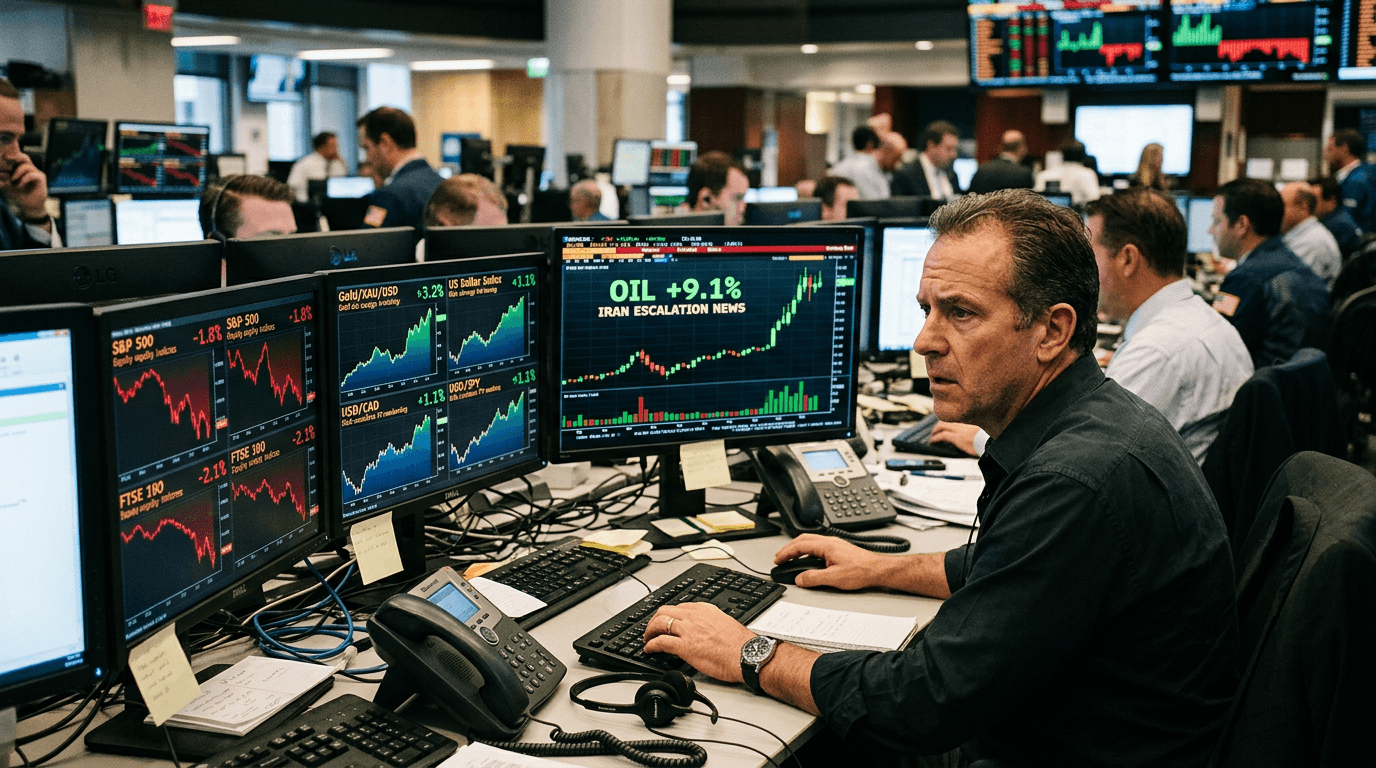
Oil’s latest surge has yanked geopolitics back to the center of the trading narrative. Crude prices jumped roughly 9%, lifting US benchmark WTI to around $81.6 and Brent to about $85.9 after an escalation in the war with Iran, a move that knocked US equities lower while powering safe-haven flows into gold, the US dollar, and select FX crosses tied to energy prices and risk sentiment.[1] For traders, this is not just “another headline” – it is a live stress test of how quickly cross-asset correlations can flip when oil becomes the story.
WHAT’S BEHIND THE OIL SPIKE?
This move in crude is primarily about perceived supply risk, not a sudden surge in demand.[1] Markets were relatively comfortable with oil fundamentals before the latest escalation, with data showing well-supplied conditions and even sizable builds in US crude inventories.[3] The shock came from the geopolitical side: renewed fears that an intensifying conflict with Iran could disrupt flows from a region that still anchors global oil supply.
One key pressure point is the Strait of Hormuz, the narrow chokepoint through which a large share of the world’s seaborne crude and LNG flows.[3] Even the risk of disruption – whether from direct attacks, blockades, or tanker traffic halts – is enough to push traders to reprice tail risks quickly, especially when tensions appear to be broadening rather than contained.
In that sense, the 9% jump is the market reattaching a “geopolitical risk premium” to crude futures.[1] The move back above recent ranges in WTI triggered a classic risk-off response across other asset classes: equity futures slipped, gold and the dollar caught a bid, and risk-sensitive FX pairs weakened as investors reassessed both inflation and growth risks.[1] Whether this spike marks the start of a new regime or a sharp but temporary shock will depend on how the conflict evolves and whether supply flows remain disrupted.
How Equities Are Digesting Higher Oil
Global equities tend to react to oil spikes through three main channels: growth anxiety, margin pressure, and changing inflation expectations. That pattern is visible again. US equity index futures drifted lower as crude broke higher, reflecting worries that more expensive energy could pressure corporate margins and weigh on consumer spending if the move persists.[1]
The impact is far from uniform across sectors. Energy stocks often outperform in these regimes, supported by stronger cash flows and higher realized prices.[3] At the same time, energy-intensive or fuel-sensitive industries – airlines, shipping, transportation, and parts of consumer discretionary – typically re-rate lower as markets price in cost pressures and weaker demand. Equity investors also watch small caps and cyclical names closely, as they tend to be more sensitive to input costs and financing conditions.
Strategists note that historically, oil needs to spike in a “historically significant” way and stay elevated for an extended period to fundamentally derail an otherwise constructive equity outlook.[3] Absent a sustained break meaningfully higher, the broader bull case for stocks can survive, even if volatility rises and leadership rotates more aggressively toward energy and away from rate- and growth-sensitive sectors.
Safe-haven Flows: Gold, Dollar, And Fx Repricing
The cross-asset reaction underscores that this is not just an energy story; it is a risk sentiment story. Gold has benefited from a dual narrative: as a geopolitical hedge and as an inflation hedge if higher energy prices feed into broader price pressures.[1] The move into gold fits the classic pattern seen during prior Middle East shocks, where investors seek assets that are less exposed to policy error or earnings downgrades.
The US dollar has also strengthened, despite the US being directly involved in the conflict.[1] In global risk-off episodes, the dollar’s role as the world’s primary reserve and funding currency tends to dominate, attracting flows from investors reducing exposure to higher-beta assets and regions. That safe-haven bid often compresses risk premia in US Treasuries and supports the greenback against both emerging market and cyclical currencies.
FX markets are another key transmission channel. Emerging market currencies, especially those of large energy importers, typically come under pressure when oil spikes because higher import bills worsen trade balances and inflation dynamics.[1] By contrast, some energy exporters’ currencies (such as those linked to oil and gas revenues) can find support, though this is often tempered by broader risk aversion. Crosses that are particularly sensitive to energy prices and risk sentiment – for example, EM Asia importers versus USD, or high-beta FX versus funding currencies like JPY or CHF – can see outsized moves as portfolios de-risk.
For traders, watching how oil, gold, USD, volatility indices, and safe-haven FX move together is crucial. When they all point in the same direction, it signals a broader risk-off regime with deeper implications for indices and emerging market assets, not just a localized energy story.[1]
A Playbook For Traders In A Headline-driven Market
Geopolitically driven oil spikes are notoriously difficult to trade because they are headline-driven and nonlinear.[1] The path of prices can be jagged, with sharp intraday reversals as new information hits the tape. In this environment, risk management often matters more than getting the direction perfectly right.
One principle is to adjust risk to volatility, not conviction.[1] As intraday ranges widen in crude, indices, and FX, position sizing should shrink correspondingly. Using wider, volatility-based stops with smaller sizes can be more effective than repeatedly getting stopped out on noise with oversized positions. This is especially relevant around known event windows, such as scheduled briefings or anticipated retaliatory actions.
Another principle is to treat headlines as catalysts, not guarantees.[1] Initial spikes on news can overshoot, and markets frequently mean-revert once the first wave of emotion fades. Building a framework that distinguishes between a short-lived shock and a sustained trend – using tools like multi-day closes, options skew, and cross-asset confirmation – can help traders avoid chasing every move.
Simulated finance environments, such as those offered by SimFi platforms, are particularly useful in this regime. Traders can back-test how their strategies behaved during previous Middle East shocks or sudden oil spikes, identify where systems tend to fail, and forward-test rule changes without risking real capital.[1] They can also run what-if scenarios: for example, how a further 10% move in oil might affect equity indices, gold, and key FX pairs, or how portfolios behave if tensions unexpectedly de-escalate and oil retraces.
Practical Takeaways And Next Steps
To turn this volatile backdrop into a learning and potentially profitable environment, traders can focus on a few practical steps.
First, map the linkages. Understand how your current portfolio or strategy is exposed to oil – directly via energy futures or equities, and indirectly via sectors sensitive to fuel costs, inflation, or EM risk. Even if you do not trade crude, your P&L may still be leveraged to oil through indices, FX, or credit spreads.
Second, watch the cross-asset “consistency check.” If oil is spiking but gold, volatility indices, and safe-haven currencies are muted, the market may be pricing a narrower, more manageable supply story.[1] When all of them move in tandem, it suggests a broader risk-off shift that warrants more defensive positioning.
Third, use this episode to stress-test your process. Ask whether your position sizing scales with volatility, whether your stop placement reflects current ranges, and whether you have clear rules around trading major geopolitical headlines. SimFi platforms are ideal sandboxes to refine these answers under realistic but risk-free conditions, building a playbook before the next shock rather than improvising in real time.[1]
Finally, remember that markets are forward-looking. The current spike reflects not just what has happened, but what traders fear might happen next. As new information emerges – from diplomatic efforts to any signs of supply normalization – the same cross-asset relationships that are flashing red today can ease just as quickly.
In a world where a single news alert can move oil, equities, gold, and FX together within minutes, preparation, flexibility, and disciplined risk management offer a more durable edge than bold predictions about the exact level of crude. For active traders, this Iran-driven oil spike is both a risk and an opportunity to refine their approach to geopolitical shocks – and to ensure that the next time oil is the headline, their strategy is ready, not reactive.