
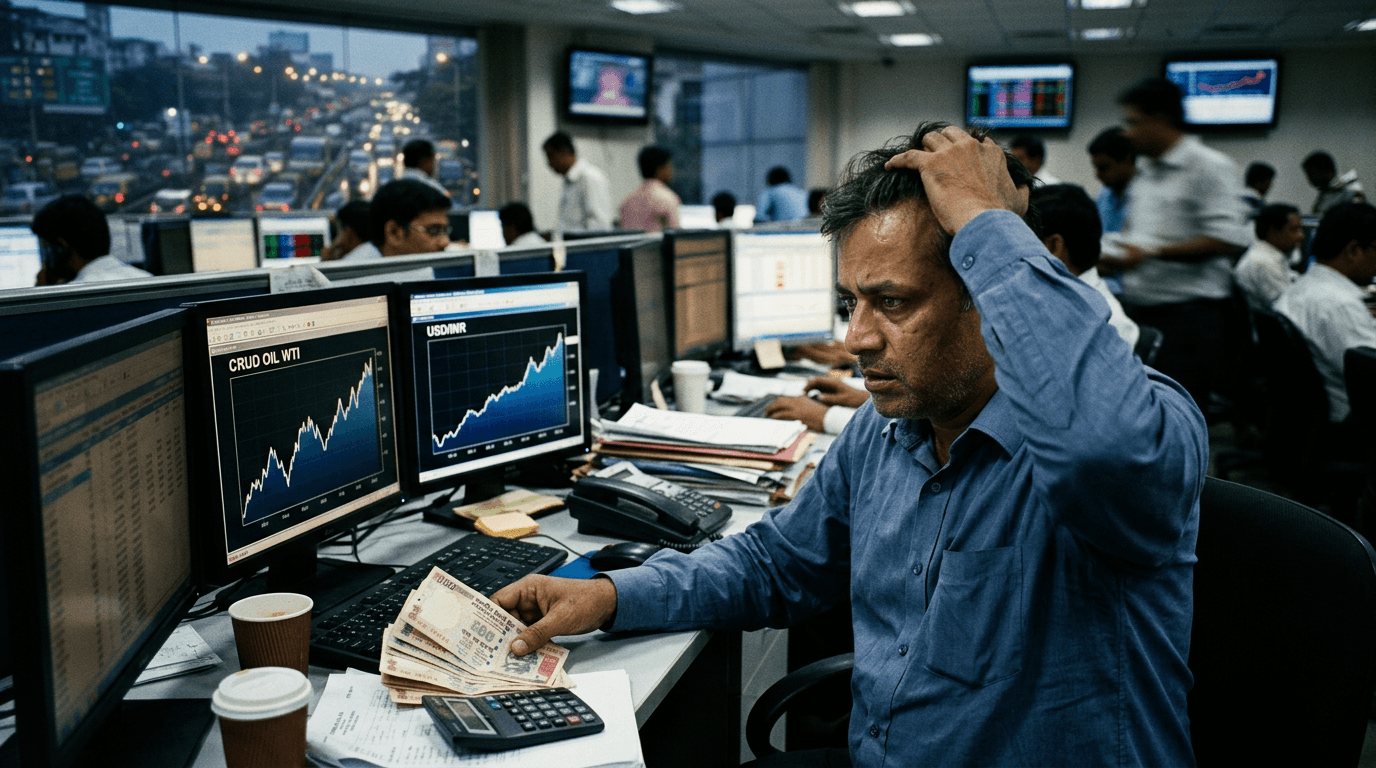
Oil prices are climbing again, and once more the Indian rupee is feeling the strain. In recent sessions, traders have been bracing for a weaker open in the currency as renewed U.S.-Iran tensions push crude higher, reviving concerns about India’s external balances and inflation trajectory[11]. For a country that imports the vast majority of its energy needs, an oil shock rarely stays confined to the commodity market—it quickly spills into foreign exchange, bonds, equities and broader sentiment.
Why Oil Matters So Much For The Rupee
India relies on imports for roughly 80-85% of its crude oil requirements, making the economy structurally exposed to swings in global energy prices[7]. When oil jumps, two things happen almost immediately: the import bill rises and domestic refiners and other energy buyers need more dollars to pay for shipments. That extra dollar demand tends to push the rupee lower, especially if the move in crude is sharp and sudden[12].
Higher oil costs widen India’s trade and current account deficits, because the country spends more on imports while export growth rarely accelerates enough to offset the shock[7][11]. Analysts have repeatedly warned that if Brent averages around levels such as $80–100 per barrel for a sustained period, financing the current account becomes more challenging and rupee volatility rises[1][14]. The currency’s recent slide to record or near-record lows—trading above 92 and even 96 per dollar in some episodes—has coincided with stubbornly high oil prices and persistent external pressures[3][4][8][13].
The inflation channel matters just as much. Costlier crude feeds into fuel and transport prices, which then ripple through food, fertilizer and manufactured goods. Economists caution that if the geopolitically driven oil surge persists, the impact could stretch well beyond markets into inflation, fiscal balances, corporate earnings and growth[3][14]. For FX traders, this creates a feedback loop: a weaker rupee makes imported oil even more expensive in local terms, which can further stoke inflation and weigh on sentiment.
Geopolitics, Risk Aversion And Emerging-market Fx
The latest pressure on the rupee is not just about fundamentals; it is also about geopolitics and global risk appetite. Renewed hostilities involving Iran and tensions across West Asia have repeatedly triggered spikes in crude, as markets price in potential supply disruptions and shipping blockades[1][9][11]. In one recent episode, Brent futures jumped more than 7%, crossing $102 per barrel after the U.S. moved to block Iranian shipping, setting off a sell-off in Indian stocks and bonds and a drop in the rupee[9].
These shocks tend to hit Asian currencies and equities in a correlated way. A surge in oil prices after strikes and escalations in the region has led to broad risk aversion: regional currencies fell, benchmark indices such as the Sensex and Nifty dropped nearly 2–3%, and safe-haven assets rallied[3][7][9]. Foreign investors, wary of the twin risks of higher inflation and slower growth, have pulled money from local markets; since the onset of the Iran conflict, net foreign sales of Indian stocks and bonds have exceeded tens of billions of dollars[9][13].
This matters because portfolio outflows add a capital-account dimension to pressure on the rupee. Once viewed as one of Asia’s more stable currencies, it has recently ranked among the worst-performing emerging-market units, pinned down by expensive oil, a strong U.S. dollar, widening trade deficits and sustained foreign selling[13]. For traders, the takeaway is clear: geopolitical headlines that move oil very often move the rupee as well, and they can do so in a “risk-off” environment where multiple emerging-market assets come under pressure at once.
RBI’S BALANCING ACT: INTERVENTION AND LIMITS
The Reserve Bank of India (RBI) has not been a passive observer. When the rupee has approached or breached psychologically important levels—such as the 92-per-dollar area—the central bank has intervened via state-owned banks, selling dollars to steady the currency and curb volatility[1][7][8]. Traders routinely attribute intraday stabilization in USD/INR to such operations, especially during sharp oil-driven sell-offs.
These interventions can blunt the immediate impact of an oil spike, as seen on days when the rupee ended nearly flat or slightly stronger despite higher crude, thanks to official dollar sales[2]. However, they cannot fully offset structural pressures. If oil remains high, the import bill stays elevated, inflation risks persist and external balances deteriorate, forcing the RBI to weigh FX stability against its broader mandate to manage inflation and support growth[7][11][14].
The bond market offers another window into this balancing act. Oil-driven rupee weakness and inflation worry have pushed benchmark 10-year government bond yields higher in several recent episodes, reflecting expectations of tighter financial conditions[8][9][11]. A sharper rise in yields can raise borrowing costs for the government and corporate sector, adding another layer of complexity to policymaking.
For traders, the key is to understand that RBI intervention tends to smooth the path of the rupee rather than dictate its trend. In an environment of sustained high oil and geopolitical stress, the underlying bias for the currency can remain toward depreciation, even if the journey is punctuated by bouts of stability or short-lived relief rallies.
What Traders Should Watch In An Oil-driven Rupee Market
In a market where “oil sets the tone” for the rupee, especially at the opening, FX and macro traders need a clear framework for monitoring risk[6]. Some practical focus areas include:
Global crude benchmarks: Intraday moves in Brent and WTI, especially around headline risk events tied to Iran or other key producers, are often mirrored in USD/INR pricing[1][9][11].
Geopolitical newsflow: Developments such as sanctions, shipping disruptions or military escalations can quickly change supply expectations and risk sentiment, impacting both oil and emerging-market FX[3][9][11].
Capital flows: Daily foreign portfolio flows into and out of Indian equities and bonds provide clues about whether global investors are leaning risk-on or risk-off with respect to India[9][13].
Domestic macro data: Inflation prints, current account numbers and fiscal updates influence how long the RBI can tolerate a weaker currency before tightening financial conditions[3][11][14].
For both directional and hedging strategies, traders should factor in the interplay between these variables rather than treating the rupee as a purely domestic story. Energy prices, global yields and cross-asset risk sentiment are now integral components of its behavior.
SIMULATED STRATEGIES FOR VOLATILE OIL–RUPEE CONDITIONS
For traders practicing on simulated finance platforms, the current environment offers a rich learning ground. Oil-linked rupee moves combine macro fundamentals, geopolitical analysis and central bank watching in a single tradeable theme. Structuring simulated positions around USD/INR with explicit oil assumptions can help clarify how shocks transmit across markets.
For example, one scenario could assume Brent remains above $100 for several weeks amid ongoing tensions, leading to incremental rupee depreciation, rising bond yields and pressure on local equities[3][9][11]. Another scenario might model a partial resolution to U.S.-Iran disputes, easing oil back toward more stable levels and allowing the rupee to regain some ground as risk appetite returns[6][11]. Comparing these cases can sharpen an understanding of how quickly sentiment can flip—and how RBI intervention may alter timing but not necessarily the end result.
Importantly, simulated trading allows participants to test hedging strategies that real-world importers often use, such as layering in forward contracts when oil spikes and rupee volatility rises[2][7]. It also highlights the value of disciplined risk management: leveraging positions into an oil-driven FX sell-off can be tempting, but drawdowns can be severe if geopolitics take another turn for the worse.
The broader lesson is that in an oil-sensitive economy like India, FX risk cannot be separated from energy and politics. Whether trading live markets or building skills through simulation, understanding that linkage is essential for navigating periods when an oil surge keeps unrelenting pressure on the rupee.