
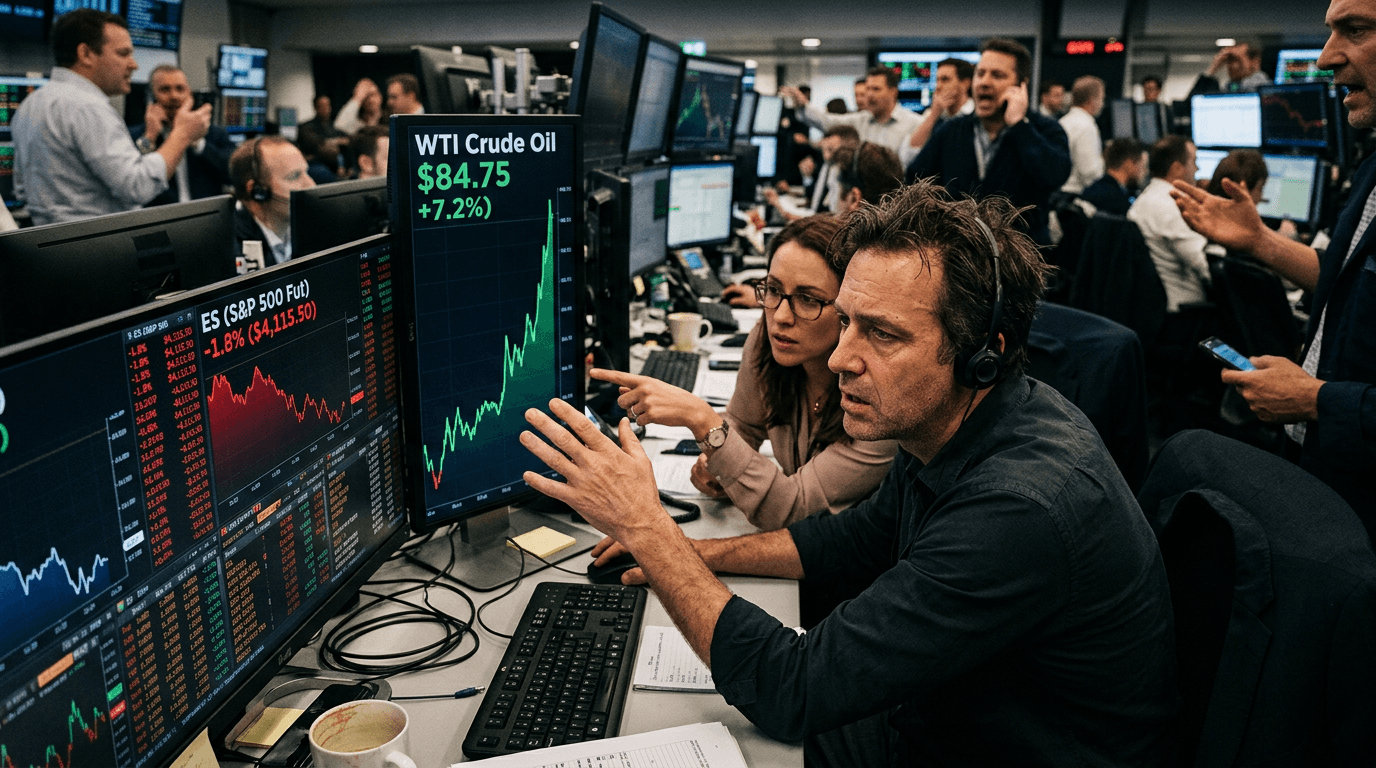
Oil’s latest price surge is doing more than moving the energy tape – it is reshaping risk sentiment across futures and equity markets. A jump in crude is being read as both an inflation warning and a real-economy signal, and that combination is feeding directly into how traders price index futures, sector rotation, and volatility across the curve.
How An Oil-price Spike Translates Into Market Risk
When oil spikes quickly, the first channel markets focus on is inflation. Higher crude filters into gasoline, diesel, jet fuel, plastics, and transport costs, raising input prices for companies across the economy.[6][7] This is a textbook case of cost‑push inflation, where firms pass higher costs on to consumers, squeezing real incomes and potentially pressuring demand.[6]
Equity traders immediately connect this to central-bank expectations. If inflation risks rise, markets are more likely to price in higher or longer‑lasting policy rates, pushing bond yields up and equity valuations down, especially for long‑duration growth stocks whose cash flows lie far in the future.[7] The result is a deterioration in broad risk sentiment, often expressed first in index futures before it shows up in the underlying cash market.
Academic work backs up the idea that oil shocks can lift uncertainty and weigh on stock prices through these channels. Research finds that higher oil prices tend to increase macro uncertainty and reduce corporate investment, both of which act as headwinds for equities.[4] That is why seemingly “purely commodity” news can quickly become a cross‑asset risk event.
What It Means For Equity Index Futures
Index futures are the market’s fast‑twitch muscle, reacting in real time to macro headlines and risk‑off shifts. An abrupt oil‑price spike often shows up as:
- Pressure on broad U.S. equity futures as traders factor in tighter financial conditions and weaker margins for energy‑intensive sectors.[7]
- Underperformance in futures tied to small caps or cyclical sectors that are more vulnerable to higher input costs and borrowing costs.[7]
- Outperformance or relative resilience in futures linked to energy‑heavy indexes or regions that are net beneficiaries of higher oil revenues.[1][7]
The nuance is that the why behind the oil move matters. Historical analysis shows that stock returns can still be positive in periods when oil prices are rising, particularly when higher prices reflect robust global demand rather than supply disruptions or conflict.[2][7] In those demand‑driven scenarios, stronger earnings can offset the drag from inflation, and equity futures may look through temporary cost pressures.[2]
By contrast, a surge tied to geopolitical shocks or supply cuts tends to be more toxic for risk sentiment. In those environments, traders worry about stagflation – slower growth but higher inflation – which is the least friendly combination for equity multiples.
Opportunities And Risks In Energy And Commodity Futures
While broad equity futures often trade under pressure during an oil spike, energy and commodity futures see a very different dynamic. Higher oil prices directly support:
- Crude and refined product futures, where tighter supply and higher marginal production costs reprice the entire forward curve.[5]
- Energy equity and sector futures, as producers’ cash flows, margins, and asset values typically rise with sustained price strength.[1][7]
Empirically, there is a strong positive relationship between oil prices and the performance of oil and gas companies; when crude trends higher over time, integrated majors and producers have historically seen outsized share‑price gains.[1] That linkage is why, in a single‑day oil spike, you often see index futures down but energy‑sector futures and ETFs sharply higher.
However, the nature of the futures curve matters. If the oil curve moves into steep backwardation (near‑dated prices much higher than longer‑dated), it signals acute short‑term tightness and can increase roll costs for long‑only futures strategies. Traders need to think beyond the headline front‑month move and evaluate how the entire curve has repriced, which affects hedging, carry, and strategy P&L.
There is also the risk that markets underreact initially. Recent work from index and risk specialists has highlighted episodes where oil jumped more than 40% over a short period while broad equity indexes barely moved, raising the possibility of mispriced inflation and growth risks that could unwind later.[8] For active traders, these dislocations can create opportunities in relative‑value trades between energy futures, inflation‑sensitive assets, and equity indexes.
Portfolio And Risk-management Takeaways For Traders
For both discretionary and systematic traders, an oil‑price shock is a stress test of portfolio construction.
First, sector exposures matter. Higher oil tends to benefit energy producers and some parts of industrials while pressuring airlines, transport, chemicals, and consumer‑facing businesses with thin margins and high energy usage.[1][7] Understanding how your equity or futures portfolio is tilted across these groups is critical.
Second, correlations can change. In some regimes, oil and stocks rise together, especially when both are responding to stronger global demand.[2][3] In others, oil spikes while equities struggle, particularly when geopolitical risk and inflation fears dominate.[3][8] Assuming a stable correlation can be dangerous; traders should monitor how cross‑asset relationships evolve as new data and headlines hit.
Third, risk management needs to incorporate scenario analysis. Because oil shocks can ripple through inflation expectations, rates, credit spreads, and currencies, a simple VaR or historical P&L distribution may understate tail risks. Mapping how a further 10–20% move in crude could affect index futures, sector performance, and volatility can help define appropriate position sizing and hedging tactics.
Simulated Trading: Practicing Oil-shock Scenarios
For many traders, especially those still building experience, an oil‑driven volatility episode can be hard to navigate in real time. This is where simulated finance environments can be particularly valuable.
By trading index, sector, and energy futures in a risk‑free simulated setting, participants can:
- Test how different strategies behave when oil jumps sharply and implied volatility spikes across equity futures.
- Practice rotating between sectors – for example, reducing exposure to consumer discretionary futures while increasing exposure to energy and value‑oriented indexes during an oil shock.
- Experiment with hedges such as long energy futures against short broad equity futures to see how basis risk and correlation shifts impact P&L in various scenarios.
Simulated markets allow traders to replay historical oil shocks as well as apply “what‑if” stress tests to today’s environment. That kind of rehearsal can make the difference between reacting emotionally to the next headline and executing a predefined playbook grounded in risk discipline and cross‑asset understanding.
Ultimately, an oil‑price surge is more than just a commodity story. It is a macro shock that runs through inflation expectations, central‑bank policy, sector earnings, and futures pricing. Traders who can connect these dots – and who have practiced their responses in a controlled environment – are better positioned not only to protect capital, but to uncover opportunities when risk sentiment swings.