
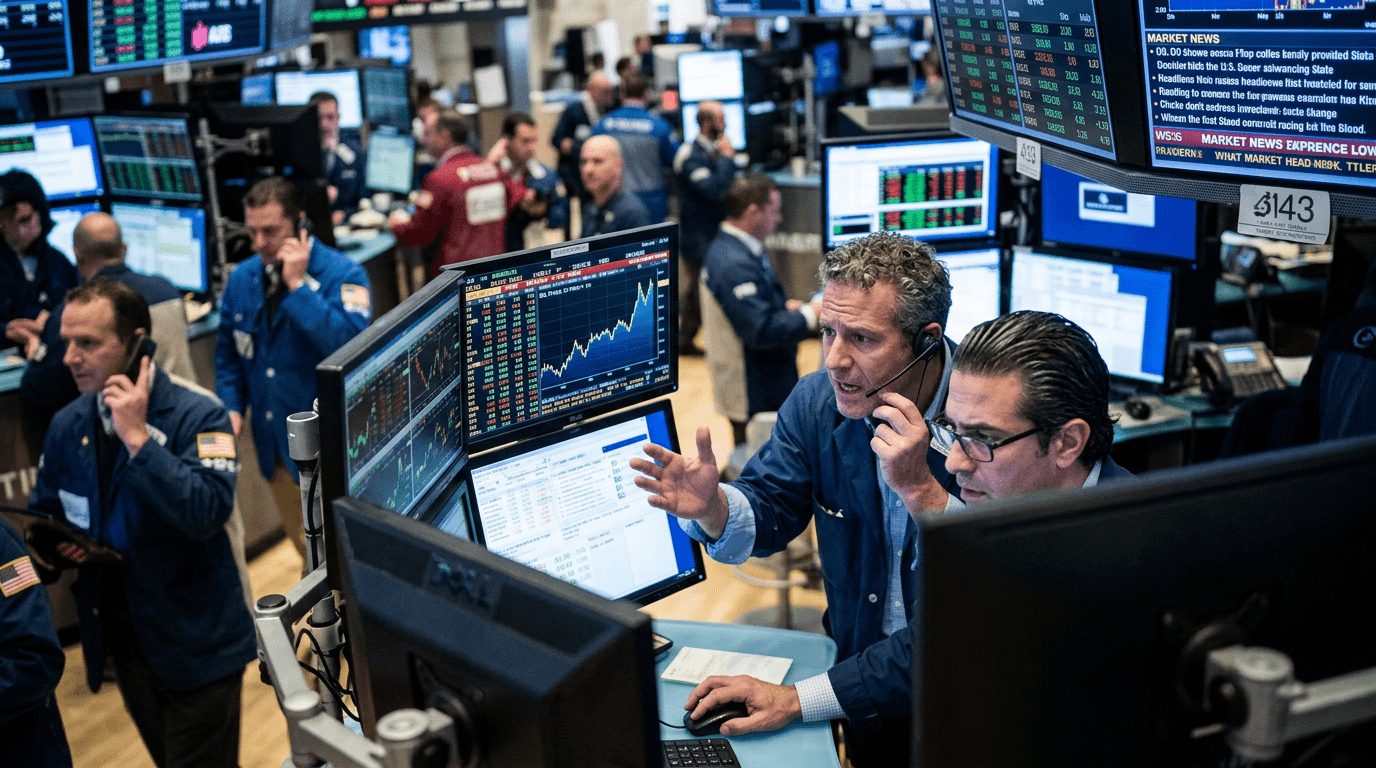
U.S. stocks and index futures are feeling the strain as a sharp spike in oil prices collides with renewed tensions in the Middle East, forcing traders to reassess risk across equities, commodities, and rates. U.S. indices opened lower after headlines of fresh escalation, while the move in crude pushed inflation expectations and rate assumptions back into the spotlight.[1][3] For traders, this is not just a geopolitical story—it is a lesson in how interconnected global risk assets really are.
Global markets have echoed this stress. World share indices have come under pressure as crude oil jumped on deepening unrest in the region, reinforcing the classic “flight to safety” pattern across risk assets.[2] At the same time, futures on major U.S. indices have turned choppy and mixed as traders weigh the immediate shock of higher energy prices against the possibility of policy and growth implications down the line.[3]
Market Reaction In Context
The immediate reaction has been straightforward: higher oil, lower stocks, softer risk appetite. U.S. stock indexes opened lower as renewed Middle East tensions and a surge in crude prices weighed on sentiment, with investors quickly rotating toward safer assets and reassessing cyclical exposure.[1] This mirrors prior episodes where geopolitical shocks in the energy-producing regions pushed crude higher and knocked back equities.
The move is global, not just domestic. European stock markets have also dipped while crude oil prices climbed sharply following military action involving Iranian targets, highlighting how dependent global risk sentiment is on the perceived security of Middle Eastern supply routes.[5] In parallel, global share markets as a whole have suffered sharp declines as the conflict noise intensified, reflecting investor discomfort with uncertainty that is difficult to model.[2]
For futures traders, this backdrop has translated into choppy index futures sessions. S&P 500, Dow, and Nasdaq futures have been mixed following strikes between Iran and Israel that pushed crude sharply higher, signaling a market struggling to decide whether to price a brief shock or a longer-lasting regime shift.[3] This mixed futures reaction is typical when the macro signal is strong but the duration and magnitude of the shock are unclear.
How Oil Shocks Hit Equities And Futures
At the core of the market reaction is a simple chain: Middle East escalation threatens supply routes, oil prices rise, corporate costs and inflation expectations move up, and valuations on growth-sensitive equities come under pressure. Recent spikes in Brent crude—such as a roughly 4% jump after U.S. military strikes on Iranian targets—illustrate how quickly supply fears can get priced into the energy complex.[4] These kinds of moves ripple into everything from transportation and manufacturing costs to consumer spending.
Higher oil acts as a tax on the global economy. For energy-importing countries, elevated crude prices squeeze corporate margins and consumer purchasing power, dampening earnings expectations and growth forecasts. That, in turn, feeds into index pricing and futures curves as traders shade down their expectations for profit growth and increase the probability of downside scenarios.
From a futures perspective, these shocks alter both direction and volatility. Index futures may initially gap lower on the headline, followed by a period of two-way trading as participants rebalance hedges, adjust option structures, and respond to new information. The oil futures curve itself can shift into steeper backwardation—where near-term prices trade above longer-dated contracts—when markets anticipate acute but possibly temporary supply disruptions.[7] For equity index futures, this often corresponds with a spike in implied volatility and heavier demand for downside protection.
Inflation, Rates, And Valuations
One of the most important second-order effects of an oil surge is its impact on inflation expectations and, by extension, interest rate trajectories. Higher energy prices tend to filter into headline inflation and, depending on duration and magnitude, can lift core measures as well. This complicates the task for central banks trying to balance inflation control with growth concerns.
Research on prior oil shocks shows that if higher crude is perceived as persistent, markets start to price in the risk that central banks either keep policy tighter for longer or delay any plans to ease. The scenario described by recent analysis around Middle East conflict—with elevated global energy prices persisting and critical shipping routes like the Strait of Hormuz under threat—illustrates how geopolitical tensions can keep inflationary pressures elevated and the oil curve in backwardation.[7]
For equities, this matters because valuations are sensitive to discount rates. If traders believe policy rates will remain higher for longer to combat energy-driven inflation, the present value of future cash flows falls, particularly for long-duration growth stocks. Equity index futures will reflect this through lower fair values and shifting sector correlations. In practical terms, tech and other high-duration segments typically underperform in a higher-for-longer rate regime, while value and energy-related names may show relative resilience.
Sector Winners, Losers, And Rotation
Not all parts of the equity market react the same way to an oil surge linked to geopolitical risk. Energy producers and some commodity-related businesses often benefit from higher crude prices, as their revenues and margins expand with the underlying commodity. Episodes like the recent Brent spike on U.S. strikes against Iran have historically provided a tailwind to energy indices even as broader benchmarks faltered.[4][5]
On the other side, energy-intensive sectors such as airlines, transportation, and parts of manufacturing tend to suffer as fuel and input costs rise. Consumer discretionary names can also lag if higher gasoline and utility bills eat into household spending power. Global market performance during the latest tensions, where European and broader world indices fell while energy prices surged, reflects this rotation dynamic.[2][5]
For futures traders who cannot easily pick individual sectors via single stocks, sector impact still matters. It influences which index contracts may be more vulnerable (for example, an index more heavily weighted toward energy vs. tech) and affects relative value trades between indices. Understanding sector composition helps explain why two indices may respond differently to the same geopolitical shock.
How Traders Can Navigate Heightened Geo-political Risk
For both discretionary and systematic traders, elevated Middle East tensions combined with an oil spike is a classic stress test of risk management. The starting point is position sizing: in an environment where headline risk can trigger sudden gaps in crude, equities, and futures, smaller initial sizes and wider, pre-defined stop levels can help avoid being forced out by noise rather than signal.
Second, scenario analysis becomes critical. Traders can map out paths where tensions escalate further, stabilize, or rapidly de-escalate, and then consider how each scenario affects oil, inflation expectations, rates, and ultimately index levels. The recent pattern of global equity declines and oil rallies on each new escalation headline provides a practical template: assume that additional conflict news supports crude and hurts broad risk assets in the near term.[1][2][3]
Third, diversification across instruments and time horizons can reduce vulnerability to any single shock. Combining index futures with options, volatility products, and, where appropriate, commodity exposure allows traders to construct more balanced profiles—using, for example, oil or energy exposure as a partial hedge to equity risk when Middle East tensions rise.
Finally, simulated environments can be particularly useful during periods like this. Because geopolitical events are hard to backtest and can produce non-linear market behavior, practicing trade ideas, hedging strategies, and intraday risk management in a risk-free setting allows traders to refine their approach before committing substantial capital in live markets.