
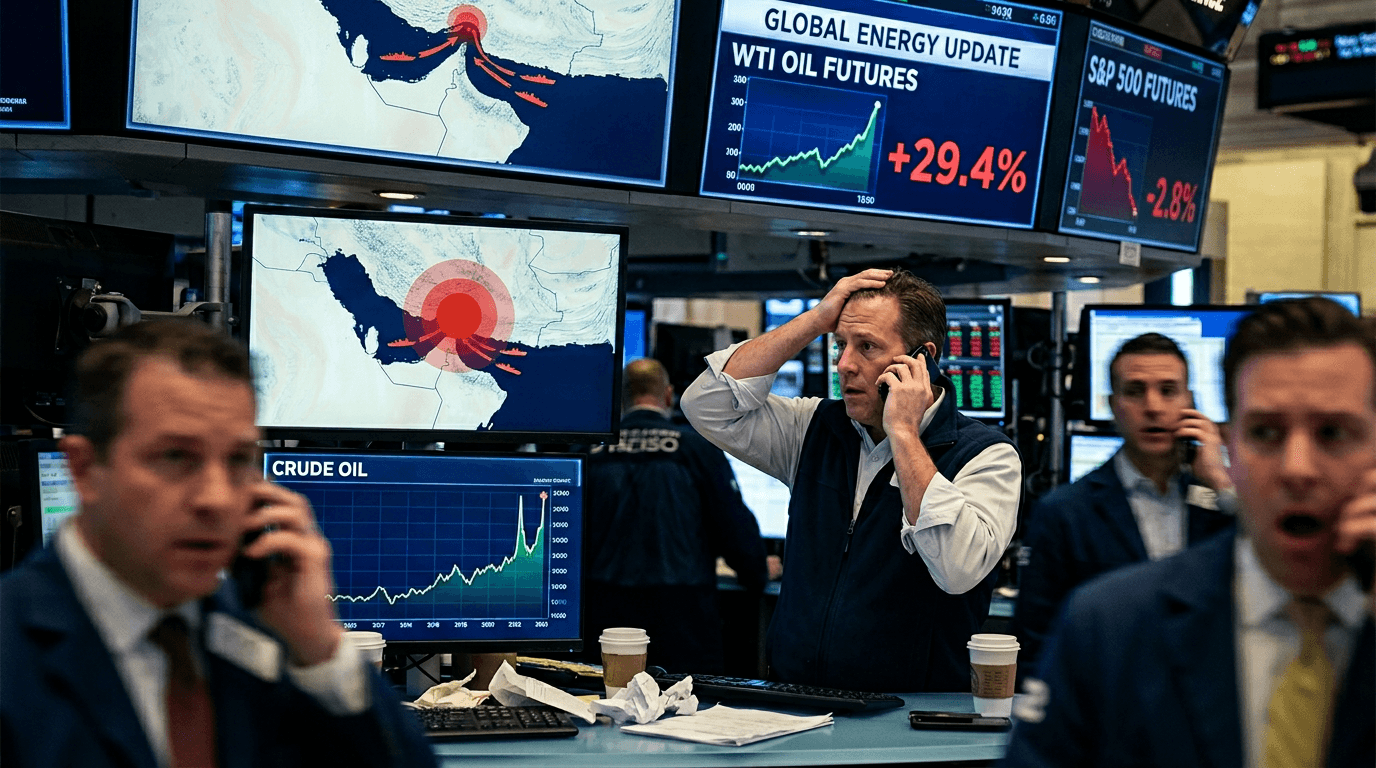
Global equity markets kicked off the week in a clear risk-off mode as escalating geopolitical tensions in the Middle East sent oil prices skyrocketing, placing heavy pressure on stock futures across major indices. This swift market repricing underscores a fundamental shift in investor sentiment, where concerns over energy security have become the central axis around which trading decisions revolve, reshaping the conventional correlation between asset classes.[1][3]
The Market Setup
Monday morning saw a notable decline in US equity futures as traders reassessed their risk exposure. S&P 500 futures dropped by 0.8%, Nasdaq-100 futures decreased 0.7%, and Dow Jones Industrial Average futures fell about 1%.[1] This was not a phenomenon isolated to US markets alone. Equity markets around the globe reacted to the worsening geopolitical climate. The Nikkei 225 plunged 5.2% and the KOSPI fell 6%, while the Stoxx Europe 600 slid 1.5%.[3] What tied these disparate markets together was a singular factor: crude oil prices reaching their highest levels since 2022.
In addition to equities, traditional safe-haven assets exhibited unusual behavior. The US dollar strengthened amidst the turmoil, while government bonds were sold off and gold declined by about 1.5%.[3] This atypical reaction underscores the severity of the energy supply concerns that have seized traders' attention.
The Oil Shock
The sheer scale of crude oil's movement captured the urgency of the situation. West Texas Intermediate crude oil futures surged 8%, reaching around $90 per barrel, while Brent crude experienced even more dramatic price action, spiking up to 29% on Monday morning and testing USD 120 a barrel during the Asia session before settling around USD 103 per barrel.[1][3] This type of oil volatility, which eclipses traditional economic data, saw traders witness oil prices rise 20 to 30 percent within hours, fundamentally altering currency markets, equity shifts, and overall risk assessments.[1]
The catalyst for this energy shock revolves around escalating tensions in the Middle East. Iran's closure of the Strait of Hormuz represents a critical chokepoint for global energy supplies. The strait remains effectively closed, with only two to three tankers crossing daily, compared to the usual 30 to 35 tankers.[3] This supply disruption has necessitated immediate production cutbacks. The UAE, Kuwait, and Iraq have reduced oil output as their storage capacities became strained, compelling them to halt production once available tankers were full.[3] Beyond the Gulf region, oil stored in tankers is being depleted due to minimal transit flows from the area.
The Geopolitical Dimension
What heightens the concern for market participants is the lack of immediate resolution. The appointment of Mojtaba Khamenei, son of the late Ayatollah Ali Khamenei, as Iran's new supreme leader, suggests that US-Iran hostilities could continue far longer than some traders had initially expected.[3] While ceasefire negotiations between the United States and Iran are ongoing, with US officials preparing to return to Islamabad for talks aimed at extending a two-week ceasefire, Iran's participation in these discussions remains uncertain.[1]
This uncertainty has led traders to adopt distinctly cautious positions. The current market environment reflects a period of genuine ambiguity, where traditional correlations have broken down and new risk factors have taken precedence.[1]
What This Means For Traders
The immediate implications for market participants are clear: energy supply constraints will persist until either the Strait of Hormuz reopens or demand adjusts downward.[3] As long as supply remains restricted, oil prices are likely to continue rising until demand destruction occurs. This dynamic means that global markets will progressively price in more negative economic outcomes the longer the situation remains unresolved.[3]
For those monitoring the situation, three key indicators merit close attention. First, watch for announcements regarding the scope or duration of any negotiated agreements. Second, observe the actual response of oil prices to these announcements—energy markets will quickly indicate whether traders believe geopolitical risks have genuinely subsided. Third, monitor how equity markets respond once there is greater clarity on the likelihood of sustained hostilities versus diplomatic resolution.[1]
Looking Ahead
While risk-off sentiment currently prevails, this stance could undergo significant reversal if negotiations result in genuine progress. Should ceasefire agreements hold and oil prices retreat, equity markets could experience equally sharp rebounds.[1] UBS analysts highlight that historically, short-lived oil price spikes rarely cause lasting economic damage, although they expect near-term dollar strength to persist amid ongoing Middle East tensions.[3]
The current market environment highlights a crucial lesson for traders: geopolitical risk can swiftly override traditional economic narratives. Energy supply disruptions, particularly those involving chokepoints like the Strait of Hormuz, wield an outsized influence on global asset pricing. Success in these markets demands vigilance over both technical energy supply metrics and the diplomatic developments that could resolve the underlying tensions.