
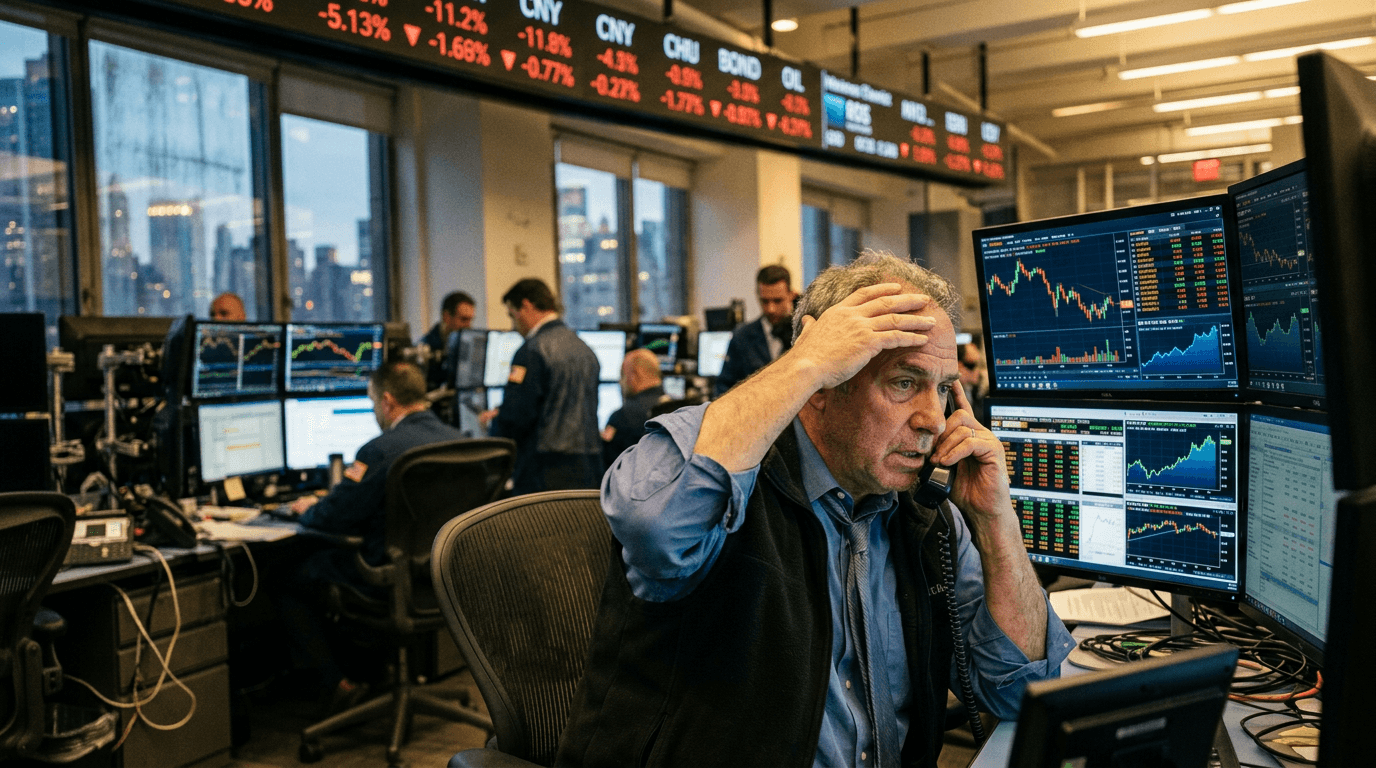
China’s latest move to slap steep new tariffs on U.S. goods has pushed trade tensions back to the forefront of global markets, just when investors were starting to focus more on inflation and central banks than on geopolitics. By lifting duties on some U.S. imports to roughly 125%, Beijing has sharply raised the cost of doing business across key sectors and reignited fears of a broader slowdown in global trade and growth.[4][5] The immediate reaction has been textbook “risk‑off”: pressure on equities and higher‑beta assets, alongside renewed demand for safe‑haven assets such as the U.S. dollar and Treasuries.[7]
What Just Happened
China has announced a new round of retaliatory tariffs on U.S. imports, raising levies on selected products to as high as about 125%.[4][5] These measures come on top of several years of tit‑for‑tat actions that have already pushed average tariffs between the two economies far above pre‑trade‑war levels.[5][7]
In earlier phases of the dispute, the United States had raised tariffs on Chinese goods to triple‑digit levels, prompting China to respond with its own sweeping increases on American exports.[4][5][7] At one point, China’s average tariffs on U.S. goods reached above 30%, while U.S. tariffs on Chinese exports climbed to several times their pre‑2018 levels.[5][7] Although there were temporary truces and partial rollbacks, the latest announcement signals that the era of elevated trade barriers is not over.[4][5]
Tariffs are essentially a tax on cross‑border trade. When duties jump from single‑digit rates to levels approaching or exceeding 100%, many previously profitable trade flows become uneconomic. Importers are forced either to absorb the cost, pass it on to consumers, or reconfigure their supply chains—each option carrying its own economic friction.
Why It Matters For Global Growth
Higher tariffs between the world’s two largest economies rarely stay a bilateral issue for long. Global supply chains are deeply interconnected, and disruptions in U.S.–China trade tend to ripple across Asia, Europe, and commodity‑exporting regions.
Past modelling of earlier tariff waves suggested that very high levies—such as the 125% rate China has applied in previous escalations—could knock measurable fractions off global merchandise trade volumes.[5] Even seemingly small percentage hits to trade can matter for growth when they compound over time and across sectors. Export‑oriented industries—from machinery and autos to agriculture and technology hardware—are particularly exposed.
Beyond the direct impact on trade volumes, tariffs create uncertainty. When firms do not know what tariff regime will apply in six or twelve months, they are less likely to commit to new factories, cross‑border projects, or long‑term supply agreements. That uncertainty can weigh on capital expenditure, hiring, and productivity growth, adding another drag to the global outlook.
For investors, softer global growth expectations typically translate into lower earnings assumptions for cyclical sectors, wider credit spreads, and a higher risk premium demanded for holding equities and emerging‑market assets. That is why trade headlines can move markets far beyond the companies directly targeted by tariffs.
Winners And Losers: Currencies, Bonds, Commodities
The initial market reaction to the new Chinese tariffs has followed familiar patterns from earlier phases of the trade war. Risk‑sensitive assets—equities, high‑yield credit, and emerging‑market currencies—have come under pressure, while safe‑haven assets such as the U.S. dollar and Treasuries have found support as investors seek liquidity and perceived safety.[7]
For currencies, one important channel is global growth and trade intensity. Economies like Australia and New Zealand, which are heavily tied to Chinese demand for commodities and goods, are often treated as proxies for the China cycle. When investors worry that higher U.S.–China tariffs will dampen Chinese import demand and industrial activity, currencies such as AUD and NZD can weaken as markets price in a softer regional outlook.
Emerging‑market foreign exchange, particularly in export‑oriented or commodity‑producing countries, tends to be vulnerable as well. Higher tariffs can reduce export volumes, worsen current‑account balances, and make it harder for some economies to attract capital, especially when risk sentiment is fragile.
On the fixed‑income side, episodes of trade tension have historically supported demand for U.S. Treasuries, compressing yields as investors rotate out of equities and riskier debt into government bonds.[7] This can partly offset the growth shock by easing financial conditions, but it also reflects heightened concern about the macro outlook.
Commodities sit at the intersection of trade, growth, and politics. Industrial metals and energy prices are sensitive to changes in expected manufacturing activity and global trade volumes. If markets conclude that the new tariffs will constrain global growth, demand expectations for oil, copper, and other cyclicals can soften. At the same time, agricultural products—like soybeans and other crops that were explicitly targeted in previous rounds of U.S.–China tariffs—may face renewed uncertainty over market access and pricing.[4][6]
How Traders Can Navigate The New Tariff Wave
For traders and investors, the key is not just to react to headlines, but to understand the mechanisms through which trade policy affects markets. Tariff shocks tend to propagate through a few recurring channels: growth expectations, risk sentiment, currency realignment, and sector‑specific earnings revisions.
One practical framework is to separate your analysis into three horizons:
1) Immediate reaction: In the hours and days after an announcement, markets often move on sentiment and positioning. Safe‑haven currencies and government bonds rally, while equities and high‑beta FX sell off. Volatility may spike, creating both risks and opportunities for short‑term traders.
2) Medium‑term adjustment: Over weeks and months, investors reassess earnings, trade flows, and central‑bank responses. Export‑heavy sectors, logistics, and globally integrated supply‑chain plays may see earnings downgrades. Conversely, some domestic‑focused or import‑substituting firms can benefit if they gain market share behind tariff walls.
3) Long‑term realignment: If tariffs remain elevated, supply chains may re‑route through third countries, and new trade agreements can emerge. This can reshape which regions and sectors are structural winners versus losers.
In practice, traders can respond by:
- Stress‑testing portfolios for trade‑sensitive exposures, including companies with high revenue shares in U.S.–China corridors or reliance on tariff‑affected inputs.
- Watching correlations: in past episodes, AUD, NZD, and select EM FX have tended to trade as leveraged bets on China and global risk sentiment.
- Using options and other derivatives to hedge tail risks around key policy dates, such as high‑level summits or tariff implementation deadlines.
- Testing strategies in simulated environments that mirror real‑market conditions, to explore how portfolios might behave under different tariff and growth scenarios without putting capital at risk.
Looking Ahead: Key Signposts For Market Participants
The biggest question now is whether this latest tariff step is a bargaining tactic on the way to another truce or the start of a more entrenched phase of economic decoupling. In previous episodes, both Washington and Beijing have escalated sharply—sometimes into triple‑digit tariff territory—only to later negotiate partial rollbacks when the economic and market costs became clearer.[4][5][7]
Key signposts to watch include any change in the language from trade and commerce ministries on both sides, the scope of carve‑outs or exemptions for specific industries, and whether other major economies align more closely with U.S. or Chinese trade positions. Global data on export volumes, manufacturing PMIs, and business investment will offer early evidence of how much damage the new tariffs are doing to real activity.
For traders, the takeaway is that trade policy risk is back as a major macro driver. The combination of elevated tariffs, sensitive political timelines, and already‑fragile global growth means that U.S.–China headlines can move currencies, bonds, commodities, and equities in meaningful ways. Building a disciplined process for tracking these developments—and incorporating them into risk management and strategy design—will be essential as the tariff story enters its next chapter.