
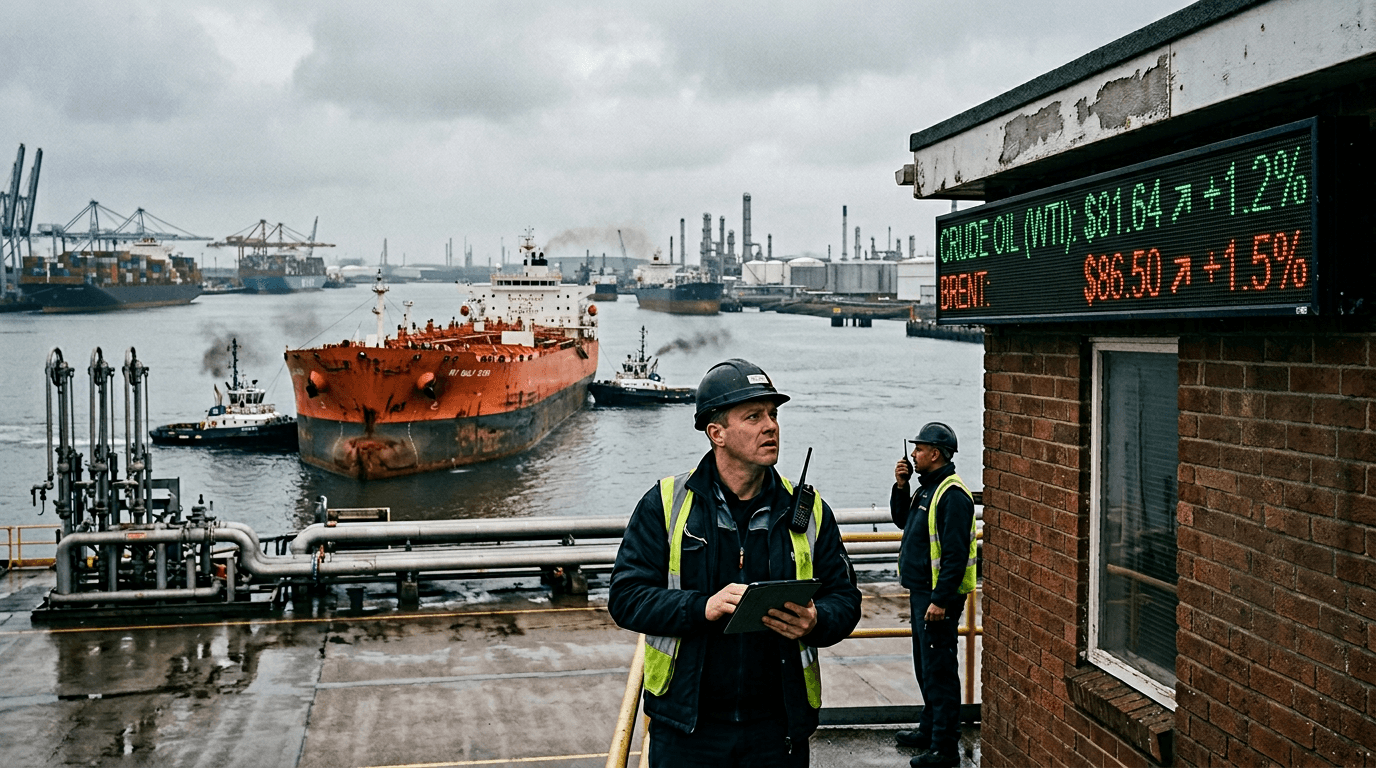
The oil market has sent a strong message to investors and traders: prices have risen sharply, with crude reaching nearly 9% growth to $81.64 per barrel, and Brent crude escalating to $85.85. This surge isn't due to typical supply and demand changes but is a direct outcome of escalating geopolitical tensions. The ramifications of this conflict are now echoing across global stock indices. For those managing portfolios, comprehending the driving forces behind this surge and its broader economic impacts is crucial for effective market navigation.
Understanding The Oil Price Surge
The nearly 9% increase in oil prices signals more than just routine market fluctuations. This rise is rooted in a deepening military conflict between the United States and Iran, transforming a regional issue into a global energy crisis. U.S. airstrikes on Iran have persisted, generating instability across energy markets. In retaliation, Iranian forces have targeted essential oil infrastructure and shipping lanes, disrupting the global flow of energy supplies.
This disruption is visible in various crude benchmarks, with West Texas Intermediate experiencing a significant jump, and Brent crude's rise to $85.85 highlighting the crisis's extensive impact across global markets. Over 200 vessels, including oil tankers and gas carriers, are now anchored outside the Strait of Hormuz—a vital chokepoint linking the Persian Gulf to the Arabian Sea—turning a potential short-term price spike into a prolonged supply constraint with extensive consequences.
The Geopolitical Dimension
The conflict in the Middle East is about more than military hostilities; it's fundamentally about controlling global energy resources. The disruption of the Strait of Hormuz is central to this economic struggle, as Iranian retaliatory attacks have damaged tankers and halted shipments crucial to the global energy supply. This isn't just a military clash but an energy blockade with immediate market consequences.
Notably, Iranian forces have specifically targeted sites like Saudi Aramco's Ras Tanura refinery with drones, directly impacting global refining capacity. These aren't mere symbolic acts but strategic moves designed to heighten economic pressure on Western nations through energy markets. Markets are recognizing the gravity of this conflict, although analysts currently view it as a geopolitical shock rather than a systemic crisis.
Stock Market Pressure And Broader Economic Concerns
The interplay between energy prices and stock market performance is intricate yet significant. Rising oil prices create several challenges for stock markets: they elevate operating costs for businesses across numerous sectors, fuel inflation concerns, potentially leading central banks to keep interest rates higher for longer, and threaten consumer purchasing power, which drives corporate revenue growth.
The timing of this oil increase is particularly critical for economic policy. A sustained price rise threatens the delicate global economic recovery, spurs inflation, and could significantly drive up U.S. retail gasoline prices. This adds both political and economic pressure, rippling through financial markets. Analysts caution that U.S. gasoline prices could surpass $3 per gallon due to the conflict, with futures already climbing as high as 9.1% to $2.496 per gallon.
Inflation, Consumer Impact, And Downstream Effects
Energy is a fundamental component of modern economies. When oil prices surge, the impact extends from transportation to manufacturing to heating. U.S. gasoline prices act as a direct conduit to consumer finances, and sustained higher prices threaten purchasing power throughout the economy. This is especially crucial as inflation continues to be a concern for central banks globally.
The year-to-date performance of crude benchmarks adds further context. Brent crude has risen over 19% year-to-date, while West Texas Intermediate is trading approximately 17% higher. This ongoing elevation in energy prices intensifies the inflation challenge for policymakers and pressures households managing costs across various categories.
What Traders Should Watch
For traders and investors, the current climate necessitates strategic positioning. Analysts suggest that Brent crude could trade between $80 and $90 per barrel amid ongoing conflict. This range indicates further volatility ahead, particularly if geopolitical tensions escalate or decline unexpectedly.
Consider diversifying portfolios to balance energy sector gains while hedging broader market exposure. Inflation-sensitive assets may encounter challenges, whereas energy stocks could offer portfolio stability. Monitor developments in the Strait of Hormuz closely, as any further disruption could significantly raise prices. Additionally, observe OPEC+ decision-making—the organization recently agreed to a slight output increase of 206,000 barrels per day for April, but further supply additions may be required if tensions persist.
The current oil surge reflects true economic disruption, not speculative excess. Trading during these events necessitates both conviction and discipline, but opportunities are ample for those who grasp the underlying dynamics driving market movements.