
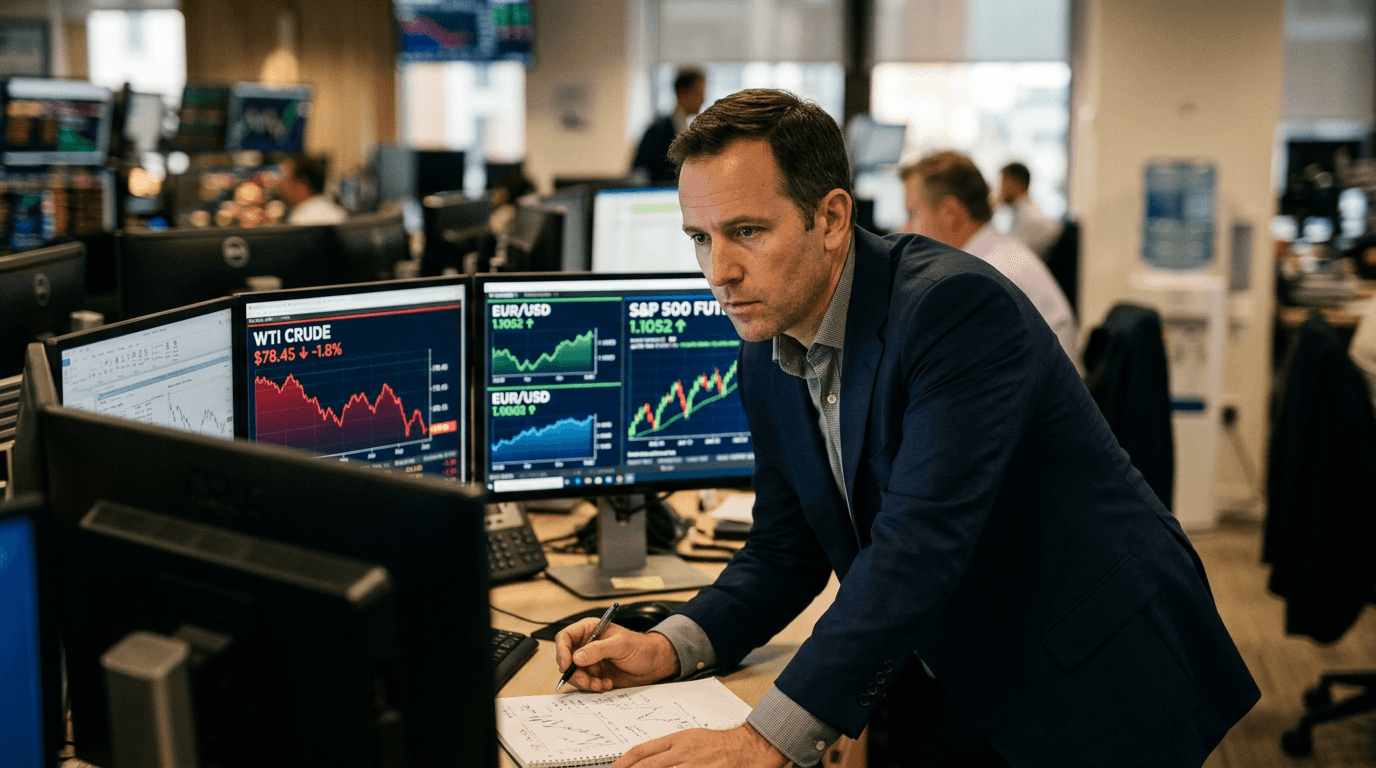
Oil’s latest tumble is a reminder that in macro-driven markets, one headline can reshuffle the entire risk ladder in a matter of hours. Hopes for a US–Iran deal and a reopening of the Strait of Hormuz have knocked crude sharply lower, encouraged a reversal in safe-haven positioning, and lifted risk appetite across global currencies and equity-linked futures.[1][2][3][4][5] For traders, this is a textbook “geopolitical risk premium unwind” – and a valuable live case study to learn from.
Market Reaction: Oil, Equities, And Futures
As signs of progress toward a ceasefire and potential agreement to reopen key shipping lanes in the Gulf emerged, oil prices fell hard.[1][2][3][4][5] Brent crude has dropped anywhere from more than 4% in a single session to roughly 11% over the week in some measures, as traders mark down the probability of sustained supply disruption.[1][2][4]
The reaction has been swift across risk assets. US equity futures turned higher as the perceived tail risk of an escalating conflict eased, with contracts linked to major US indices pointing to gains after the oil move.[2][4] In earlier sessions, cash equity benchmarks like the S&P 500 and Japan’s Nikkei 225 pushed to record highs, underscoring how sensitive equities are to changes in the geopolitical backdrop.[1]
Emerging-market assets have also responded positively. A widely followed index of emerging-market stocks gained about 1.5%, extending a multi-session rally, while an accompanying gauge of EM currencies strengthened around 0.3%.[3] This pattern – weaker oil, stronger EM – is consistent with a “risk-on” turn in global markets when energy supply fears recede.[1][3][5]
Why A Lower Oil Price Lifts Risk Appetite
The shift in sentiment is rooted in how oil prices feed into the broader macro picture. Elevated crude prices are effectively a tax on global growth, squeezing consumers, raising input costs for businesses, and complicating central banks’ attempts to tame inflation. When oil falls on de-escalation hopes, markets quickly reassess both the growth and inflation outlook.
With the risk of a prolonged supply shock reduced, investors are downgrading the probability of another inflation flare-up and additional aggressive rate hikes. Bond markets have reflected this, with yields easing as expectations for tighter policy are pared back.[5] Lower yields, in turn, support valuations for growth-oriented assets and high-duration sectors like technology.
At the same time, a lower “geopolitical risk premium” tempers the demand for classic hedges. Some of the defensive positioning in the dollar and inflation-linked assets gets unwound, while riskier corners of the market – from EM equities to high-beta cyclicals – see renewed interest.[3][4][5] The rotation is less about optimism in isolation and more about a recalibration of tail risks.
Currency Market Winners And Losers
In FX, the narrative mirrors what is happening in oil and equities. As peace hopes rise and energy prices retreat, high-beta and emerging-market currencies tend to benefit, while traditional safe havens lose some shine.
Emerging-market currencies have gained alongside local equities as investors reach for yield and growth exposure.[3] Currencies of oil-importing economies often outperform in this environment for a simple reason: cheaper energy improves their trade balance and eases domestic inflation pressures, giving central banks more flexibility.
On the other side, the dollar has softened as safe-haven demand ebbs and as markets speculate that lower inflation risks could limit the need for additional policy tightening.[4][5] For traders, this creates opportunities in FX pairs where the macro impulse from oil is most direct – for instance, currencies of major oil importers versus exporters, or EM FX versus the dollar in a risk-on phase.
The key is recognizing that these moves are not just technical; they are rooted in shifting expectations around future growth, inflation, and policy paths. That makes them particularly important for macro and cross-asset strategies.
What This Means For Traders And Simulated Strategies
For active traders and those using simulated environments like E8 Markets to test ideas, this episode highlights several practical lessons.
First, geopolitical risk is often priced as a premium that can be both built and unwound quickly. Oil’s sharp drop on Iran deal hopes underscores how fragile those premia can be once headlines shift.[1][2][5] Strategies that performed well during the risk build-up – long oil, long the dollar, long volatility – may suddenly struggle when the narrative pivots.
Second, correlations matter. The same news flow that drives crude lower can simultaneously drive equity futures, EM FX, and bond yields in consistent directions. Understanding these relationships allows traders to build multi-asset views: for example, pairing an oil short with a long in EM equity indices or high-beta currencies when de-escalation appears credible.[1][3][5]
Third, conviction is not the same as direction. Even as prices move, many institutional desks note that overall conviction remains relatively low, with investors wary of headline risk reversing.[5] That argues for disciplined risk management: smaller position sizes, clearly defined stop levels, and scenario planning around alternative outcomes (e.g., talks stall, escalation resumes).
Simulated trading environments are ideal for stress-testing these approaches. Traders can replay similar historical episodes – such as prior Middle East flare-ups, OPEC shocks, or ceasefire announcements – and evaluate how their strategies would have behaved. This helps refine rules for entry, exit, and risk allocation when the next geopolitical headline hits.
Key Lessons For Managing Geopolitical Risk
A few practical takeaways stand out from the current move:
1) Treat geopolitics as a volatility amplifier, not a constant. The Iran headline cycle shows how risk premia can spike and then compress. Build strategies that can adapt as volatility regimes shift, rather than assuming elevated risk will persist indefinitely.
2) Anchor trades in macro linkages. Oil is not just a commodity price; it is a transmission channel into inflation, rates, currencies, and growth-sensitive equities.[1][3][5] When news hits, mentally map the knock-on effects: who benefits from cheaper energy, who loses from lower oil revenues, and how central banks might respond.
3) Separate short-term relief from long-term fundamentals. A ceasefire or reopening of shipping lanes can justify a sharp near-term move, but underlying structural issues – supply capacity, fiscal positions, energy transition dynamics – still matter for the medium-term trend. Use the “relief rally” to reassess whether prices have overshot in either direction.
4) Use simulated trading to crystallize rules. Decide in advance how your strategy reacts to event risk: Do you reduce leverage into key meetings? Do you fade initial overreactions or wait for confirmation? Testing these rules in a SimFi environment provides data-driven insight without risking capital.
Ultimately, the oil tumble on Iran deal hopes is more than just a headline; it is a live demonstration of how macro narrative shifts cascade through crude, currencies, and futures. Traders who can connect those dots – and who use tools like simulated trading to rehearse their playbook – are better positioned not just to survive the next risk pivot, but to capitalize on it.