
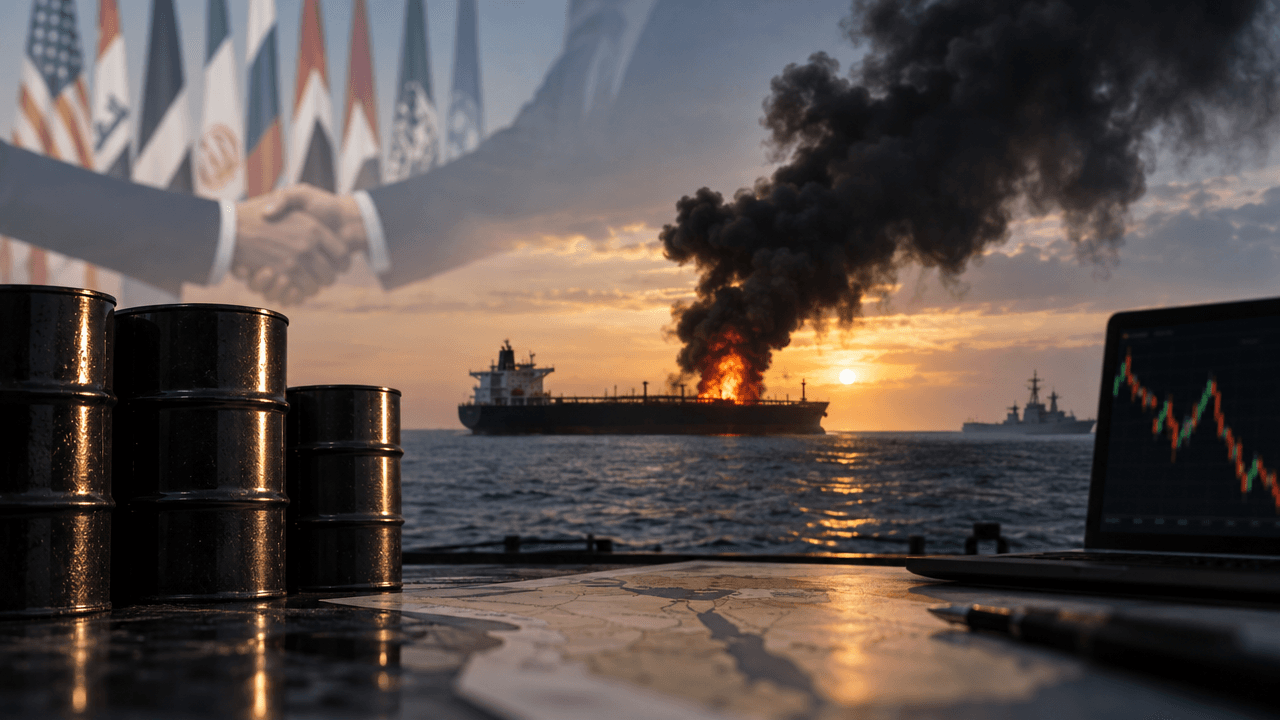
Oil volatility has returned to the center of global markets as two opposing forces compete for control of prices. Hopes for a diplomatic breakthrough between the United States and Iran have pushed crude sharply lower, while continuing attacks on oil-carrying vessels and uncertainty around the Strait of Hormuz have kept supply fears alive. Brent crude was on track for a weekly decline of more than 13%, its steepest weekly fall since March 2020, yet prices rebounded when tanker incidents renewed concerns about regional exports. [7][5]
For traders, the message is clear: the market is no longer pricing a single outcome. Instead, oil is reacting rapidly to every signal about negotiations, shipping security, sanctions, infrastructure, and the future of the world’s most important energy chokepoint.
The Diplomacy Premium
Oil prices fell sharply earlier in the week as investors assessed whether political developments could create a path toward de-escalation. Discussions involving Iranian and Qatari officials, along with wider diplomatic efforts, raised the possibility that the conflict could move toward a negotiated settlement. A successful agreement could improve shipping conditions, support the reopening of the Strait of Hormuz, and allow more Middle Eastern crude to reach global markets. [3][9]
That possibility created a rapid reversal in the risk premium embedded in oil prices. When traders believe supply disruptions may ease, they often sell futures contracts before physical flows have fully recovered. This explains why crude can fall several percentage points in a single session even when current inventories and deliveries have not changed dramatically.
The move also reflects expectations about future production. If blocked or restricted exports return to the market, additional barrels could weigh on prices. Some analysts have warned that a restoration of Gulf flows could produce a substantial supply surplus, particularly if demand growth remains moderate. [12]
However, diplomacy is not the same as restored supply. Negotiations can reduce immediate fear, but physical energy markets require ships, insurance, terminals, pipelines, and functioning infrastructure. Until those elements are reliably available, the diplomatic price decline remains vulnerable to reversal.
The Strait Of Hormuz Risk
The Strait of Hormuz remains the central issue behind oil’s volatility. The narrow waterway is a crucial outlet for Middle Eastern oil shipments, making any disruption a direct threat to global energy supply. Recent reports described at least five vessel-related incidents in the Persian Gulf, while maritime security data indicated that attacks on oil-carrying ships remained close to record levels. [2][7]
The market response has been asymmetric. Prices can fall quickly when traders anticipate peace, but they can rise just as quickly when a new attack suggests that supply routes remain unsafe. Reports that two oil tankers and a tugboat caught fire after attempting to use unauthorized routes through the strait added to uncertainty around commercial traffic. [4]
The key distinction for traders is between a temporary shipping disruption and a sustained supply outage. A delayed cargo may create short-term volatility, but a prolonged closure or major infrastructure damage could affect refinery operations, inventory levels, freight costs, and consumer prices worldwide.
That is why the market can remain nervous even after a major weekly decline. Lower prices do not necessarily mean that risk has disappeared. They may simply indicate that traders are assigning greater probability to de-escalation while maintaining protection against a sudden deterioration.
Why Oil Matters Beyond Energy
Crude oil is not only an energy-market asset. Its price affects inflation expectations, currencies, interest-rate forecasts, transportation costs, and equity valuations.
Commodity-linked currencies such as the Canadian dollar and Norwegian krone can respond to changes in oil prices because energy exports are important sources of national income. A sharp decline in crude may weigh on these currencies, while a renewed supply shock can provide support. The reaction is not automatic, however. Traders must also consider domestic interest rates, economic growth, and the broader direction of the U.S. dollar.
Oil also influences inflation expectations. Higher fuel and transportation costs can raise headline inflation and place pressure on central banks to maintain restrictive policy. Lower crude prices can have the opposite effect, reducing energy costs for households and businesses. For this reason, a sudden oil rally may affect bond yields even before official inflation data captures the change.
Futures markets provide another important signal. When near-term contracts trade at a premium to later deliveries, the market may be reflecting immediate scarcity or elevated geopolitical risk. When the curve shifts toward lower future prices, traders may be anticipating improved supply conditions. The shape of the futures curve can therefore provide more information than the headline spot price alone.
A Practical Framework For Simfi Traders
Simulated trading offers a useful environment for studying these reactions without risking real capital. The first step is to separate the headline from the transmission mechanism. Ask whether an event changes expected production, the safety of shipping routes, refinery access, or simply market sentiment.
Next, monitor confirmation across related markets. A genuine supply shock may appear simultaneously in crude futures, tanker rates, energy equities, inflation expectations, and commodity currencies. If oil rises but those markets show little confirmation, the move may be driven more by short-term positioning than by a lasting change in fundamentals.
Risk management is especially important during geopolitical events. Traders can reduce exposure when price gaps become unusually large, define stop levels before entering a position, and avoid assuming that a sharp move will continue indefinitely. Scenario planning can also help: one scenario for successful de-escalation, another for prolonged disruption, and a third for escalation involving infrastructure or shipping routes.
The current market offers a practical lesson in volatility. A bearish oil view based on peace expectations can be reasonable, but it must account for the possibility that one new incident can quickly restore the risk premium.
Conclusion
Oil markets are caught between the promise of improved diplomacy and the reality of continuing supply risks. De-escalation could release additional crude and push prices lower, but attacks on tankers and uncertainty around the Strait of Hormuz show that physical risks remain unresolved. [1][14]
For traders, the most valuable skill is not predicting a single headline outcome. It is recognizing how political news moves through supply expectations, futures pricing, currencies, inflation, and risk sentiment. In a market this sensitive, disciplined scenario analysis and careful position sizing matter as much as the direction of the next oil price move.