
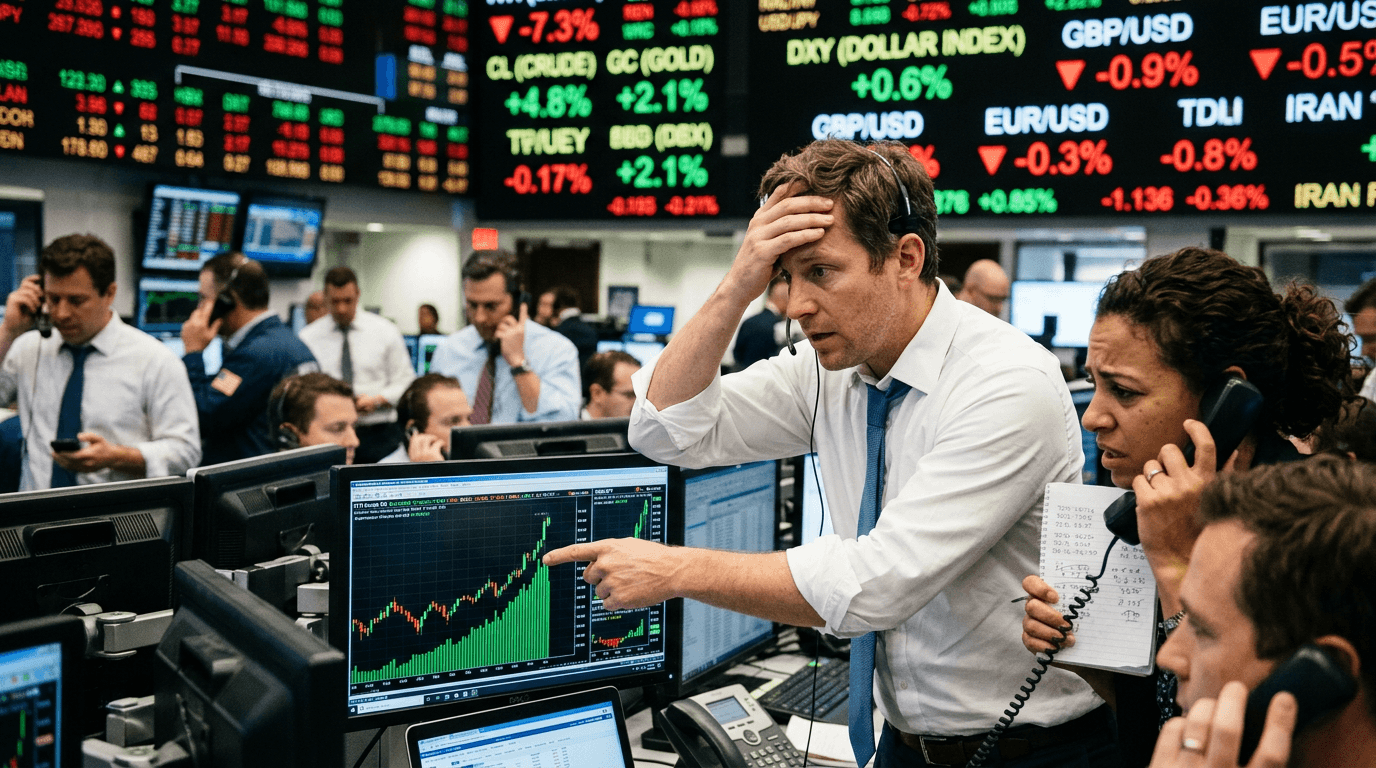
Renewed U.S.–Iran hostilities have pushed oil prices higher and sparked another rush into safe-haven assets, putting the U.S. dollar back on the front foot while sterling and other risk-sensitive currencies edge lower. A familiar pattern is playing out: geopolitical tension in the Middle East is being translated into higher energy prices, shifting inflation and interest-rate expectations and repricing major FX pairs in the process.[2][7][11]
Market Reaction: Oil Up, Safe Havens In Demand
Whenever traders see headlines about fresh U.S. strikes on Iranian targets, their first instinct is to look at oil. The region sits astride the Strait of Hormuz, a critical chokepoint for global crude and LNG flows, so any escalation immediately adds a “risk premium” to oil prices.[3][9][14] Earlier phases of the conflict saw Brent jump by around $10 per barrel to just below $80 as war risk rose and supply routes were disrupted.[12]
More recently, U.S. West Texas Intermediate (WTI) and Brent futures have tended to spike on each bout of U.S.–Iran tension, with gains of 1–2% in a day not uncommon when markets refocus on Middle East supply risks.[7] Even when prices later retrace as traders reassess the likelihood of prolonged disruption, the underlying volatility stays elevated and keeps an embedded geopolitical premium in the curve.[8][13]
That rise in perceived risk does not stay confined to energy. Safe-haven assets typically catch a bid: gold has repeatedly surged during the conflict, including one episode where it jumped 2% as tensions escalated and investors sought protection.[1][2] Safe-haven currencies and bonds have also benefited. The U.S. dollar index has previously climbed close to 1% in a day during earlier waves of the Iran crisis as global investors sought the relative safety and liquidity of U.S. assets.[2] Similar flows often support the Japanese yen and top-rated sovereign bonds.[2][6]
Why Geopolitics In Oil Spills Into Fx
The mechanics connecting U.S.–Iran hostilities to FX are straightforward but powerful. First, higher oil prices act like a tax on energy-importing economies. Europe and the UK are net importers, so rising crude can squeeze real incomes, dampen growth and complicate inflation control at the same time.[9][11][14] That mix—slower growth but potentially higher inflation—raises the risk of “stagflation-style” trade-offs for central banks.
Second, oil shocks influence market expectations for policy rates. If traders believe higher energy costs will push headline inflation back up and keep it stickier, they may push out the timing of rate cuts from the Federal Reserve, Bank of England or European Central Bank.[2][10] For the U.S., the combination of higher inflation risk and safe-haven demand often translates into higher yields and a stronger dollar versus its peers.[2]
For the UK, the picture can be more nuanced. Sterling can weaken against the dollar when investors see the U.S. as offering both higher relative yields and a safer macro backdrop, even if the Bank of England is also facing pressure to stay cautious on cuts. At the same time, a weaker growth outlook for the UK due to higher energy costs can reduce appetite for GBP exposure, particularly against a firm USD.
How Major Fx Pairs Are Affected
Against this backdrop, the latest round of U.S.–Iran hostilities has reinforced familiar patterns across major currency pairs:
EUR/USD and GBP/USD: The dollar’s safe-haven status tends to dominate when geopolitical risk spikes. Flows into U.S. assets, plus the perception that the U.S. economy is more insulated from imported energy shocks than Europe or the UK, often see EUR and GBP drift lower versus the greenback.[2][9][14] Sterling’s modest slip in the latest episode fits that template.
USD/JPY: In classic risk-off periods, the yen is another beneficiary as Japanese investors repatriate capital and global traders seek liquidity in JPY. However, when U.S. yields rise on inflation and rate expectations while the Bank of Japan stays ultra-dovish, USD/JPY can diverge from the traditional pattern—leaving the pair pulled between safe-haven yen demand and higher U.S. yield support.[2]
Commodity currencies: Oil-linked currencies such as the Canadian dollar and Norwegian krone can receive some support from higher crude prices, as improved terms of trade benefit their economies. Yet broad risk aversion may offset those gains, particularly versus the U.S. dollar, which usually dominates the safe-haven hierarchy in global stress events.[2][3]
Emerging-market FX: Higher oil, higher U.S. yields and a stronger dollar are typically a challenging mix for emerging markets. Importers of energy face worsening trade balances, while any increase in global risk aversion tends to reduce capital flows into EM assets.[9][10] That combination often leads to underperformance of EM FX against the dollar during intense geopolitical episodes.
Trading Implications: Volatility, Correlations And Risk
For active traders—whether in live or simulated environments—these episodes highlight why it is essential to watch cross-asset linkages rather than FX in isolation. Moves in oil, gold and bond yields can provide early clues about how currencies might react as the narrative evolves.[1][2][3]
Volatility is both an opportunity and a threat. Headline-driven spikes can create sharp, short-lived dislocations in major pairs as algorithms and discretionary traders react simultaneously to news flashes. Spreads can widen and liquidity can thin, especially in less-traded crosses or during off-peak hours. That makes position sizing and risk controls critical.
From a strategy standpoint, traders may:
1) Track real-time oil and gold moves alongside DXY to anticipate pressure points in EUR/USD and GBP/USD.
2) Consider relative growth and policy narratives—how higher energy costs may change rate-cut expectations across the Fed, BoE and ECB.
3) Use simulated accounts to stress-test strategies under Iran-related shock scenarios, including gaps, slippage and fast-reversing moves.
4) Avoid overreacting to the first headline; markets often overshoot on initial fear and then mean-revert as more information emerges.[8][13]
Key Takeaways For Simulated And Live Traders
Events like renewed U.S.–Iran hostilities are reminders that macro, geopolitics and FX are tightly intertwined. For traders building their playbooks:
1) Always map the chain of impact: headline → oil and gold → yields and safe havens → FX majors and risk assets.
2) Understand each currency’s role: the dollar as global safe haven and reserve asset, sterling and euro as energy-importer proxies, and commodity currencies as partial beneficiaries of higher crude.
3) Incorporate scenario planning into your process: best-case de-escalation, base-case elevated tension, worst-case supply disruption through the Strait of Hormuz.[3][9][14]
4) Use simulated environments to practice execution in volatile conditions, refine entries and exits, and test how your strategy behaves during sudden spikes in oil and the dollar.
Episodes of geopolitical stress are unlikely to disappear from the market landscape, and the Middle East will remain a focal point whenever energy security is questioned. Traders who learn to read the interplay between oil, safe-haven demand and major FX pairs will be better prepared—not just to navigate the current U.S.–Iran flare-up, but to handle future shocks with a structured, risk-aware approach.