
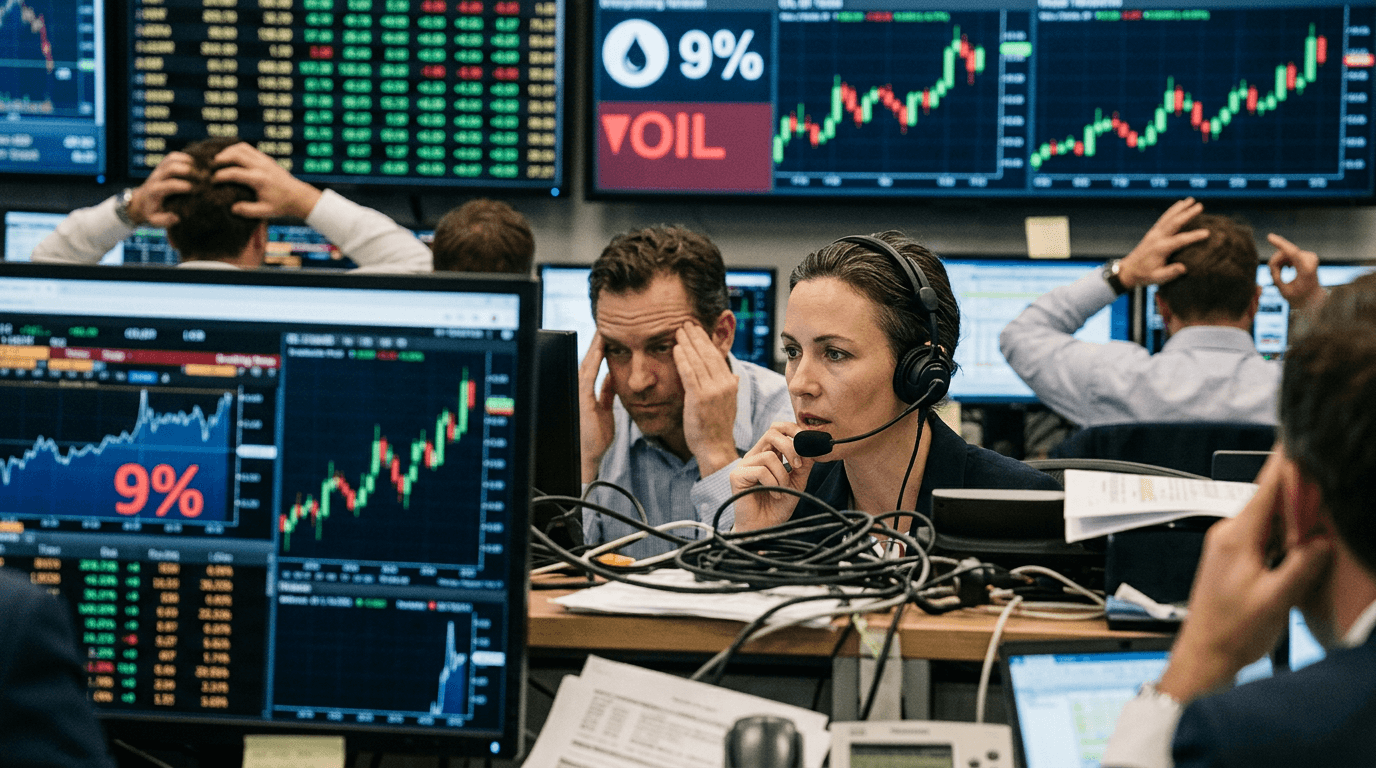
Crude oil ripped higher, jumping as much as 9% as renewed military clashes between the US and Iran jolted energy markets and triggered a global risk-off move. West Texas Intermediate (WTI) briefly pushed above recent highs, while Brent crude climbed toward the mid‑$80s, reviving fears of a fresh inflation wave at a time when central banks were only just starting to talk about easing policy. The result: energy stocks caught a bid, broader equities slipped, safe-haven assets rallied, and traders rapidly repriced the “higher for longer” interest rate narrative.
WHAT’S DRIVING THE 9% OIL SURGE?
This is not a garden‑variety geopolitical headline rally. The price action reflects material supply risk in a structurally tight market.
The immediate catalyst is the renewed military escalation between the US and Iran, including strikes on energy infrastructure and shipping in and around the Persian Gulf. Markets are hypersensitive to any sign of disruption in this region because it controls one of the world’s most important chokepoints: the Strait of Hormuz.
Roughly 20% of global oil supply typically passes through this narrow waterway every day. Even partial closures, increased inspections, or attacks on tankers can materially restrict flows. Traders don’t wait for barrels to physically disappear before repricing risk. The mere threat that 10–11 million barrels per day could be taken offline is enough to force refiners and importers to scramble for alternative supply.
Physical market stress is already evident in the form of higher premiums on seaborne cargoes outside the Gulf. Asian refiners, in particular, are bidding aggressively for North Sea, West African, and US Gulf Coast grades, driving up differentials over benchmarks like Brent. When prompt‑month futures rally and physical cargo premiums surge at the same time, it signals genuine concern that supply may not be sufficient at current prices.
Layer on top of this a market that was already tight—after years of under‑investment in upstream projects and disciplined output from OPEC+—and you have the recipe for outsized moves. With global demand hovering near record highs and inventories not especially bloated, the risk premium being priced into oil is a rational response to a genuine shock.
How The Shock Is Ricocheting Across Markets
A 9% one‑day move in oil is large enough to reverberate across virtually every major asset class.
Equities reacted with classic risk‑off behavior. Broad US indices came under pressure as investors digested what higher energy costs mean for profit margins and consumer spending. Sectors with high fuel sensitivity—airlines, transportation, consumer discretionary—faced particular headwinds. At the same time, energy stocks outperformed, with integrated majors and exploration and production names benefiting from sharply improved cash‑flow expectations.
Fixed income markets reflected the tug‑of‑war between inflation risk and growth fears. On one side, a sustained oil spike lifts headline inflation and can bleed into core prices through higher transportation and input costs. That argues for higher yields, especially at the front end, as expectations for central bank rate cuts are pushed further out. On the other side, a severe risk‑off episode typically triggers a flight into Treasuries and other sovereign bonds, compressing yields at the long end. The net effect can be a bear‑steepening or flattening of the curve, depending on how traders weigh inflation versus growth.
In currencies, oil‑exporting countries often see support for their FX as higher prices improve trade balances and fiscal positions, while large net importers (particularly in emerging markets) face depreciation pressures and potential reserve drawdowns. The US dollar can benefit as a safe‑haven and as higher US yields attract capital, even if the US is now a significant producer of energy.
Commodities beyond crude oil did not move uniformly. Gold and other traditional safe‑havens rallied as investors looked to hedge geopolitical and stagflation risk. Industrial metals were more mixed, balancing weaker growth expectations against any supply‑side boosts from energy‑linked production costs.
INFLATION, CENTRAL BANKS, AND “HIGHER FOR LONGER”
The most consequential impact of this oil spike may be on inflation expectations and monetary policy.
Energy prices feed into inflation through several channels: directly via gasoline, diesel, and heating fuels, and indirectly via higher transport and production costs for goods and services. A single 9% move in oil does not by itself re‑anchor inflation, but it can reinforce the perception that price pressures are more persistent than central banks had hoped.
For the Federal Reserve and its peers, the timing is awkward. Markets had been pricing in the prospect of rate cuts as inflation data showed signs of cooling and growth appeared to be moderating. A sustained oil shock complicates that narrative. If inflation expectations creep higher, policymakers can be forced to keep rates elevated for longer or to delay easing cycles altogether.
In a worst‑case scenario, markets begin to price a stagflationary environment—slower growth combined with rising prices. That’s particularly challenging because policy tools are blunt: cutting rates supports growth but risks exacerbating inflation; keeping policy tight protects against inflation but at the cost of weaker demand and higher unemployment.
Traders need to monitor not just the level of oil prices but also how they filter into breakeven inflation rates, real yields, and central bank communication. Hawkish shifts in tone, upward revisions to inflation projections, or explicit references to energy‑driven risks can all be catalysts for further repricing in rates and FX.
What Traders Should Watch Next
For both live and simulated traders, this environment demands focused attention on a handful of key drivers.
1. Geopolitical trajectory in the Gulf Headline risk is paramount. Any sign of escalation—more strikes on infrastructure, confirmed tanker attacks, or formal announcements about closing or restricting the Strait of Hormuz—could send another leg higher in crude. Conversely, credible diplomatic progress, ceasefire talks, or international naval escorts to secure shipping lanes could deflate some of the risk premium.
2. Physical market signals Watch timespreads (the price difference between near‑dated and later‑dated futures). Deepening backwardation—where front‑month contracts trade at a large premium—usually indicates acute near‑term tightness. Monitoring inventory data, refinery utilization rates, and changes in export flows from key producers can provide an early read on whether the supply shock is intensifying or being absorbed.
3. Central bank rhetoric and pricing of rate paths Track interest rate futures, overnight index swaps, and market‑implied probabilities for policy moves. If traders increasingly price out rate cuts and even flirt with additional hikes, growth‑sensitive assets like equities and high‑yield credit could remain under pressure.
4. Consumer impact and demand destruction High fuel prices eventually hit consumer wallets. Look at retail gasoline prices, consumer confidence surveys, and high‑frequency spending data. If demand destruction starts to appear—people driving less, cutting discretionary spending—that could cap oil’s upside over time while amplifying recession fears.
Practical Takeaways For Traders
For short‑term traders, this is a volatility‑rich environment. Sharp intraday swings in crude, equity indices, and rates markets create opportunities but also elevate risk. Position sizing, clear stop‑loss levels, and an awareness of event risk around geopolitical headlines are essential.
Medium‑term traders should consider scenario analysis: – If the conflict escalates and flows through Hormuz are heavily disrupted, oil could move materially higher, supporting energy equities and inflation hedges while pressuring rate‑sensitive sectors. – If tensions stabilize but remain unresolved, a sustained risk premium could keep oil in an elevated range, with markets oscillating between inflation and growth concerns. – If a credible de‑escalation occurs, some of the geopolitical premium could unwind quickly, hitting crowded long positions in crude and energy stocks while offering relief to broader risk assets.
For participants using simulated finance platforms, this episode is an ideal live‑fire exercise in managing macro‑driven shocks: integrating cross‑asset signals, stress‑testing portfolios for tail risks, and practicing discipline when volatility surges.
Ultimately, the 9% spike in oil is not just about energy—it is a test of how resilient the global economy and financial system are to renewed geopolitical shocks. The path of the conflict, the behavior of physical oil flows, and the response from central banks will determine whether this is a sharp but temporary scare or the start of a more persistent stagflationary regime.