
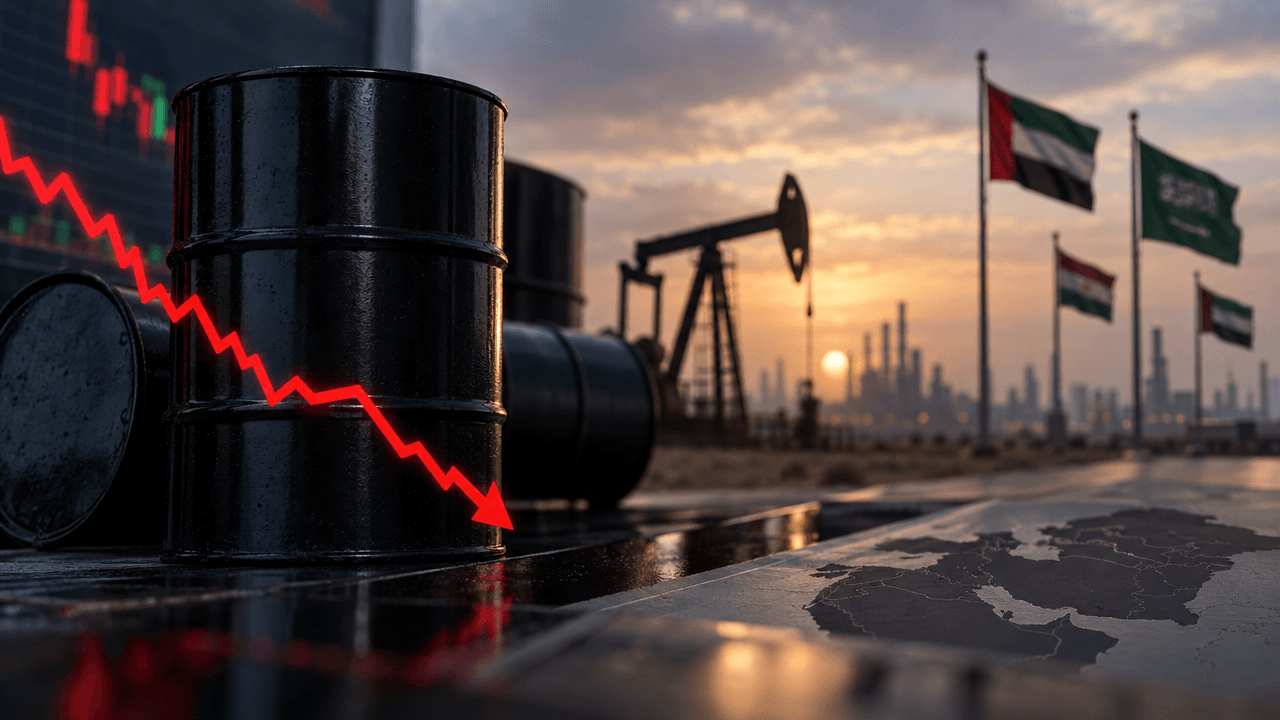
Oil’s surge above $100 a barrel is losing momentum as traders reassess just how severe Middle East supply disruptions will be, trimming the risk premium that had rapidly built into prices and relieving some pressure on global inflation expectations.[8][10][13] For both real and simulated traders, this kind of swift sentiment shift is a textbook example of how geopolitics, logistics, and psychology intersect in the energy markets.
Price Action: From Spike To Pullback
Brent crude futures recently broke through the $100 threshold on escalating conflict and attacks on shipping and infrastructure, marking multi‑month highs and sharp weekly gains.[1][8][12][14] West Texas Intermediate (WTI) followed closely, briefly trading around or just above $100 as the market priced in worst‑case scenarios for Middle East supply.[6][8]
Since that spike, futures have retreated, with Brent now hovering closer to the $100–103 range as the initial panic gives way to a more measured assessment of actual barrels at risk.[10][13] Daily moves of around 1% down from the highs reflect a cooling of fears rather than a wholesale reversal of the earlier rally, keeping prices elevated relative to levels seen earlier in the summer.[8][10]
Importantly, the pullback has occurred after several sessions of volatile, headline‑driven trading in which prices swung on each new report of attacks, outages, and diplomatic efforts.[3][4][7][15] Traders who chased the breakout above $100 on pure momentum are now confronting the reality that risk premiums can unwind just as quickly as they arise.
KEY TAKEAWAY: Price surges driven by fear often retrace once the market sees credible paths to restoring supply, even if underlying risks have not fully disappeared.
Why Middle East Risk Premium Is Unwinding
The latest leg higher in oil was fueled by attacks on Saudi energy infrastructure and shipping routes that disrupted flows and temporarily shut key pipelines, putting the kingdom’s East‑West pipeline and Red Sea export hub in focus.[4][7][9][15] These events raised concerns that crude moving through the region, including via the Strait of Hormuz and nearby routes, could face prolonged interruptions.[1][6][14]
More recently, however, reports have highlighted that Saudi Arabia is finding ways to keep exports moving, including reliance on alternative routes and expectations that additional barrels can reach global buyers despite damage to key infrastructure.[5][10] This has reassured markets that the worst‑case scenario of sustained, large‑scale outages is less likely, prompting traders to pare back the conflict‑driven premium embedded in prices.[3][10]
At the same time, the pattern of attacks has shifted from surprise to familiarity, and markets tend to discount risks that become “known knowns.” Earlier waves of Houthi attacks on tankers and pipelines triggered sharp jumps as traders rushed to reprice disruption.[9][14][15] Now, each new incident still matters, but the immediate impact on prices is moderated by the belief that producers and shippers are adapting.
This is a classic illustration of the risk premium concept: prices move not only on current supply and demand but also on perceived probability and severity of future disruptions. As confidence grows that producers can reroute or restore flows, that premium contracts.
KEY TAKEAWAY: When credible mitigation strategies emerge—such as alternate shipping routes or incremental supply additions—the geopolitical risk premium embedded in oil prices tends to shrink.
Implications For Inflation, Central Banks, And Other Assets
The jump in oil above $100 had re‑ignited concerns about renewed inflationary pressure, with some analysts arguing that higher energy costs could bolster the case for further interest rate hikes by major central banks.[7][14] Energy is a key component of headline inflation measures, and sustained triple‑digit oil prices would feed through into transport, manufacturing, and consumer goods costs.
The recent retreat toward—but still above—$100 slightly eases these worries, signaling that the inflation shock may be more contained than feared if prices consolidate instead of accelerating higher.[10][13] That moderation helps risk assets such as equities, especially in energy‑sensitive sectors like airlines, logistics, and consumer discretionary, which suffer when fuel bills spike.
In currency markets, stabilizing oil can relieve pressure on large net importers and temper support for producers whose currencies often strengthen when crude rallies aggressively. Bond markets, too, respond to shifting inflation expectations; moderating oil prices can reduce the probability of aggressive rate paths being priced into yields.
However, traders should note that even at current levels, oil remains expensive relative to much of the past year, and any renewed escalation in Middle East tensions could quickly rebuild the risk premium that just came out of the market.[1][6][14]
KEY TAKEAWAY: A pullback from extreme levels is helpful for inflation and rate expectations, but as long as oil stays near $100, energy remains a meaningful macro risk factor.
What Active Traders Should Watch Next
For futures traders, the $100 mark has re‑emerged as a critical psychological and technical level, with recent charts showing key support zones around that price area for Brent.[13] A sustained break below $100 would signal that the market is more confident supply risks are contained, while renewed buying pressure above $105–108 would suggest the risk premium is expanding again.[3][10][15]
News flow will remain the primary driver of short‑term volatility. Traders should track developments around Saudi infrastructure repairs, shipping security in and around the Strait of Hormuz, and any signs of coordinated supply responses from other producers.[1][4][5][10] Weekly inventory reports from major hubs like the United States can either reinforce or challenge the narrative that physical markets are well supplied despite the disruptions.[3]
Given the headline‑sensitive environment, using options to hedge directional futures positions can help manage gap risk on overnight news. Scenario planning—mapping out price responses to different levels of disruption, restoration, or diplomatic breakthroughs—can provide a framework for disciplined decision‑making instead of reacting emotionally to each headline.
KEY TAKEAWAY: Focus on key price levels, headline risk, and inventory data, and consider options and scenario analysis to navigate rapid sentiment swings in oil.
Using Simulated Finance To Navigate Energy Shocks
For traders using SimFi platforms like E8 Markets, this episode offers a rich learning environment without the financial stress of live exposure. Simulating trades around the breakout above $100 and the subsequent pullback helps build intuition about how risk premiums form and unwind.
Practicing with different strategies—trend‑following on the initial spike, mean‑reversion during the retreat, or options hedging around key support levels—can reveal strengths and weaknesses in a trader’s approach. Simulated environments allow experimentation with position sizing, stop‑loss placement, and diversification across energy and non‑energy assets when oil volatility rises.
Perhaps most importantly, SimFi trading encourages post‑trade review. Traders can analyze how their simulated portfolio would have behaved if Middle East tensions escalated further versus how it performed as supply disruption fears eased. That kind of structured reflection is invaluable preparation for real‑money decision‑making when the next geopolitical shock hits commodity markets.
KEY TAKEAWAY: Use simulated trading to rehearse how you would respond to both the surge and the pullback in oil, refining strategy and risk management before committing capital.
Conclusion
Oil’s retreat from above $100 as Middle East supply disruption fears ease is a reminder that markets price probabilities, not certainties. As producers demonstrate an ability to restore flows and reroute exports, the conflict‑driven premium in crude softens, offering some relief to inflation‑sensitive assets while leaving underlying geopolitical risks intact.[5][10][13] For traders—whether live or simulated—the challenge is to distinguish between temporary fear‑driven spikes and more durable structural shifts, using disciplined analysis to navigate the energy market’s next move.