
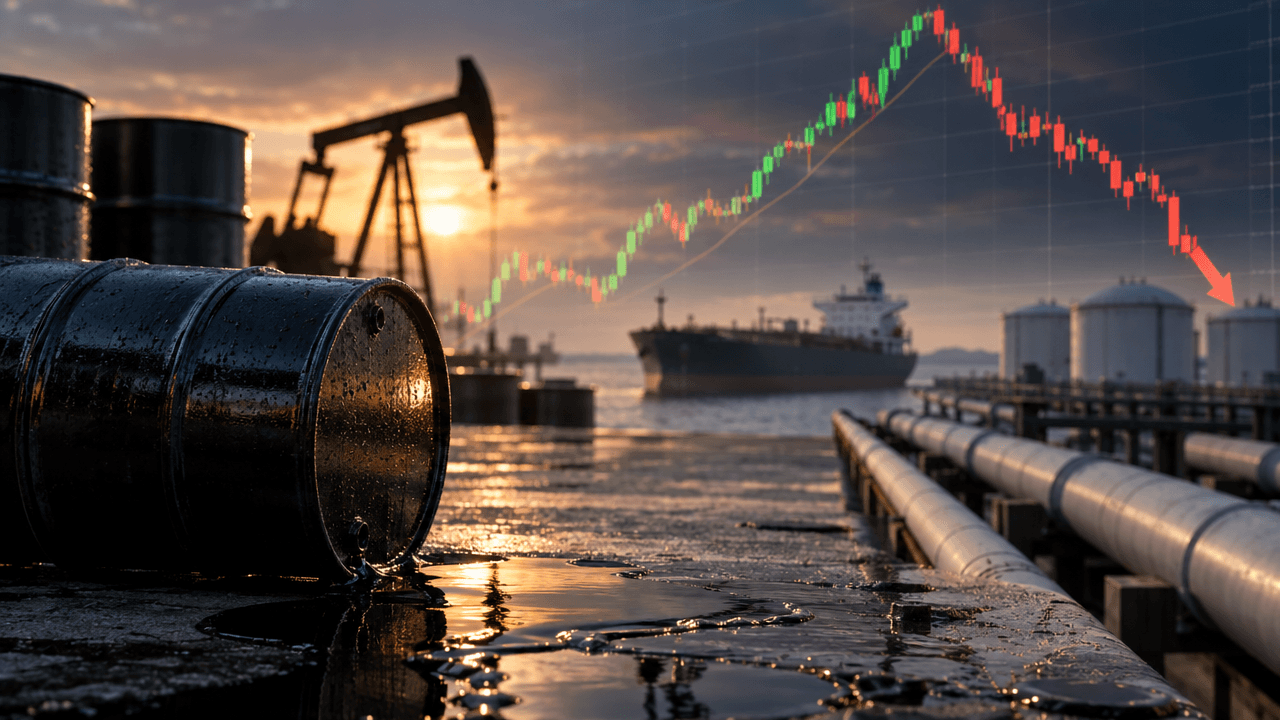
Oil’s sharp intraday reversal on Wednesday was a textbook example of how quickly sentiment can swing when structural supply risks collide with policy-driven efforts to calm the market.[2][8] Prices initially pushed higher on persistent geopolitical concerns but faded as traders focused on a coordinated plan to release 100 million barrels from strategic reserves, leaving Brent hovering around the psychologically important $100 mark and WTI near $89 by the close.[2][5][8]
Market Snapshot: A Volatile Day For Crude
Crude began the session bid as ongoing tensions around Middle East supply routes and Gulf infrastructure kept a risk premium embedded in prices.[1][6][11] With Brent futures trading near or slightly above $100 per barrel, the market was still reflecting worries about potential disruptions even after recent improvements in export flows.[2][5][8]
As headlines around a coordinated reserve release gained traction, momentum flipped.[2][3][11] The Group of Seven plan to deploy 100 million barrels of crude and diesel over several months signaled that policymakers are willing to lean aggressively on emergency stocks to cap fuel prices and stabilize markets.[2][3][5][10] That announcement helped pull Brent off intraday highs and nudged WTI back toward the high-$80s, erasing early gains.[2][5][8]
For traders, this type of reversal is more than just noise; it’s a reminder that price action is shaped by both physical flows and policy signaling. Intraday spikes driven by headline risk can quickly turn into mean-reversion moves once the market digests how new supply will enter the system.
Why Reserve Release Plans Matter
Emergency oil reserves exist precisely for moments like this—when geopolitical risk or structural tightness threatens to push prices into disorderly territory.[3][4][10] The G7 plan to release 100 million barrels of crude and diesel over roughly four months is meaningful because it injects a predictable stream of supply at a time when inventories in some regions are tight.[2][3][5][10]
This volume will not fully erase the risk of disruptions, but it can smooth short-term imbalances and dampen extreme price spikes.[3][4][10] By signaling a clear schedule and scale of releases, policymakers reduce uncertainty about near-term availability, which flows directly into futures pricing and spreads between near- and longer-dated contracts.[3][10]
Psychology is crucial here. Even before all the barrels are delivered, the expectation of future supply can change positioning.[3][5][11] Refiners, physical traders, and speculative funds recalibrate their view of scarcity, which often translates into lower prompt prices, tighter backwardation, or, in some cases, a shift toward mild contango if the market believes near-term supply will temporarily exceed demand.[4][10]
For active traders—whether in live markets or simulated environments—understanding how reserve-release announcements repriced risk is key. The move is not just about “more barrels”; it’s about how expectations change and how quickly those expectations show up in intraday volatility.
SUPPLY CONCERNS HAVEN’T DISAPPEARED
Despite the calming effect of the reserve plan, underlying supply risks have not vanished.[1][3][6] Crude exports from the Middle East have recovered toward or above pre-war levels, but flows still depend on vulnerable routes such as the Strait of Hormuz and alternative pipelines whose security cannot be taken for granted.[1][6][11][14] Shipping risk, higher insurance costs, and the potential for renewed disruptions keep a risk premium embedded in the curve.[1][6][11]
At the same time, tight distillate stocks in key consuming regions, including the US, mean diesel and heating fuel markets remain sensitive to shocks.[3][6][12] That is one reason the reserve-release plan explicitly includes diesel alongside crude: policymakers are targeting the refined-product bottleneck, not just upstream supply.[2][3][5]
Additional factors complicate the outlook. OPEC+ has signaled caution on output increases, storms have periodically threatened Gulf Coast production and refining, and there is still uncertainty around the trajectory of the Iran conflict and its impact on infrastructure.[1][3][6][11] These elements collectively argue against complacency; the market may be choppy, but it is not yet “comfortable.”
For traders, the takeaway is clear: reserve releases can cool prices, but they don’t remove the need to track shipping lanes, refinery outages, and producer policy decisions. Structural tightness and geopolitical risk can reassert themselves quickly if new disruptions emerge.
What Traders Are Pricing In
Beyond supply headlines, macro themes are feeding into oil’s price action. Expectations of tighter US monetary policy and further rate hikes are reinforcing concerns that economic activity and fuel demand could slow into year-end.[3][4][10] That outlook adds a demand-side brake on prices, offsetting some of the supply risk and contributing to the reversal seen after Wednesday’s early surge.[3][4][10]
Positioning also plays a role. After a strong run-up driven by war-related fears, some speculative longs were vulnerable to profit-taking once a credible plan to boost supply via reserves appeared.[6][10][11] Algorithmic traders monitoring headline feeds and price levels can amplify these swings as they flip from trend-following to mean-reversion strategies when momentum stalls.
For discretionary traders, this environment underscores the importance of integrating macro, policy, and physical-market data into a single framework. It is not enough to know that “oil is tight”; the timing and scale of reserve releases, central bank decisions, and export data can all trigger sharp adjustments in risk premia and volatility.
Practical Lessons For Simulated Finance Traders
For participants using SimFi platforms to practice trading, Wednesday’s reversal offers several concrete lessons that translate directly into strategy refinement and risk management.
First, treat coordinated policy announcements—such as a 100 million barrel reserve release—as potential inflection points, not background noise.[2][3][10] When the narrative shifts from “scarcity” to “managed supply,” be prepared for volatility and reassess directional exposure.
Second, develop scenarios that explicitly combine supply and policy variables: escalating Gulf tensions with no reserve action, moderate tensions with aggressive reserve releases, or easing tensions with reserve programs winding down.[1][3][6][11] Testing strategies across these regimes helps reveal where a portfolio is over-reliant on one narrative.
Third, emphasize risk controls around major news events. Use predefined levels for trimming positions, tightening stops, or reducing leverage when headline-driven moves push prices rapidly through key technical zones.
Finally, focus on process rather than prediction. The goal in a simulated environment is to build repeatable routines for digesting news—updating assumptions, adjusting exposure, and reviewing outcomes—so that, when similar situations occur in live markets, the response is disciplined rather than reactive.
Conclusion
Oil’s sharp reversal after an early surge highlights the constant tug-of-war between structural supply anxiety and policy efforts to stabilize prices.[2][3][6] The G7’s plan to release 100 million barrels from emergency reserves has tempered immediate fears and pulled prices back from extremes, yet underlying geopolitical and infrastructure risks remain firmly in play.[2][3][5][11]
For traders, the key is to recognize that markets rarely move on a single factor. Prices reflect a dynamic blend of flows, reserves, macro policy, and sentiment, all interacting in real time. Whether trading live or in a simulated environment, the edge lies in understanding that interplay—and building strategies flexible enough to adapt when the balance between fear and reassurance shifts as abruptly as it did this week.