
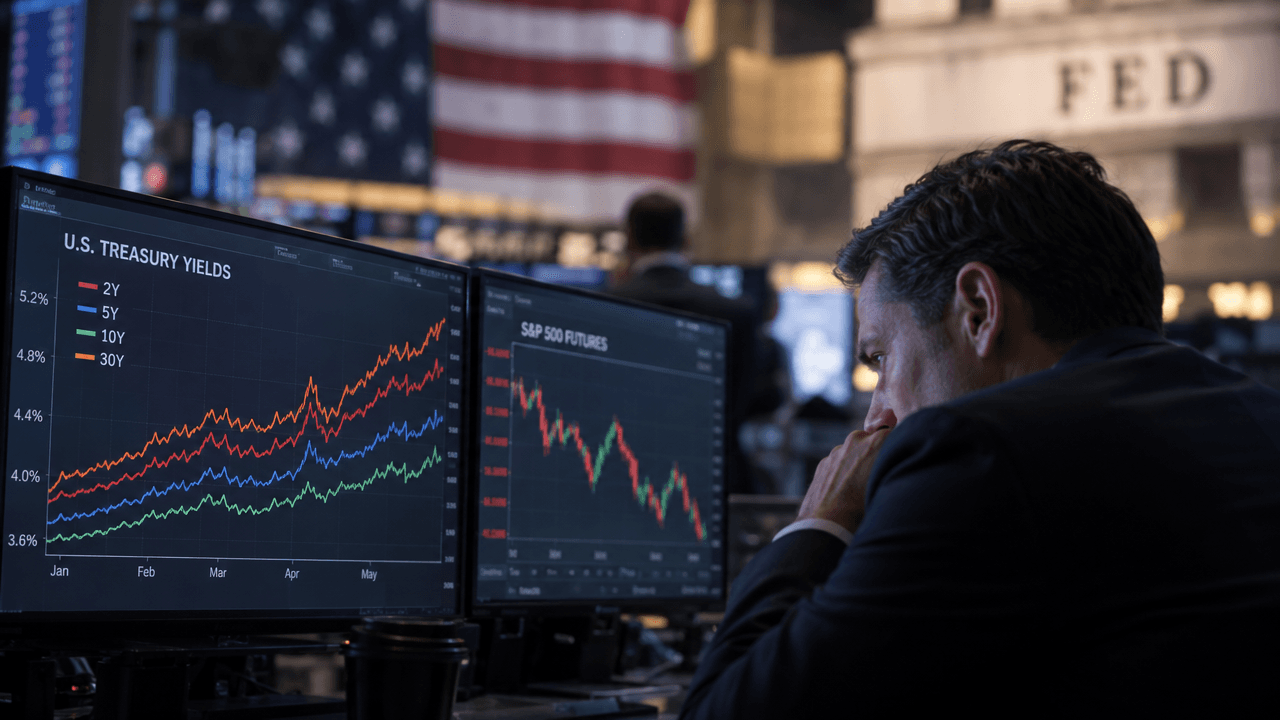
Treasury yields are climbing again, and equity markets are feeling the weight as U.S. index futures trade mildly in the red ahead of the latest Federal Reserve minutes release.[2][7][12] Dow futures are down around 0.14% and Nasdaq 100 futures about 0.18%, signaling a cautious tone rather than outright risk-off as traders position around potential policy surprises.[6][8] For active and simulated traders alike, this kind of pre-event drift can be as revealing as the reaction that follows.
Market Snapshot: Yields Up, Futures Soft
After a brief pullback, longer-dated U.S. Treasury yields have resumed their upward climb, with the 10-year benchmark hovering near multi-decade highs around the 5% zone and the 30-year also elevated.[7][12][13] These levels reflect persistent concerns about inflation, fiscal dynamics, and the possibility that the Fed may need to keep rates higher for longer.[2][11] As yields rebound, rate-sensitive and high-beta assets remain under pressure, from growth tech to small caps.[3][7]
Index futures are reflecting that tension, but in a measured way.[3][8][14] S&P 500 and Dow futures are modestly lower, while Nasdaq 100 futures—more exposed to duration and growth expectations—are also edging down.[3][6][8] Rather than panic selling, the tape suggests investors are trimming risk and tightening exposure ahead of the minutes release, keeping dry powder available in case the Fed narrative shifts.[6][8][11]
Why Treasury Yields Matter For Equity Traders
Treasury yields sit at the core of modern asset pricing because they anchor discount rates for future cash flows and compete directly with risk assets as a store of value.[10][12] When yields move sharply higher, the relative appeal of stocks—especially long-duration growth names—can decline as investors demand higher returns to compensate for increased opportunity cost and macro uncertainty.[2][7]
Higher yields also ripple through the real economy by lifting borrowing costs for mortgages, corporate debt, and consumer credit.[12] That can weigh on sectors tied to housing, discretionary spending, and capital-intensive industries, all of which are sensitive to changes in financing conditions.[7][12] For index traders, this usually shows up as underperformance in cyclicals and high-beta segments when the bond market sells off, and relative resilience in defensive sectors with stable cash flows.
Importantly, not all yield moves are equal. A rise in short-dated yields often reflects shifts in near-term Fed expectations, while longer-maturity moves can signal changes in growth or inflation views.[7][12] Today’s rebound in long-maturity yields suggests the market is reassessing the trajectory of inflation and the credibility of policy guidance over the medium term.[11][12] That nuance matters when deciding whether a move is a tradable spike or part of a broader regime shift.
What Traders Watch In Fed Minutes
Fed minutes provide a detailed look at the central bank’s recent meeting, including how policymakers debated inflation, employment, financial conditions, and risks to the outlook.[1][10] Beyond the official rate decision, traders focus on the distribution of views—how many members leaned hawkish or dovish, and what conditions might trigger future hikes, pauses, or cuts.[1][11]
Key sections often highlight how the Fed interprets market moves, including shifts in Treasury yields, credit spreads, and equity valuations.[10] If the minutes emphasize stubborn inflation and upside risks, markets may infer that another hike remains on the table, potentially pushing yields even higher and weighing further on risk assets.[1][11] Conversely, if the tone acknowledges softer data and growing downside risks, that can validate expectations for a longer pause and support both bonds and equities.[1][11]
Because minutes are backward-looking but rich in nuance, the immediate reaction can be volatile yet short-lived, followed by a more measured repricing as traders digest the details.[9][10] Simulated and live traders both benefit from planning for those phases: the initial headline-driven spike, the secondary adjustment as desks read the document, and the broader narrative that develops over the next 24–48 hours.
Strategies For Live And Simulated Traders In A Yield Rebound
Ahead of event risk like Fed minutes, many professional desks reduce directional exposure and focus on managing volatility rather than chasing short-term trends.[6][8] One common approach is to scale position sizes, avoid concentrated bets in the most rate-sensitive names, and favor liquid instruments that can be adjusted quickly if the narrative shifts.[3][7]
For index futures traders, small pre-event ranges can be an opportunity to practice scenario planning in a simulated environment.[6][10] For example, you can design three simple playbooks: a hawkish surprise where yields jump and equities sell off; a dovish tilt where yields retreat and growth sectors bounce; and a mixed outcome where volatility spikes but the trend remains unclear.[1][11] Running each scenario in simulation helps clarify entry levels, stop placements, and profit targets before capital is put at risk.
Options traders, whether live or simulated, might use elevated uncertainty to explore hedging structures around core index exposures.[3][7] Strategies like buying protective puts, selling covered calls, or constructing spreads can be tested in a SimFi environment to understand how implied volatility and gamma behave during policy-sensitive events.[6][10] The key is to treat the minutes not just as a headline risk, but as a real-time laboratory for refining process and discipline.
Key Takeaways For The Next 24 Hours
First, rebounding Treasury yields are a clear signal that markets are still questioning the endgame for inflation and the Fed’s rate path, and that tension is feeding into equity valuations.[2][7][12]
Second, modest declines in U.S. index futures show a cautious, not panicked, positioning ahead of the minutes, with investors trimming risk rather than exiting en masse.[3][6][8]
Third, the tone of the minutes—hawkish or dovish—will likely set the near-term direction for both yields and risk assets, making flexibility and risk management more important than directional conviction.[1][10][11]
Finally, simulated trading offers a low-risk way to rehearse responses to different Fed narratives, sharpen execution, and understand how macro catalysts translate into price action across indices, sectors, and rates.[6][10]
In an environment where every basis point in yields can ripple through global markets, treating events like Fed minutes as structured learning opportunities—rather than mere binary bets—can give both new and experienced traders a durable edge.