
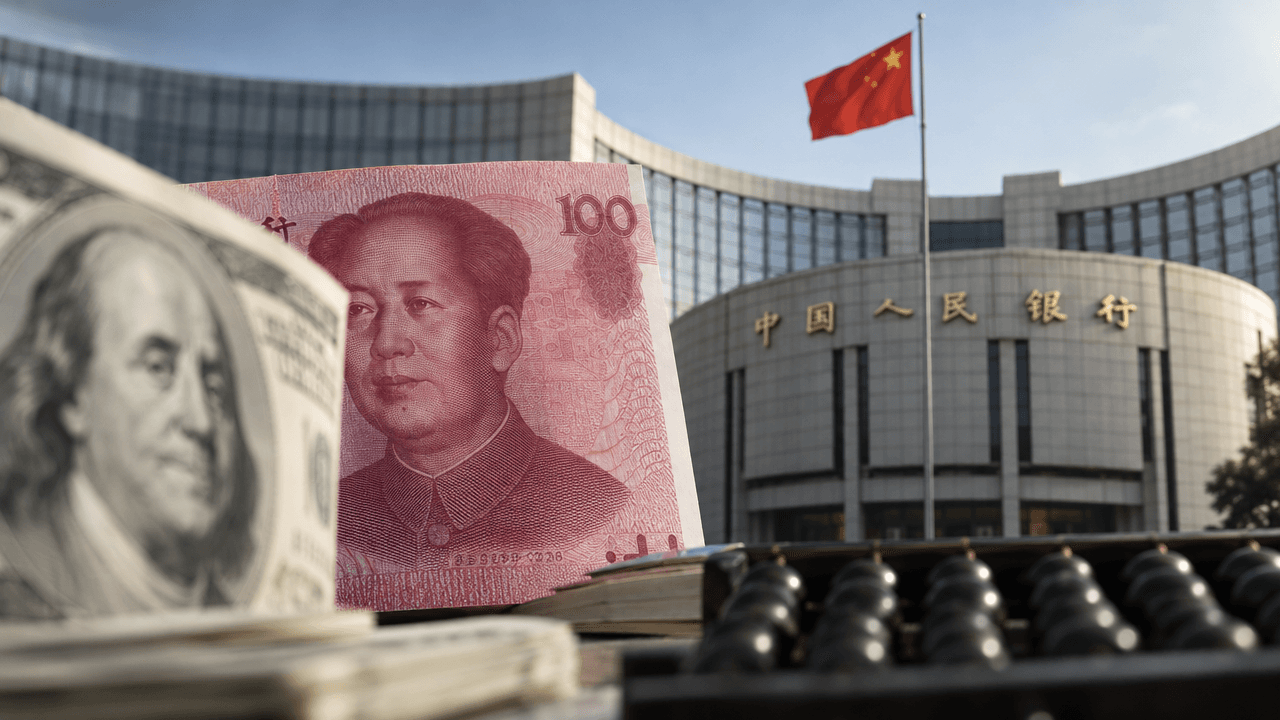
The yuan’s powerful rally has met a clear warning from Beijing. China’s central bank, the People’s Bank of China, will raise the foreign-exchange reserve requirement for financial institutions from 4% to 6% on November 15. The decision is designed to reduce excess dollar liquidity in the financial system and slow the currency’s rapid appreciation against the U.S. dollar. [1][10]
The policy announcement immediately changed the tone in currency markets. The onshore yuan weakened to around 6.68 per dollar, reaching a two-week low and moving away from its strongest level in more than four years. The currency had closed near 6.6458 per dollar before the PBOC signaled that officials were becoming increasingly uncomfortable with the speed and direction of its gains. [2][8]
Why The Pboc Is Acting Now
The foreign-exchange reserve requirement is the share of banks’ foreign-currency deposits that must be held as reserves rather than used in the financial system. When the requirement rises, financial institutions have less foreign currency available for lending, trading, or selling.
That matters because banks selling dollars and buying yuan can add to appreciation pressure. By requiring lenders to hold a larger portion of their foreign-currency deposits at the central bank, the PBOC is effectively reducing the supply of dollars available in the domestic market. A tighter supply of dollars can make it more difficult for the yuan to continue rising at the same pace. [3][6]
The adjustment is expected to withdraw roughly $20 billion to $24 billion from the financial system, depending on the calculation used. While that is meaningful in the short term, it is relatively modest compared with China’s broader trade-related foreign-exchange flows. One estimate placed the potential liquidity impact at about $20 billion, versus average monthly goods-trade foreign-exchange inflows of approximately $66 billion over the previous year. [1][14]
This comparison helps explain the policy’s purpose. The move is less about reversing the yuan’s long-term trend and more about preventing an overly rapid, one-directional rally.
A Signal, Not Just A Liquidity Tool
The PBOC’s decision carries significance beyond the immediate amount of liquidity removed. Central banks often use policy adjustments to communicate their preferred pace of currency movement, and this announcement sends a direct message: Beijing may tolerate a stronger yuan, but it does not want appreciation to become disorderly.
The timing is important. The yuan had been on an extended winning streak, with the onshore currency reaching its strongest level in more than four years. The rally reflected a combination of factors, including a weaker U.S. dollar, changing expectations for global interest rates, and improving sentiment toward Chinese assets.
A stronger currency can reduce the cost of imported commodities, energy, and industrial inputs. It can also support domestic purchasing power and help limit imported inflation. However, an excessively strong yuan may reduce the competitiveness of Chinese exporters by making their goods more expensive for overseas buyers.
Policymakers therefore face a delicate balance. They want to avoid a sharp depreciation that could encourage capital outflows, but they also want to prevent speculative buying from pushing the currency higher than economic fundamentals justify.
The Daily Fixing Adds To The Message
The PBOC reinforced its position through the daily yuan midpoint, the reference rate around which the onshore currency is allowed to trade. On Wednesday, the central bank set the midpoint near 6.72 per dollar, weaker than the level markets had expected and at its softest point since late October. [2]
The fixing does not fully determine the yuan’s market price, but it provides an important signal about official preferences. A weaker-than-expected midpoint can discourage traders from assuming that the central bank will permit an uninterrupted appreciation trend.
For traders, the combination of the reserve-ratio increase and the daily fixing is more significant than either action alone. Together, they suggest that the PBOC is prepared to use both liquidity management and currency guidance to smooth the yuan’s advance.
What Markets Should Watch Next
The first key date is November 15, when the new 6% reserve requirement takes effect. Market participants will monitor whether dollar funding conditions tighten and whether banks adjust their foreign-exchange positions ahead of implementation.
The second is the daily fixing. If future midpoint settings remain weaker than market expectations, the PBOC could be signaling a sustained effort to slow appreciation. If the fixings move back toward stronger levels, the latest action may prove to be a temporary cooling measure rather than the beginning of a broader policy shift.
Traders should also track the U.S. dollar, China’s trade data, capital flows, and interest-rate expectations. A weaker dollar could continue supporting the yuan even as Beijing applies brakes. Conversely, renewed dollar strength could make the PBOC’s intervention less necessary.
For SimFi traders, this is a useful example of why currency markets cannot be analyzed through economic data alone. Central-bank communication, reserve rules, reference rates, and liquidity conditions can all move prices rapidly. A strategy based only on the yuan’s recent trend could be vulnerable when policymakers decide that the trend has become too strong.
Practical Takeaways For Traders
First, distinguish between a policy signal and a complete trend reversal. The PBOC’s move is intended to slow the yuan’s rally, not necessarily to create a prolonged decline.
Second, watch the reaction around 6.68 to 6.72 per dollar and compare price action with the daily fixing. A currency that weakens despite a supportive global backdrop may be showing that official guidance is having an effect.
Third, manage exposure around November 15. The implementation date could produce short-term volatility as financial institutions adjust their dollar holdings.
Finally, avoid treating a central-bank action as an isolated event. The yuan’s direction will still depend on the interaction between China’s economic outlook, global dollar demand, interest-rate differentials, and official policy.
Conclusion
The PBOC’s decision to raise the foreign-exchange reserve requirement from 4% to 6% marks one of Beijing’s clearest efforts to moderate the yuan’s extended rally. The move tightens dollar liquidity, raises the cost of betting on further appreciation, and communicates that policymakers prefer a steadier currency path.
For markets, the central lesson is straightforward: momentum can change when a central bank decides that price movement has become too rapid. Traders who monitor both market fundamentals and policy signals will be better positioned to navigate the yuan’s next move.